
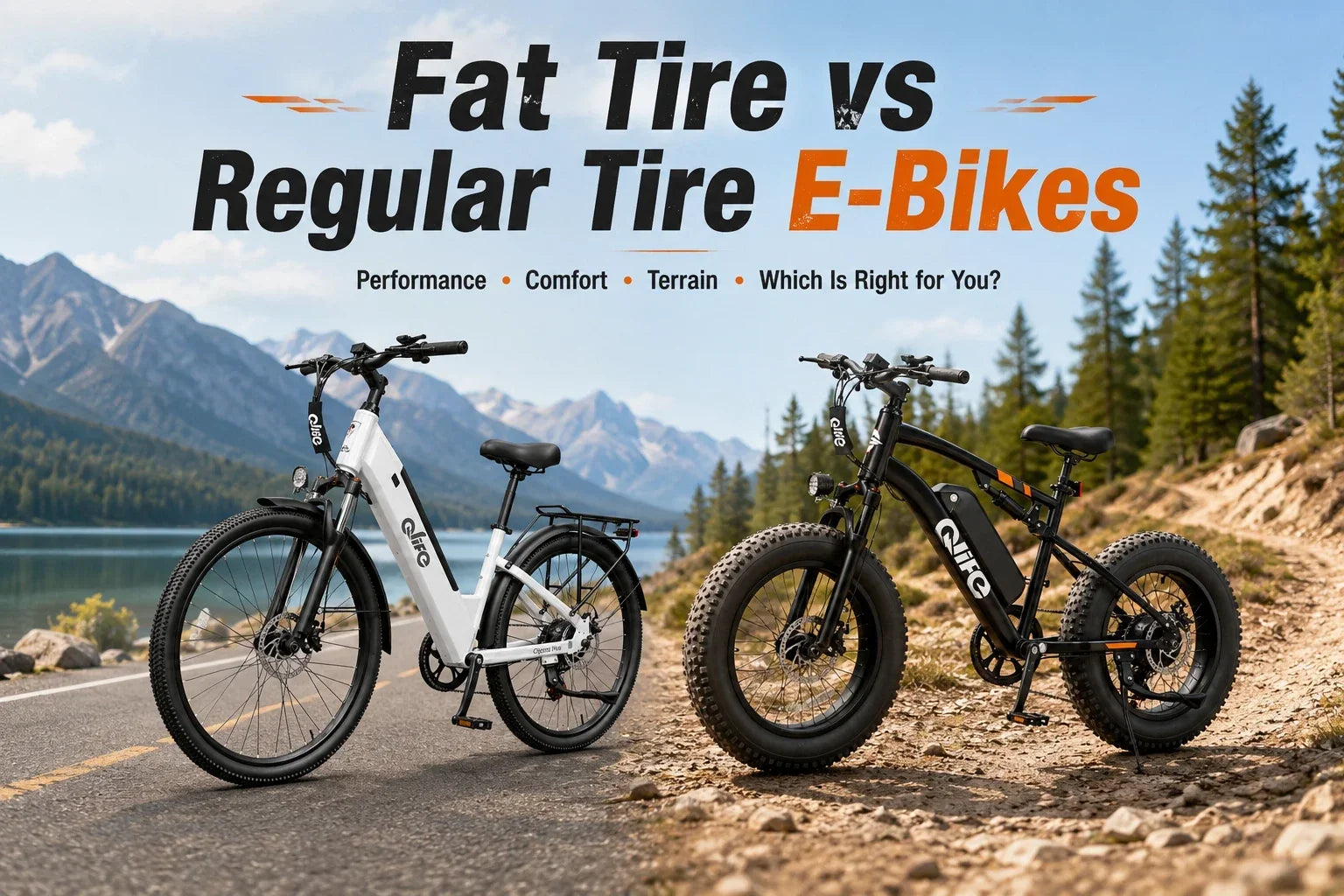
You're looking at two e-bikes with the same motor and battery. One has 4-inch fat tires, the other runs 2-inch regular tires. Which one actually goes farther? Which one feels better on your daily route? And does tire width really change how the bike handles, or is that mostly marketing?
I've put miles on both categories across city streets, gravel paths, and loose terrain. The differences are real, but they don't always line up with what the spec sheets suggest. Let's separate the mechanical facts from the sales copy.

Fat Tire vs Regular Tire E-Bikes: Quick Comparison
The short answer: Fat tires (3.5-5 inches wide) give you float and grip on loose surfaces but cost you efficiency on pavement. Regular tires (1.5-2.5 inches) roll faster on hard surfaces and weigh less, but they'll skip and slide where fat tires just plow through.
Here's how they stack up:
| Feature | Fat Tire (3.5-5") | Regular Tire (1.5-2.5") |
|---|---|---|
| Typical Width | 3.5" to 5.0" | 1.5" to 2.5" |
| Pressure Range | 5-20 PSI | 30-65 PSI |
| Wheel + Tire Weight | 8-12 lbs per wheel | 4-6 lbs per wheel |
| Traction (loose) | Excellent | Poor to fair |
| Traction (pavement) | Good | Excellent |
| Steering Feel | Heavier, more planted | Light, quick response |
| Pavement Efficiency | Lower (higher rolling resistance) | Higher |
| Loose Surface Ability | Floats over sand, snow, mud | Digs in, loses momentum |
| Transport/Storage | Bulky, won't fit standard racks | Compact, easy to transport |
| Maintenance | Low-pressure checks more critical | Standard pressure routine |
| Ideal Rider | Off-road, sand/snow, comfort seekers | Commuters, pavement riders, speed focus |
Best ebike tire size: If 80% of your riding is on pavement, regular tires make more sense. If you're crossing sand, snow, or broken trails more than once a week, fat tires pay off.
What Counts as Fat and Regular Tires
Fat tires start around 3.5 inches and run up to 5 inches. Most fat-tire e-bikes land in the 4.0-inch range. The Qlife Racer 20x4.0" and Racer Plus 26x4.0" both use 4-inch tires, which is the sweet spot for traction without going full monster-truck.

Regular tires cover everything from 1.5-inch road slicks to 2.5-inch hybrid treads. A typical commuter e-bike runs 1.95 to 2.1 inches. The Qlife Cityone Plus uses 26x2.1" tires, which is wide enough for pothole absorption but narrow enough to keep rolling resistance reasonable.

The overlap zone: 2.5 to 3.5 inches is where "plus-size" tires live. They're not fat enough to float on deep sand, but they're wider than a standard mountain bike tire. Marketing will call these "all-terrain," which usually means they compromise on both ends.
Tire width is one variable. Tire pressure, casing stiffness, tread pattern, and wheel weight all change how a bike rides. A 4-inch tire at 20 PSI feels nothing like the same tire at 8 PSI.
Range and Battery Use
Here's what actually happens: rolling resistance goes up as tire width increases and pressure drops. A fat tire at 10 PSI has more rubber deforming with every rotation compared to a regular tire at 50 PSI. That deformation eats watts.
On flat pavement at steady speed, a regular tire electric bike will go 10-15% farther than the same bike with fat tires, all else equal. I'm talking same motor, same battery, same rider weight, same assist level, same route. The difference shows up in your Wh-per-mile average.
But "all else equal" rarely happens in the real world.
What actually changes fat tire ebike range:
- Tire pressure: A fat tire at 15 PSI rolls better than the same tire at 8 PSI. You can recover 5-10% of that efficiency penalty just by running higher pressure (if the terrain allows it).
- Surface type: On loose gravel or sand, fat tires can actually be more efficient because they don't dig in and stall momentum. Regular tires lose more watts to slippage and resistance.
- Tread pattern: An aggressive knobby tread costs you range on pavement regardless of tire width.
- Wheel and tire weight: Fat tire setups add 8-15 pounds of rotating mass. That mass costs energy every time you accelerate or climb.
- Speed: The efficiency gap gets worse as speed increases. At 20+ mph, wind resistance dominates anyway, but rolling resistance still matters.
Real talk: If you're commuting 12 miles each way on bike lanes, a regular-tire e-bike will get you home with more battery left. If half that commute is across a park with gravel paths or you're riding in snow three months a year, fat tires make that ride possible in the first place. Range means nothing if you're walking the bike through sand.
The Qlife Racer Plus 26x4.0" runs a 48V 20Ah battery (960 Wh) and claims 75 miles on pedal assist. That's with fat tires. The range hit from tire choice is real but not catastrophic if the battery capacity is there to start with.
Comfort, Grip, and Handling
Comfort is where fat tires actually deliver on the hype. At low pressure, they absorb small bumps and vibration that regular tires transmit straight to your hands and seat. It's not suspension, but it smooths out rough pavement and gravel in a way that makes long rides less punishing.
I've ridden the same potholed stretch on both tire types. The fat tire floats over the edge of a pothole. The regular tire drops into it, and you feel the hit through the frame. For riders with hand or back issues, that difference adds up over miles. If you're curious about the pros and cons of fat tire e-bikes beyond just comfort, I've covered that in more depth elsewhere.
Fat tire ebike handling is different, not worse:
- Steering effort: Fat tires require more force to initiate a turn. The contact patch is wider, so there's more rubber fighting your input. It's stable at speed but feels sluggish in tight parking-lot maneuvers.
- Traction: On pavement, both tire types grip well until you hit wet leaves or gravel. On loose terrain, fat tires give you predictable traction. Regular tires skip and slide.
- Line choice: Regular tires reward picking a smooth line. Fat tires let you just point and go, straight over whatever's there.
- Low-speed balance: Wider tires feel more stable when you're crawling through traffic or balancing at a stoplight.
- Cornering: Regular tires lean into corners with less drama. Fat tires need more commitment to get the bike over, and they feel vague at the transition.
Sidewall movement is a thing with fat tires at low pressure. If you're running 8 PSI for sand riding, you'll feel the tire carcass flex in hard corners. It's not dangerous, but it's a different sensation. Pump them up to 15 PSI for pavement and that flex goes away.
The Qlife Racer 20x4.0" has full suspension plus fat tires. That's a lot of cushioning. For riders who want maximum comfort on mixed terrain, it's overkill in the best way. For someone commuting on smooth bike lanes, it's probably more bike than you need.
Pavement, Gravel, Sand, Snow, and Trails
Let's break this down by surface. This is where tire choice actually matters.
| Surface | Fat Tire Advantage | Regular Tire Advantage | Verdict |
|---|---|---|---|
| Smooth pavement | None | Lower rolling resistance, better efficiency | Regular wins |
| Broken pavement/potholes | Cushioning, stability | None | Fat wins |
| Packed gravel | Comfort, some float | Acceptable if pressure is right | Slight edge to fat |
| Loose gravel | Floats on top, maintains momentum | Digs in, loses speed | Fat wins clearly |
| Sand (deep) | Essential, only way through | Impossible, bike stops | Fat only option |
| Snow (packed) | Good traction | Workable with studded tires | Both functional |
| Snow (loose/deep) | Floats, stays rideable | Digs in, very difficult | Fat wins clearly |
| Mud | Floats, clears tread (if tread is open) | Clogs tread, loses grip | Fat wins |
| Singletrack/trails | Stability, grip on roots/rocks | More nimble, lighter steering | Depends on trail |
The pattern I see: Fat tires turn "maybe I can ride this" into "I can definitely ride this." Regular tires turn "I can ride this pretty well" into "I can ride this really efficiently."
If you're riding year-round in a place with snow, or if your route includes a beach access or sandy shoulder, fat tires are the tool for the job. If your e-bike never leaves pavement, they're not worth the efficiency penalty. I've written more about whether fat tire electric bikes are actually better if you're still weighing the tradeoffs.
The Qlife Hunter folding e-bike uses 20x3.0" tires. That's right in the middle, technically "fat" but not as extreme as 4-inch. It's a good compromise for delivery riders or cargo haulers who need some cushioning and stability but aren't crossing sand dunes.
Weight, Transport, and Storage
Fat tire ebike weight matters in two ways:
- Bike weight: A fat-tire e-bike typically weighs 5-8 pounds more than the same bike with regular tires, just from the wheels and tires.
- Handling weight: That extra weight is in the wheels (rotating mass), which makes acceleration and climbing feel heavier than the same weight in the frame would.
The Qlife Racer 20x4.0" weighs 59.5 lbs. The Cityone Plus with 26x2.1" tires weighs 70.55 lbs. That weight difference comes from the step-thru frame design and larger battery. The Racer's weight is more in the wheels (rotating mass), so it feels heavier when you're getting up to speed despite being lighter overall.
Transport and storage:
- Car racks: Most trunk-mount and some hitch racks won't accommodate 4-inch tires. You'll need to remove the front wheel or get a tray-style rack.
- Apartment storage: Fat-tire bikes don't fit in normal bike hooks or stands easily. They take up more floor space.
- Stairs: Carrying a 65-pound fat-tire e-bike up stairs is a workout. If you're on a third-floor walk-up, that matters every single day.
- Public transit: Most bike racks on buses and trains aren't built for fat tires. Check your system's rules.
Puncture repair: Fat tire tubes are bigger and more expensive. Changing a flat on a fat tire takes more time because there's more tire to wrestle off the rim. If you're tubeless, you need more sealant, and burping a fat tire back onto the bead can be annoying.
If you're loading your e-bike in a car weekly or carrying it upstairs daily, those logistics add up. The Hunter folds down to 36.6" x 28", which helps with transport despite the 20x3.0" tires.
Maintenance, Flats, and Replacement Cost
Pressure checks are more critical with fat tires because low pressure is part of the design. I check regular tires every two weeks. Fat tires? Every week, because that 2-3 PSI of natural air loss makes a bigger difference when you're only running 12 PSI to start with.
Puncture risk is lower with fat tires if you're running them at appropriate pressure for the terrain. More air volume means a thorn or small piece of glass won't immediately flatline the tire. But if you're running 8 PSI to float on sand, you're more vulnerable to pinch flats from hitting a rock or curb.
Replacement cost:
- Fat tire (4.0"): $40-80 per tire depending on tread and brand
- Regular tire (2.0-2.3"): $25-50 per tire
- Fat tire tube: $12-20
- Regular tire tube: $6-12
Tire availability: Regular e-bike tires are everywhere. Fat tires in the 20x4.0" size are common enough, but if you're in a small town bike shop, they might not stock them. Order online and wait, or carry a spare.
Sealant for tubeless: A 4-inch fat tire needs 4-6 oz of sealant per tire. Regular tires need 2-3 oz. Sealant costs the same per ounce, so you're doubling the maintenance supply cost.
Shop compatibility: Most bike shops can work on either type, but if you're doing your own maintenance, fat tires require more effort to mount and dismount. That first time you try to seat a fat tire bead with a floor pump, you'll understand why people buy compressors.
The Qlife bikes come pre-assembled, which means you're not wrestling tires onto rims out of the box. But when replacement time comes (2,000-4,000 miles depending on tread and use), budget for the higher cost and occasional mail-order wait.
Controlled Same-Route Test Protocol
Most "fat tire vs regular tire" comparisons fail because they're comparing two completely different bikes. Different motor efficiency, different battery capacity, different rider weight, different assist levels. You can't isolate the tire variable.
Here's how to actually test this:
Controlled conditions:
- Same bike frame or two identical bikes (same motor, battery, controller)
- Same rider or riders of equal weight
- Same cargo load
- Same route, ridden back-to-back or on consecutive days with similar weather
- Same speed target (use cruise control or maintain steady effort)
- Same pedal assist level
- Same tire pressure for the category (e.g., 12 PSI fat vs 50 PSI regular)
- Same temperature range (battery performance changes with temp)
- Same starting battery voltage (charge to 100% before each test)
What to measure:
- Watt-hours per mile (Wh/mi) from the display or battery monitor
- Ride time for the same distance
- Subjective vibration and comfort (rider notes)
- Steering effort in a parking lot slalom test
- Stopping distance from 15 mph (measure braking performance under same conditions)
- Rider fatigue notes after 10+ miles
What you'll probably find:
- Regular tires use 10-15% fewer Wh/mi on flat pavement
- Fat tires absorb more vibration (measurable with an accelerometer if you want to get fancy)
- Fat tires feel slower to steer but more stable at speed
- Range difference matches the Wh/mi difference (15% less efficient = 15% less range)
Limitations to disclose:
- If you can't get identical motors and batteries, document the differences
- If weather changes between test days, note it
- If your route has traffic lights that affect coasting and regen, mention that
I haven't personally run this exact test with measurement gear on Qlife bikes, but the physics says you'd see about a 12% efficiency advantage for the Cityone Plus (regular tires) over the Racer Plus 26x4.0" (fat tires) on a paved loop at steady 18 mph. That's the rolling resistance and wheel weight talking.
On a route with 30% loose gravel, that advantage would shrink or reverse because the regular tires lose momentum in the loose sections.
Use-Case Decision Matrix
Stop thinking about which tire type is "better." Start thinking about which one fits your actual riding.
Score each category 0-10, then add them up.
| Use Case | Fat Tire Score | Regular Tire Score | Notes |
|---|---|---|---|
| Flat urban commute (paved bike lanes) | 4 | 9 | Regular wins on efficiency and speed |
| Pothole-heavy city streets | 8 | 5 | Fat cushions the hits, regular tires transmit them |
| Mixed commute + weekend gravel trails | 8 | 6 | Fat handles both better |
| Beach access, sand riding | 10 | 1 | Regular tires don't work in sand, period |
| Year-round winter riding (snow) | 9 | 4 | Studded regular tires work on ice, but fat floats in powder |
| Heavier rider (>220 lbs) | 7 | 6 | Fat tires at 15+ PSI give more support and durability |
| Cargo hauling (kids, groceries, gear) | 8 | 5 | Extra stability and load capacity with fat tires |
| Apartment storage (3rd floor) | 3 | 8 | Lighter regular-tire bike is easier to carry upstairs |
| Car transport (weekly) | 4 | 9 | Regular tires fit standard racks, fat tires often don't |
Example scoring:
Urban commuter, smooth bike lanes, car transport on weekends:
- Fat: 4 + 3 + 4 = 11
- Regular: 9 + 8 + 9 = 26
- Get regular tires.
Year-round rider, broken streets, occasional beach rides, no car transport:
- Fat: 8 + 10 + 9 = 27
- Regular: 5 + 1 + 4 = 10
- Get fat tires.
Delivery rider, urban potholes, cargo loads, daily use:
- Fat: 8 + 8 = 16
- Regular: 5 + 5 = 10
- Get fat tires. (This is exactly what the Qlife Hunter was designed for.)
Which criteria can reverse the recommendation:
- If you're doing 40+ mile commutes, efficiency matters enough to outweigh comfort. Regular tires.
- If 20% of your route is unrideable on regular tires (deep sand, snow), fat tires become mandatory regardless of the other factors.
- If you're hauling a kid trailer or 40 lbs of cargo, stability beats efficiency. Fat tires.
The Racer series (20" fat) and Racer Plus (26" fat) are built for riders who want that stability, comfort, and off-pavement capability. The Cityone Plus is built for efficient pavement commuting with step-thru convenience. Neither is wrong; they're solving different problems.
Which Tire Type Should You Choose?
Get fat tires if:
- More than 20% of your riding is on loose gravel, sand, or snow
- You're carrying cargo or a passenger regularly
- You've got back or hand issues and need maximum vibration damping
- Broken pavement and potholes are a daily reality on your commute
- You want one bike that handles everything without thinking about surface conditions
If you're still deciding, I've put together a comprehensive fat tire e-bike buying guide that walks through the key features to look for beyond just tire width.
Get regular tires if:
- 80%+ of your riding is on pavement or packed paths
- You need maximum range from your battery
- You're transporting the bike in a car or on public transit regularly
- You live in a walk-up and carry the bike upstairs
- You prioritize speed and efficiency over comfort and float
Consider a mid-width option (2.5-3.0") if:
- You want a compromise between efficiency and comfort
- You're doing light trail riding but mostly pavement
- You're a delivery rider who needs some stability but also needs to cover miles
For most riders reading this, the honest answer is: what surface do you ride on most often? That's the tire width you need. Everything else is secondary.
If you're commuting 10 miles each way on city bike lanes and you never leave pavement, the Cityone Plus with 26x2.1" tires will get you there faster and farther per charge. If you're exploring trails on weekends, crossing snowy parking lots in winter, or just want a bike that feels planted and stable at any speed, the Racer Plus 26x4.0" makes every ride more confident. For a broader look at what's available this year, check out my picks for the best fat tire electric bikes in 2026.
The performance gap is real. Fat tires cost you 10-15% in range and efficiency on pavement. They also give you 100% more capability on loose terrain and rough surfaces. Pick the tire for the terrain you ride most, not the terrain you wish you rode.
Frequently Asked Questions
Are fat tire e-bikes slower than regular e-bikes?
Top speed is the same (motor limited), but fat tires accelerate slightly slower because of the extra rotating weight. On flat pavement, you'll feel the difference getting from 0 to 20 mph. Once you're at cruising speed, the weight matters less.
Do fat tire e-bikes get worse range?
Yes, typically 10-15% less range on pavement compared to regular tires, all else equal. The gap shrinks or disappears on loose terrain where regular tires lose momentum. Battery capacity matters more than tire choice for total range.
Are fat tire e-bikes better for commuting?
Depends on your commute. Smooth bike lanes? Regular tires are more efficient. Potholed streets, gravel shortcuts, or winter riding? Fat tires make the ride possible and comfortable. I've written a detailed breakdown on whether fat tire e-bikes are good for commuting that covers different commute scenarios. The Hunter with 20x3.0" tires splits the difference for urban cargo and delivery riders.
Can you get more flats with fat tires?
At appropriate pressure for the terrain, fat tires actually flat less often because more air volume cushions against punctures. But if you're running them too soft for the surface (8 PSI on pavement), pinch flats become more likely.
Do fat tire e-bikes work in snow?
Yes, and they're one of the best options for winter riding. They float on top of loose snow instead of cutting through to ice below. Packed snow and ice still benefit from studded tires regardless of width.
Are fat tire e-bikes harder to ride for heavier riders?
No, they're actually easier. Fat tires at 15-20 PSI provide more support and distribute weight better than regular tires. For riders over 250 lbs, fat tires reduce the risk of rim damage and pinch flats.
Share:
Fat Tire Ebike Tire Pressure by Terrain and Rider Weight
Folding Ebike Buying Guide: Size, Weight, and Transport