
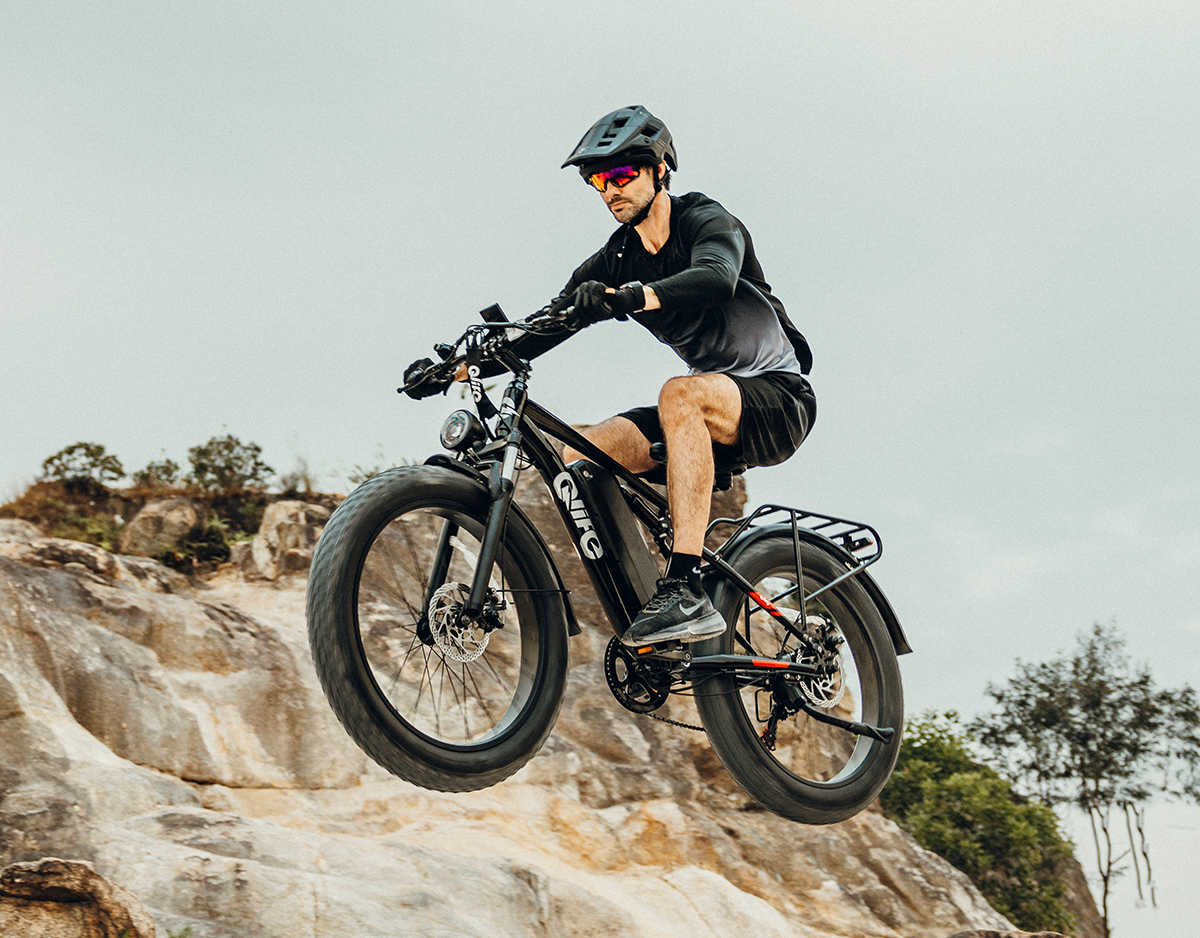
Commuting to work by bike doesn’t have to mean arriving sweaty and out of breath. And it doesn’t have to be limited to smooth roads or ideal conditions. With a fat tire e-bike, you can handle a wide range of routes — from uneven roads and gravel paths to busy urban streets.
Fat tire e-bikes offer excellent stability and control on rough or unpredictable terrain. With electric assist, you can cover your commute without exhausting yourself before the day has even begun.
Below, we break down the pros and cons of fat tire e-bikes for commuting, answer common questions, and compare them to standard commuter e-bikes.
What Is a Fat Tire E-Bike?
First off — what even is a fat tire e-bike?
Well, they’re basically the same as a standard e-bike. They’re shaped like a normal bike with an electric motor that drives the wheels. The main difference is the tires, of course.
Fat tires are generally defined as 3.8” to 5” in width. Just like any tires, the extra width provides increased stability, traction, and comfort on mixed terrain. They’re specifically designed for rough roads and uneven surfaces like gravel or off-road paths.
But that thickness comes with a downside. Extra thickness means extra weight and rolling resistance. You won’t get as many miles out of the battery, decreasing your potential range compared to a standard commuter e-bike.
Are Fat Tire E-Bikes Good for Commuting?
Broadly, yes.
Most people’s commutes aren’t just smooth roads. If you live in the suburbs or countryside, most likely the direct route involves gravel paths, snow, uneven pavement, or cobblestone streets. Even in the city, poorly maintained bike lanes or park paths can be a problem.
Greater suspension and thicker tires help you handle these problems. Think of it like this:
· Good for: uneven roads, potholes, gravel routes, and year-round commuting where comfort and stability matter more than speed
· Not ideal for: long-distance, speed-focused commuting where efficiency, lighter weight, and maximum battery range are priorities
That said, most Q-Life e-bikes, for example, have a range of up to 60 miles, so the distance usually isn’t a problem for commuters. Greater comfort and stability outweigh any of the downsides.
Pros of Using a Fat Tire eBike for Commuting
1.Superior Stability and Grip
The main benefit of a fat tire e-bike is stability. The thicker tire absorbs more of the vibrations and road shock and lowers the risk of slipping or sliding on uneven surfaces.
They’re popular among commuters dealing with:
- Wet roads
- Gravel paths
- Potholes
- Uneven pavement
- Cobblestone streets
- Poorly maintained roads and bike lanes
While these bikes might seem heavy-duty, they’re actually a great starting point for beginners. Narrow wheel e-bikes can have a steeper learning curve and less versatility.
2.Comfortable Ride on Poor Roads
Poor roads are quite common. Whether it’s a side street or dirt roads, the natural shock absorption from fat tires can reduce fatigue on long commutes. That matters. No one wants to arrive at work after 30 minutes of bumping and bouncing along difficult terrain.
It also means that while the tires carry extra weight, there’s less need for suspension. Take the Racer Plus 26x4.0'' Fat Tire Electric Bike For Adults, it comes with an advanced tunable suspension system that works alongside the wheels to minimize vibration on any terrain.

3. Ideal for Year-Round Commuting
Most people face difficult conditions during certain times of the year. Even if your standard commuter e-bike works flawlessly in dry conditions, you only need a few months of rough weather to render it useless. You need a bike that works every day without fail.
The best fat tire e-bikes for commuting can handle snow, mud, and rain with ease. Powered by a strong motor and a high-torque controller, it can drive through any terrain (or hill climb) without much difficulty. That’s something you’ll be grateful for when the heavy snow begins to fall.
The last thing you want is to be stranded miles from home with a bike that can’t handle the weather.
4. Versatility Beyond Commuting
You’re not going to be commuting every day. If you want a bike for weekend use, you’re going to need something a little more heavy-duty. Investing in a fat tire electric bike gives you the option to go:
- Weekend trail riding
- Try light off-road detours
- Ride on gravel paths or park routes
One bike does everything. Rather than restricting bike routes to work and back, you’ve now got a great alternative to driving. Enjoy the fresh air and head off-road during your time off.
Cons of Fat Tire E-Bikes for Daily Commuting
1. Slower and Less Efficient
Friction occurs when a surface comes into contact with another. The more surface area in contact, the greater the friction. That’s how fat tire e-bikes are intended to work — the friction provides stability and grip.
But it comes with a downside.
Rolling resistance is the force that slows a tire down as it rolls along the ground. Fat tires increase rolling resistance, increasing the energy used per mile. The result? Acceleration feels slower, and battery life goes quicker.
2.Shorter Battery Range
Heavier bikes with greater rolling resistance burn through the power more quickly. That means that if you’re riding along at top speed, you’ll probably get to work, but you won’t get back on the same charge (at least not all the way).
Of course, that depends on how far you travel.
Q-Life fat tire bikes have a range of anywhere from 55 to 75 miles. Unless you’re traveling to another city, that’s likely to cover your commuting trip. But you will have to charge your bike a few times a week. If you forget, you won’t be going anywhere quickly.
3. Heavier and Harder to Handle
Do you have to carry your bike upstairs? Or store it in a small space? That might be an issue. The extra weight can feel extremely heavy when you’re carrying it into the storage space day after day. It might not even be possible.
Some people rely on e-bikes to commute to and from a train station or subway. If that’s the case, then a fat tire e-bike might be too heavy to carry up and down the long staircases.
For reference, the Racer Plus weighs around 67.5 lbs (30.5 kg) — that’s like a large, full-packed suitcase or a medium-large dog. It’s manageable, but not something you’d want to carry every day.
4. Not Ideal for Long Commutes
How far do you have to commute? There comes a point where e-bikes become less practical for daily commuting. That’s especially true for fat tire e-bikes, where the added weight and rolling resistance mean the motor has to work harder.
For most riders, they’re best suited to short to medium commutes of around 3-10 miles (5-15 km) each way.
Once you start pushing beyond that — especially 10-12+ miles (15-20+ km) — the drawbacks become more noticeable. You’ll use more battery, maintain lower average speeds, and feel the weight of the bike more over time.
Fat Tire E-Bike vs Regular E-Bike for Commuting
Choosing between a fat tire e-bike and a standard commuter e-bike comes down to how and where you ride. While they both offer electric assist, they’re built for very different situations. One focuses on comfort and grip across varied terrain; the other is designed for speed and efficiency on paved roads.
The differences become much clearer when you compare them side by side. Here’s how fat tire e-bikes stack up against standard commuter models for everyday commuting.
|
Feature |
Fat Tire E-Bike |
Standard Commuter E-Bike |
|
Speed |
Slower due to wider tires and higher resistance |
Faster and more responsive on roads |
|
Comfort |
Very comfortable; absorbs bumps and rough surfaces well |
Comfortable on smooth roads, less forgiving on uneven terrain |
|
Battery Range |
Shorter range as the motor works harder |
Longer range with better efficiency |
|
Terrain |
Handles gravel, potholes, mud, and snow easily |
Best for paved roads and cycle paths |
|
Weight & Handling |
Heavier but very stable and confidence-inspiring |
Lighter, more agile, easier to maneuver |
|
Best For |
Mixed terrain, poor roads, and year-round riding |
Longer, faster, road-based commuting |
When a Fat Tire E-Bike Makes Sense for Commuting
If you’re commuting a short stretch along a main road in dry conditions, you’re probably best with a standard commuter e-bike. For anything else, there are definite advantages to a fat tire e-bike.
You’ll notice a difference in:
- Poor road conditions
- Mixed terrain routes
- Winter commuting
- New to e-bikes
While it’s not suited to extremely long commutes, it can often allow you to take shortcuts that standard e-bikes cannot handle. Plus, as conditions worsen during the winter, you won’t have to seek alternative transport. Your fat tire e-bike can plow through the snow without issue.
When it’s Not the Best Choice
Fat tire e-bikes have lots of advantages. But they’re not always the best option for commuting. Consider alternatives in these situations:
- Long-distance commuting (15km+)
- Speed-focused riders
- Tight storage/carrying requirements
- Pure city roads with good infrastructure
How Comfortable Is a Fat Tire E-Bike for Daily Commuting?
Comfort is one of the biggest reasons riders choose a fat tire e-bike for commuting — and it’s immediately noticeable from the first ride.
The wider tires act as natural shock absorbers. Instead of feeling every bump, crack, or pothole, the tires compress slightly and smooth out the surface beneath you. On rough roads, this can make a significant difference, especially over longer commutes.
That matters more than people realize.
Even a 20-30 minute bike ride on uneven terrain can hurt your hands, wrists, and lower back more than a standard bike. Fat tire e-bikes reduce that strain, so you arrive at work rested and reinvigorated, not utterly exhausted.
You’ll notice the difference most on:
- Poorly maintained roads
- Cobblestone streets
- Gravel or park paths
- Curbs and uneven surfaces
That said, comfort comes with a trade-off. The same softness that smooths out bumps also reduces efficiency slightly. You won’t glide as quickly as you would on narrower tires, but you’ll arrive feeling less worn down.
Battery Range and Efficiency: What to Expect
Perhaps the biggest downside to a fat tire e-bike is the battery range and efficiency. But how bad is it exactly?
You will notice a decreased range compared to most other e-bikes. However, there’s often an assumption that it reduces the range beyond a functional limit.
That’s not the case.
Depending on the terrain, rider weight, and tire pressure, you can still manage a trip to and from work easily on a single charge. For most commutes, the battery life will probably last 2-3 days.
Even the shortest range of a Q-Life e-bike is up to 55 miles (pedal assist). The Racer 20x4.0” offers a top speed of 28 mph and a payload capacity of 350 lbs on a 48V/10.4Ah lithium-ion battery.
Are Fat Tire E-Bikes Worth It for City Commuting?
It really depends on your city commute.
Most people think a city commute is a gentle bike ride on smooth, flat roads. But that’s a simplistic view. Cities can have potholes, rough bike lanes, cobblestone streets, and even gravel paths and park routes.
Fat tire e-bikes thrive in all these settings.
Plus, there’s the weather condition. While cities often see milder weather than in the countryside, snow and rain present hazards that fatter tires can manage more safely. If you’re interested in using the bike on the weekend, you’ll have greater versatility in your life.
How Well Do They Handle Urban Traffic
You might think a fat tire e-bike is a bit bulky for city commuting. That’s a fair point. However, in practice, they perform better than many riders expect.
Stability is a big factor. In stop-start traffic, busy junctions, and tight spaces, the wider tires offer a more planted, confidence-inspiring ride. That’s particularly beneficial for newer riders who are less accustomed to unpredictable traffic conditions.
Of course, that comes with a trade-off.
Being heavier and slightly less agile, the bike will struggle with quick turns, tight gaps, and rapid acceleration. So, if you’re weaving through dense traffic or lifting your bike frequently, the problem becomes noticeable.
Is a Q-Life Fat Tire E-Bike Right for Your Commute?
If your commute isn’t perfectly smooth — and most aren’t — a fat tire e-bike can completely change how your journey feels.
Q-Life fat tire e-bikes are built specifically for real-world riding conditions. With 4.0” tires, powerful motors (up to 1,200W-3,000W peak), and ranges reaching 55-75 miles, they can handle everything your commute can throw at them. Potholes, snow, rough roads, and cobblestone streets aren’t an issue.
Explore Q-Life Fat Tire E-Bikes

FAQs About Fat Tire E-Bikes for Commuting
Are fat tire e-bikes good for daily commuting?
Yes — fat tire e-bikes are a great option for daily commutes. They give you a greater range of options for how you reach your destination. If there’s a park path or cobblestone street you’d normally avoid, the fat tires offer a more comfortable ride and greater stability.
Are fat tire e-bikes slower than normal e-bikes?
Yes — fat tires increase the weight and rolling resistance of the e-bike. That means the motor cannot achieve the same acceleration or top speed you’d expect from a normal e-bike. That said, some models of fat tire e-bikes can still reach top speeds over 28 mph.
Do fat tire e-bikes use more battery?
Yes — greater rolling resistance and bike weight drain the battery faster for each mile traveled. Because the battery determines the top speed and range, you’ll notice that the bike rides slower and won’t go as far.
Are fat tire e-bikes harder to pedal?
Without assistance, yes. If you’ve not got the extra battery power to help, you’ll have to supply it yourself. The greater rolling resistance makes it much harder to pedal compared to a standard e-bike. You might not notice the difference on flat roads, but it’s especially apparent on hill climbs. However, the extra grip can help increase stability.
Can you commute long distances on a fat tire e-bike?
It’s possible, but not optimal. Commutes greater than 10-12 miles (15-20 km) generally aren’t recommended as the battery will begin to decline by the end. If you’re commuting this far each day, the battery will need to be charged every night without fail.
Are fat tire e-bikes good in winter?
They’re one of the best options. Fat tires increase stability and grip during frosty conditions, whether that’s snow or ice. Black ice is often a major risk for cyclists, causing many injuries each year. Fat tires mean you can cycle to and from work more confidently.
Share:
Spark Plus 20×4.0″ Moped-Style E-Bike: High-Speed, Long-Range Electric Bike for City & Off-Road Adventures
Are Fat Tire Electric Bikes Better?