
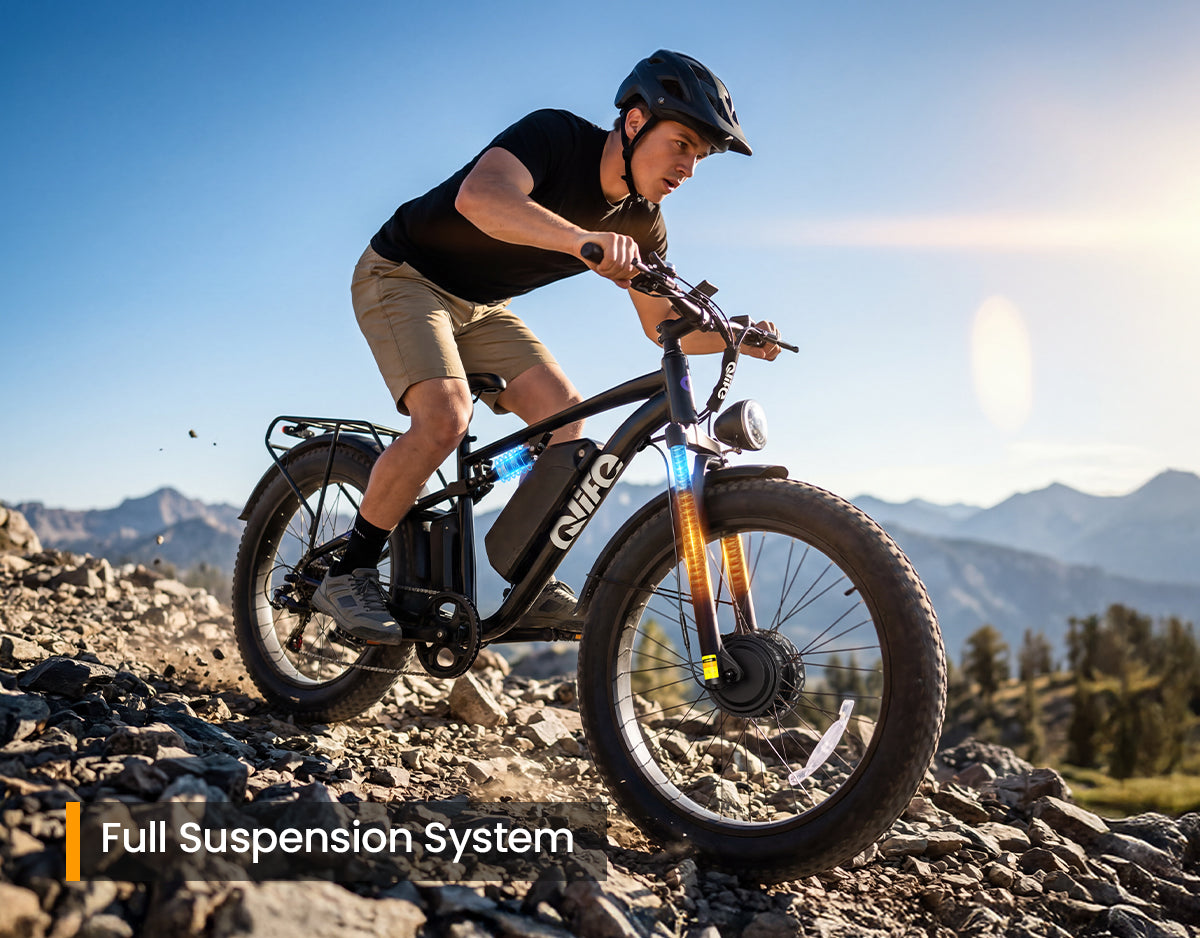
Fat tire electric bikes (e-bikes) offer greater stability, grip, and comfort, making them ideal for rough terrain, loose surfaces, and pothole-heavy roads. But while they outperform standard e-bikes in certain conditions, they’re not the right choice for everyone.
A “fat tire” is typically defined as a tire between 3.8” and 5” wide. Most e-bikes use narrower tires, designed for flat, smooth commutes and efficient road riding. Take those same tires off-road, though, and they start to struggle — traction drops, and the risk of slipping increases.
Fat tires, by contrast, provide far more surface contact with the ground, giving you better grip and a more stable ride. The trade-off is added weight and rolling resistance, which can reduce speed and efficiency.
So, are fat tire e-bikes actually better — or just better suited to a specific type of rider?
What is a Fat Tire Electric Bike?
A fat tire electric bike has wider tires, lower tire pressure, and greater traction. The typical specs include:
- 3.8–5 inch tyres
- Often paired with powerful motors
- Built for mixed terrain
Just like you’d change up the tires on your car during winter or driving off-road, the same is true for bikes. Fat-tire e-bikes are designed for off-road, snow, sand, gravel, or rough roads.
Are Fat Tire Electric Bikes Better Overall?
They definitely can be.
Fat tire electric bikes aren’t intended for all situations. The thicker tires offer more grip and stability, something that’s a big issue on uneven ground or off-road.
Generally, they’re better for:
- Off-road riding
- Snow, sand, gravel
- Comfort and shock absorption
However, the thicker tires add a lot of extra weight and increase rolling resistance. The result? You simply won’t get as far on a single charge or accelerate as quickly.
They’re not better for:
- Speed and efficiency
- Urban commuting
- Lightweight portability
So, if you’re primarily zipping around your local city, carrying it onto public transport (or upstairs), and need something you can store compactly, it’s probably not for you.
Key Benefits of Fat Tire Electric Bikes
Superior Traction on Difficult Terrain
Standard e-bikes struggle the moment the terrain gets slippery or uneven. They’re designed for mild conditions on flat roads. Fat tire e-bikes, however, have additional grip that helps with sand, snow, mud, or gravel. More surface contact means more grip and traction.
Increased Comfort and Shock Absorption
The thicker wheel has a natural suspension effect. While fat tire electric bikes still have a suspension system, they’re often much more comfortable to ride thanks to the tires. That’s especially noticeable when riding over bumps or potholes.
Greater Stability for Beginners
Whether you’re new to e-bikes or just bikes generally, wider tires offer more balance. Most new riders don’t really need that on flat roads in mild conditions. But if you’re heading into parks or off-road, a fatter tire can prevent slips and accidents.
Versatility Across Multiple Surfaces
Most people don’t just ride their bikes on flat roads. Even if you’re commuting to and from work, routes can include gravel, cobblestones, dirt roads, and more. Fat tire e-bikes can handle that diversity of surfaces, providing the same comfort and grip. You don’t have to switch bikes or find a longer route.
Downsides of Fat Tire E-Bikes
Heavier and Harder to Handle
More rubber adds additional weight to the bike. Often, e-bikes compensate for the reduced range with more batteries, further increasing the weight. That’s not a problem if you’re riding on quiet streets. But if you’ve got to make sharp turns in the city or carry it upstairs, it can be challenging.
Lower Efficiency and Range
Thicker tires increase contact with the ground. That additional friction is known as rolling resistance. It drains the battery faster, meaning you can’t go as far on a single charge. As mentioned, some models get around this without larger batteries. But that just adds more weight.
Slower on Pavement
Fat tire e-bikes aren’t built for speed; they’re built for stability. Compared to a standard e-bike, they’re likely to feel slower on a pavement and can feel like they’re dragging on smooth roads. The pedal-assist can compensate partially. But if you’ve got pedal solely under your own power, you’ll find it a slog.
Higher Cost
Fat-tire e-bikes are usually slightly more expensive than their standard counterparts. More materials and stronger components boost the cost.
For example, Qlife commuter bikes range from $799 for the Cityone SO 2.0 to $1,799 for the Cityone ST 2.0*2. In contrast, the basic Racer Fat Tire 2.0 starts at $999, and the Racer Max comes in at $2,399.
 Fat Tire vs Regular E-Bike: Key Differences
One type of bike isn’t better than the other. Instead, it’s a matter of trade-offs. Fat tire e-bikes give up speed and efficiency for grip, comfort, and stability. If your rides are rough or unpredictable, they’re a clear upgrade. But if you’re mainly on smooth roads, a regular e-bike will feel faster, lighter, and easier to handle.
Here’s a quick overview:
|
Feature |
Fat Tire E-Bike |
Regular E-Bike |
|
Best Terrain |
Off-road, gravel, snow, rough roads |
Pavement, cycle paths, urban roads |
|
Grip & Stability |
Excellent — strong traction and balance |
Moderate — less stable on loose terrain |
|
Comfort |
High — absorbs bumps naturally |
Moderate — smoother on flat surfaces |
|
Speed & Efficiency |
Lower — more drag, shorter range |
Higher — faster and more efficient |
|
Weight & Handling |
Heavier — stable but less agile |
Lighter — easier to handle and carry |
When Are Fat Tire Electric Bikes Worth It?
It all comes down to your daily route. If you’re using your bike for short journeys in dry or spotty rain, you’re probably safe with a standard e-bike. However, you’ll want a fat tire e-bike if you ride:
- Trails or countryside
- Snow or sand
- Poor road conditions
They’re also more comfortable to ride. Some people hate the bumpy feel of a standard e-bike. They’re more than happy to trade speed for comfort. Plus, you can use a fat tire e-bike for everything, whether it’s commuting to work or heading onto the trail on the weekend.
When a Standard E-Bike Is the Better Choice
Standard e-bikes are built for daily commuting or long-distance riding. They’re generally cheaper, offering a quick, convenient way to get to work. Being lightweight and simple to use, they’re great in urban environments, where you’ll often need to carry them up or down stairs. You’ struggle to take a fat tire e-bike on public transport, for example.
Final Verdict: Are Fat Tire Electric Bikes Better?
Fat tire electric bikes aren’t universally better. But they are better for the right conditions.
If your ride involves rough roads, trails, gravel, or unpredictable weather, the added grip, comfort, and stability make for a safer, better ride. By contrast, they’re a little much if you’re riding on smooth roads, commuting through the city, or prioritizing speed and range. A standard e-bike will be lighter, faster, and easier to handle day in and day out.
Which raises the real question — where and how are you riding?
Bikes like the Qlife Racer Fat Tire Electric Bike are built for poor road conditions and off-road riding. With a 1,200W motor, a top speed of 28mph, and a range of up to 55 miles, it’ll handle almost anything you can throw at it. Or, if you want a real powerhouse, there’s the Racer Max (3,000W motor, 37mph top speed, and up to 60-70 miles of range).
 So the answer is simple:
- Yes — fat tire e-bikes are better for comfort, grip, and versatility
- No — they’re not better for speed, efficiency, or everyday commuting
If you want a bike that can handle almost anything you throw at it, a fat tire model like Qlife’s Racer range is a solid choice. But if your rides are predictable and road-based, a standard e-bike will feel quicker, lighter, and easier to live with long term.
FAQs About Fat Tire E-Bikes
Are fat tire e-bikes harder to ride?
Slightly. If you’re used to a regular bike, fat tire e-bikes can suddenly feel much heavier and more cumbersome. The electric motor will offset some of those difficulties. The benefit is that they’re much more stable. For beginners, the extra stability can be helpful, especially on uneven terrain.
Do fat tire e-bikes use more battery?
Yes — fatter tires have more contact with the ground. Greater rolling resistance eats up electricity, reducing the potential range of the battery. That said, you might not notice a difference in the specifications, as manufacturers compensate for the extra weight and resistance with more batteries.
Are fat tire bikes good for commuting?
That depends on the route. If you stick to conventional roads, you’re probably better with a standard e-bike. But if your route involves rougher terrain or harsh weather conditions, a fat tire bike is a sensible option. That could be dirt roads, park routes, or even just cobblestones and potholes.
Share:
Are Fat Tire E-Bikes Good for Commuting?
Are Moped-Style E-Bikes Legal?