If you've been thinking about getting a fat tire e-bike, 2026 is a good time to buy. The range of options has expanded in recent years, the prices have come down, and the spec levels on budget-friendly models have improved enough that you don't need to spend a lot to get something capable and very useful. Fat-tire electric bikes are ideal for anyone who wants to ride on the beach, tackle light trails, commute through the winter, or just enjoy a more stable, comfortable ride than you get with a standard electric bike.
Fat-tire e-bikes have grown well beyond niche use. They were once seen mainly for snow or beach riding, they're now used for commuting, trail riding, hunting, touring, and getting around in all-weather conditions. Versatility and lower pricing are driving this surge, making them an attractive choice for those seeking all-terrain capability.
This guide covers what makes fat tire e-bikes worth considering, what to look for when you're buying, and the best models from the Qlife fat tire e-bike range.
 What Makes Fat Tire E-Bikes Different?
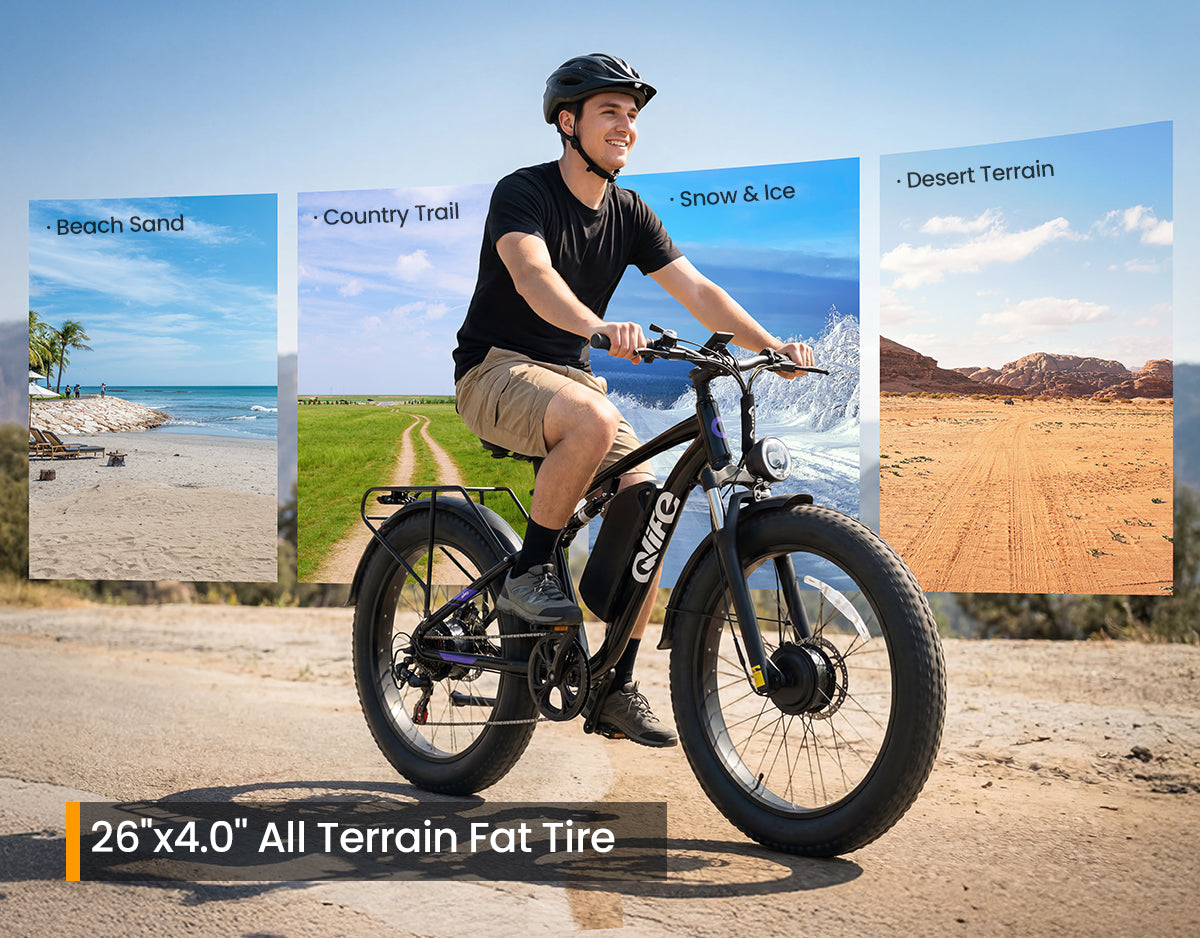
The obvious thing is the tires. Fat tire e-bikes use tires that are usually between 3.5 and 5 inches wide, which is roughly double the width of a standard e-bike tire. That extra width gives you a bigger contact patch with the ground, which means more grip on loose or uneven surfaces and a more cushioned ride on rough roads.
In practice, this means you can ride terrain that would be difficult or impossible on a regular e-bike. Sand, snow, mud, gravel, and rough trails all become manageable. The wider tires also make the bike feel more planted and stable at speed, which many riders appreciate even on normal roads. If you've ever felt nervous on a narrow-tired bike in wet conditions or on loose ground, a fat-tire e-bike solves that problem.
The motor assist is what makes a fat tire e-bike worth having day to day. Fat tire bikes are heavier than standard e-bikes, which makes them harder to pedal without assistance. With a good motor, that weight disappears on the road, and you get all the benefits of extra traction without the weight penalty.
Fat tire bikes are great for riders who don't have much confidence. These bikes feel stable and predictable in a way that lighter, narrower bikes don't, especially at lower speeds, on loose ground, or in the wet. People who feel the most benefit are those returning to cycling after a break, or who want to ride in conditions that would make a regular e-bike feel skittish.
What to Look For
Before getting into specific models, there are a few things worth checking on any fat tire e-bike you're considering buying.
Motor
 Motor power is more important on a fat tire e-bike than on a standard commuter. This is because the heavier frame and wider tires create more rolling resistance, so you need more motor output to compensate. Most decent fat tire e-bikes have 1000W to 2000W peak motors. For most riders, 1200W to 1500W peak is more than enough. For heavier riders, anyone planning to tackle steep hills, or riders who want to ride on seriously loose terrain like sand or deep mud, more power is useful.
Torque is the spec that determines how well the bike climbs. It's measured in Newton-meters and tells you how much rotational force the motor applies to the wheel. Higher torque means faster acceleration and better hill-climbing. A motor with 70-85Nm will climb hills much more comfortably than a lower-torque motor at the same peak wattage.
Battery
Battery capacity determines how far you can ride. To work out battery capacity, you need to look at the watt-hour figure, which is the voltage multiplied by the amp-hours. For example, a 48V 13Ah battery gives you 624Wh of capacity. In real-world riding with moderate assist, budget for 60-70% of the claimed range. If a bike claims 65 miles, expect 40-45 miles in typical use.
Suspension
 You may also want to think about suspension based on where you'll ride. Fat tires provide a lot of cushioning on their own, so for road use, gravel paths, and light trail riding, a fat-tire e-bike with front suspension is adequate. But if you ride rougher terrain or longer off-road rides, full suspension makes a significant difference to your comfort. After 30 minutes on rocky ground, you'll notice the difference. All three Qlife fat-tire models in this guide have full suspension, which is a significant advantage over many competitors at similar price points that only have suspension forks.
Brakes
Brakes are worth paying attention to, too. Many fat tire electric bikes have mechanical disc brakes that are reliable and do the job well in most conditions, and they're easier to service yourself. Hydraulic disc brakes give you more stopping power with less hand effort and perform better in wet or muddy conditions. At the speeds fat tire e-bikes can reach, one with hydraulic brakes is the better choice for anyone riding off-road regularly or in variable weather. The Racer Max includes hydraulic brakes front and rear as standard.
Tire Pressures
Finally, you can fine-tune how your fat-tire electric bike performs by adjusting its tire pressure. For example, running 5 to 10 PSI gives you maximum float and traction on soft ground, snow, or sand. But you may want to inflate your tires to 12 to 15 PSI on roads, which reduces rolling resistance for more efficient riding. Being able to tweak your tire pressure to the surface you're riding on is one of the most useful and underrated advantages of a fat tire e-bike.
Best Fat Tire Electric Bikes from Qlife in 2026
Now we will go through the Qlife range of fat-tire electric bikes to give you an idea of what to expect.
Racer Fat Tire 2.0: Best for Most Riders
 The Racer Fat Tire 2.0 starts at $659 and is the right starting point for most people buying their first fat tire e-bike. It has a 1500W peak motor, a 48V 13Ah battery, a top speed of 35+ mph, and up to 60 miles of claimed range on pedal assist. The 20x4.0-inch fat tires handle sand, gravel, mud, and road use well, and the full suspension system, with a hydraulic front fork and rear shock absorber, takes the edge off even rougher surfaces than you might expect at this price.
With many complimentary reviews and consistently positive feedback, this is the most popular model in the range for good reason. It gives you real performance for the price. The removable battery means you can charge it without bringing the whole bike inside.
The 20-inch wheel is slightly more compact than the 26-inch wheel on the Racer Plus, which makes it more manageable and nimble at lower speeds and a better fit for shorter riders. If you're between 5'2" and 5'10", this is probably the better fit. The 350 lb payload capacity means most adult riders can use it without any concern, and it handles carrying a backpack or light cargo without any handling issues.
For riders who want to ride on the beach, in winter, or a generally more versatile bike than a standard commuter, the Racer Fat Tire 2.0 delivers all of that at a reasonable and attractive price.
Racer Plus Fat Tire 2.0: Best for Trail Riders and Adventure Riders
 If you want more capability, the Racer Plus Fat Tire 2.0 is a significant upgrade. The 1800W peak motor with 85Nm of torque climbs hills better than the standard Racer, and the 48V 15.6Ah battery gives up to 75 miles of claimed range, which is useful for anyone planning longer rides.
What sets it apart from the Racer Fat Tire 2.0 is its full suspension system and larger 26-inch wheel. The hydraulic front fork and rear shock absorber work better together on rough terrain. You'll experience a more plush ride and better grip on rocky trails, bumpy gravel roads, and mixed off-road surfaces. This means you'll finish a long ride on demanding terrain in better shape and after having more fun.
The 26x4.0-inch wheels are larger and feel more stable at higher speeds, and the 37+ mph top speed is a lot of fun on roads. The larger wheel also handles obstacles better on trails, rolling over rocks and roots more confidently than a smaller wheel. This is the pick if you know you'll be riding on anything more demanding than light gravel.
If you're choosing between this and the Racer Fat Tire 2.0, the extra $90 is worth it for most riders who plan to go off-road regularly. The combination of more torque, more range, and a larger wheel makes the Racer Plus the strongest all-around bike for serious use.
Racer Max Dual Motor: Best for Maximum Performance
 The Racer Max Dual Motor starts at $1,099 and is in a different class from the other two. It has a dual-motor system, meaning you have a 1800W front motor and a 1200W rear motor. Together, you get a massive 3000W peak, which makes a real difference on slippery or loose terrain where a single motor would struggle. On sand, snow, or steep muddy inclines, two-wheel drive gives you the traction to keep going where a single-motor bike would spin out.
The 200 Nm of combined torque is another standout figure. For context, that's more rotational force than most full-size electric scooters and gives the Racer Max the ability to tackle 45-degree inclines. In practical terms, it means almost no hill you'll encounter on a typical ride will slow it down.
The 52V 20Ah battery is one of the largest available at this price point and offers a claimed range of 60 to 70 miles. Full-suspension front and rear, 26x4.0-inch fat tires, and front- and rear-hydraulic disc brakes round out a spec that would cost considerably more from most other brands. The 38+ mph top speed means you can keep up with urban traffic without any difficulty.
This is the bike for riders who want the most capable fat-tire e-bike available for under $1,500. If you're planning to use it for hunting, backcountry exploring, winter riding, or any situation that tests a fat tire bike's limits, the Racer Max is the right choice. For everyday riding and light off-road use, the Racer Fat Tire 2.0 or Racer Plus is more than enough and costs considerably less.
How to Choose
For most riders, which fat-tire electric bike you choose comes down to three things: your height, your terrain, and your budget.
If you're a shorter rider or mostly riding on roads, beaches, and light gravel, the Racer Fat Tire 2.0 at $659 covers everything you need. It's the most popular model in the Qlife range for a reason, and for most buyers doing a mix of road and light off-road riding, there's no need to spend more.
If you like to ride trails, live somewhere with rougher roads, or want a bike you can push harder off-road, the Racer Plus Fat Tire 2.0 at $749 is the better choice. This is because it has full suspension and extra power, making it a noticeably more capable bike for serious use, and the larger battery means you can confidently ride longer routes without worrying about range.
Some riders want the best of everything and are prepared to spend more. If this is you, the Racer Max at $1,099 offers dual-motor power, a large battery, and hydraulic brakes that are hard to match at this price. It's the pick for riders who need the extra traction of two-wheel drive on demanding terrain, or who ride in conditions where the other models would start to struggle.
All three come with Qlife's standard 365-day warranty and free shipping.
Final Thoughts
Fat tire e-bikes are one of the most versatile categories in the electric bike market right now. They handle more types of terrain than a standard e-bike, they're more stable in difficult conditions, and the riding experience is more comfortable on anything other than perfectly even tarmac.
Qlife's range covers everything a fat-tire rider needs. The Racer Fat Tire 2.0 is the best entry point. The Racer Plus Fat Tire 2.0 is the right upgrade for riders who want more capability. The Racer Max is there when you need everything.
Browse the full Qlife fat tire e-bike range to find the right model for your riding.
FAQ
What is the best fat tire e-bike for beginners? The Racer Fat Tire 2.0 at $659 is the right starting point. It gives you plenty of performance without the extra complexity and cost of a dual motor system. The 20-inch wheel is also slightly more manageable for new riders, and the full suspension makes the ride comfortable enough that beginners aren't fighting the terrain while they're learning.
Are fat tire e-bikes good for the beach? Yes. Fat tires are particularly effective on sand because the wide contact patch stops the tire from sinking in. Running the tires at low pressure, around 5 to 8 PSI, gives you the best results on soft sand. All three Qlife models handle beach riding well, and the motor assist means you're not exhausted by the extra resistance sand creates.
Can fat tire e-bikes go in the rain? Yes. The wider tires give you more grip on wet roads than a standard e-bike tire, and all Qlife models have water-resistant electrical systems. The Racer Plus and Racer Max with hydraulic brakes perform better in wet conditions, as hydraulic brakes maintain their stopping power more consistently.
What is the difference between the Racer Fat Tire 2.0 and the Racer Plus Fat Tire 2.0? The main differences are wheel size, motor power, battery capacity, and torque. The Racer Plus has a 26-inch wheel instead of a 20-inch wheel, a 1800W peak motor instead of 1500W, 85Nm of torque, and a 48V 15.6Ah battery instead of 13Ah. Both have full suspension. The Racer Plus costs $90 more and is the better choice for trail riding, longer adventures, and riders who want more power for hills.
Do fat tire e-bikes work in snow? Yes, and they're one of the best options for winter riding. The wide tires provide more traction on snow and ice than a standard e-bike tire. Running at low tire pressure further improves traction. All three Qlife fat tire models are suitable for riding in winter conditions, and the Racer Max's dual motor gives it a particular advantage in deep snow where single-motor bikes struggle for grip.
Is the Racer Max worth the extra cost over the Racer Plus? It depends on how you plan to ride. For most recreational riders and commuters, the Racer Plus at $749 is more than capable. The Racer Max at $1,099 is worth the extra cost if you need dual-motor traction on demanding terrain, hydraulic brakes for high-speed or wet riding, or the larger 52V 20Ah battery for longer range and stronger power delivery.
Share:
Electric Tricycle vs Electric Bike: Which One Is Better for Adults?
What Is the Maximum Speed of Electric Bikes in the US?