
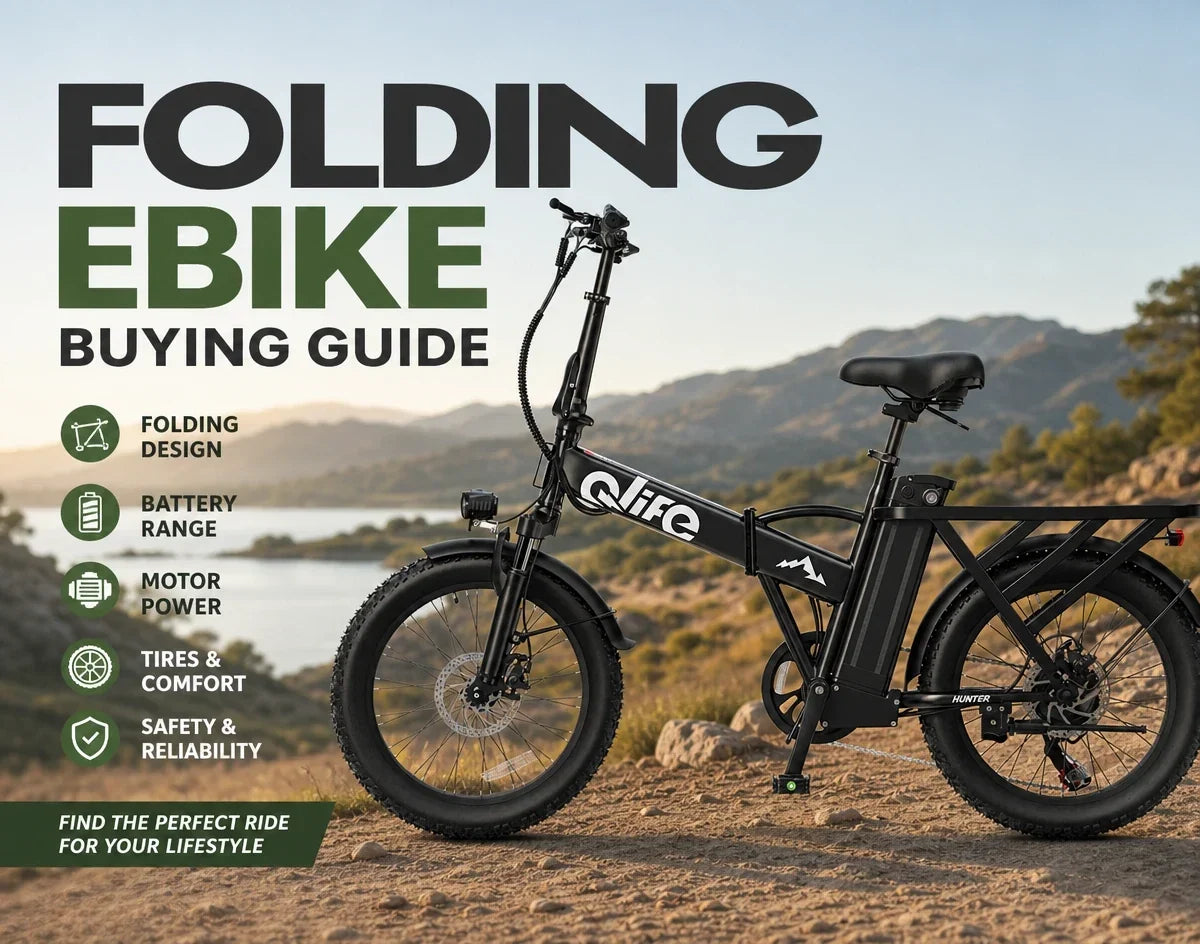
A folding ebike buying guide should start with a tape measure, not a motor wattage chart. I've watched too many people buy a "compact" folder and then spend fifteen minutes wrestling 79 pounds through a narrow hallway because they measured the closet but forgot about the door frame. A folding frame can pull a bike out of the donation pile, make a road trip possible, or turn a train commute into something you'll actually do instead of just thinking about. It can also leave you sweating on a subway platform while the brochure cheerfully insists the bike is "easy to carry."

Here's what I've learned: compact storage and frequent carrying are different jobs. The bike that fits beautifully in your trunk might be hell on stairs. The one that folds in ten seconds flat might need three hands to latch properly.
The short answer is simple: buy a folding e-bike when you have a real space or transport problem to solve. Measure the opening and the route, check the actual bike weight, inspect the folding hardware, then choose wheel size, motor, battery, and brakes around your ride. There's no single best folding ebike for every rider, and anyone who tells you otherwise hasn't carried enough bikes up enough stairs.
Top Folding Ebikes for 2026
Before we get into measurement protocols and scoring rubrics, here's what you actually want to know: which bikes are worth your money. I've narrowed it down to three Qlife models that solve different problems. Pick the one that matches your use case, then use the rest of this guide to verify it'll actually fit your space.
Best Overall Value: Qlife Hunter

Price: $529-599 | Weight: 60.49 lb | Range: Up to 65 miles
The Hunter hits the sweet spot between portability and capability. At 60.49 pounds, it's not lightweight enough for daily subway stairs, but it's manageable for occasional carries and perfect for car trunk transport. The 648Wh removable battery means you can charge it inside while the bike stays in the garage. The 20 x 3.0 tires handle city streets and light trails without the bulk of fat tires.
Best for: Daily commuters with car or ground-level storage, delivery riders who need cargo capacity (400 lb total payload, 120 lb rack), anyone who folds the bike 2-3 times per week.
Skip it if: You're carrying it up more than one flight regularly, or you need the absolute smallest folded package. The folded width isn't supplied in current specs, so measure before ordering if tight spaces matter.
Key specs: 500W motor (1500W peak), 80Nm torque, 28 mph, Shimano 7-speed, disc brakes, front suspension, IPX5 rated, TÜV-certified battery.
Best for Long Range & Rough Roads: Qlife Hunter Plus

Price: $699-749 | Weight: 79.3 lb | Range: Up to 90 miles
The Plus is what happens when you prioritize capability over portability. The 960Wh battery delivers serious range, the 20 x 4.0 fat tires eat gravel and sand, and the 750W motor (1800W peak, 110Nm torque) handles steep hills and heavy loads. At 79.3 pounds, this is a vehicle-transport or ground-level storage bike. Don't buy it planning to carry it.
Best for: RV travelers who drive to destinations then ride, cargo haulers who need maximum battery life, riders tackling snow or beach terrain, anyone who rarely folds it but needs the option.
Skip it if: You have stairs, tight hallways, or small elevator constraints. This bike is heavy and bulky. Also skip if your roads are smooth pavement; the fat tires add rolling resistance you don't need.
Key specs: 750W motor (1800W peak), 110Nm torque, 32 mph, 48V 20Ah battery, 20 x 4.0 fat tires, 400 lb total payload, 120 lb rack capacity, IPX5 rated.
Best for Stability & Easy Mounting: Qlife Triker 2.0

Price: $629-679 | Weight: Not supplied | Range: Up to 55 miles
If balance is your concern, skip the two-wheelers entirely. The Triker 2.0 is a folding three-wheel electric bike with a rear differential, low step-through frame, and plush oversized seat with adjustable backrest. The 18 x 3.0 tires and three-wheel platform deliver stability that no two-wheel folder can match. It's designed for seniors, riders with balance concerns, and anyone who prioritizes confidence over speed.
Best for: Older riders, anyone with balance or mobility concerns, grocery runs where you'll load the rear basket while stopped, riders who want to put both feet down at every stop.
Skip it if: You need to go fast (18 mph max) or tackle single-track trails. The three-wheel platform is stable but not nimble. Also skip if you need to navigate very narrow spaces; the track width is wider than a two-wheeler.
Key specs: Peak 1200W motor, 48V 10.4Ah battery, 18 mph, 18 x 3.0 tires, 400 lb payload capacity, foldable design, TÜV-certified battery, rear differential for cornering stability.
Can't decide? Use the detailed checklist and measurement protocol below to score each model against your actual space and route. The "best" bike is the one that fits your real constraints, not the one with the biggest battery or lowest price.
Quick Reference by Use Case
Use this table to match your primary need to the right model. These aren't personality quizzes. If you have multiple use cases, prioritize the hardest constraint first.
| Your use case | What matters most | Best Qlife model | Why this one |
|---|---|---|---|
| Daily car commute with trunk storage | Folded fit, loading ease, battery removal | Hunter | 60.49 lb, removable battery, manageable trunk lifts |
| Apartment or closet storage | All three folded dimensions, doorway clearance | Hunter Plus | Complete folded specs: 37.01 x 19.69 x 31.10 in |
| Train or bus commute with stairs | Lightest carry weight, secure latch | Hunter (or reconsider folding) | 60.49 lb is the lightest here, but still heavy for daily stairs |
| RV or van travel | Maximum range, rough-road capability | Hunter Plus | 90-mile range, 20 x 4.0 fat tires, 960Wh battery |
| Cargo delivery or family hauling | Payload capacity, battery life, stability | Hunter or Hunter Plus | Both: 400 lb total payload, 120 lb rack capacity |
| Balance concerns or senior riders | Stability, low step-through, easy mounting | Triker 2.0 | Three wheels, rear differential, plush seat with backrest |
| Beach, snow, or loose terrain | Fat tires, high ground clearance | Hunter Plus | 20 x 4.0 tires, 750W motor, front suspension |

Start here: Read the model recommendations above, then use the measurement protocol and scoring rubrics below to verify your top choice will actually fit your space and route.
How We Evaluate Folding Ebikes
This guide uses two original frameworks: the Folded-Fit Measurement Protocol and the Transport Effort Score. No other folding ebike guide teaches you how to measure fit before you buy. Most tell you "compact" and leave you guessing whether that means 36 or 40 inches. We do better.
The methodology sections below will help you verify any folding ebike, not just Qlife models. Use them when comparing bikes from any manufacturer.
---For a detailed review of the Hunter, see Qlife's best folding electric bike under $1,000. For the stability vs. portability tradeoff, read our electric trike vs electric bike comparison.
Measure the Space Before Choosing the Bike
Most folding e-bike mistakes happen because someone measures the destination but not the route. A bike can fit inside a trunk and still fail at the hatch opening. It can fit in a closet and miss the hallway turn. Measure both the opening and the space behind it. I can't say this enough.
For a car or SUV, record the narrowest trunk or hatch opening, the loading height and lip, the usable floor between the wheel wells, and the height under the parcel shelf. Measure the route from the curb too. That includes steps and tight turns. The opening is the gatekeeper. The interior volume comes second.
For a closet, elevator, or apartment, measure the door opening, inside width, and diagonal clearance. Mark the folded footprint on the floor with painter's tape, then walk the route with a box roughly the same size. You might discover that your "easy storage spot" sits behind a door that only opens 80 degrees. I've seen it happen.
For an RV, van, or boat, measure the compartment opening before the internal length, height, and tie-down points. Account for lips, hinges, insulation, and gear already inside. Folded volume doesn't tell you whether you can grip the bike or secure it without pressing on the derailleur. That part you learn the hard way.
Qlife's two Hunter models show why all three dimensions matter. Hunter Plus lists 37.01 x 19.69 x 31.10 inches folded. Hunter lists 36.6 inches folded length and 28 inches folded height, but its folded width isn't supplied. The product data I reviewed doesn't include a standardized fit test for a specific car, closet, elevator, or RV. Measure your opening and route. Don't guess.
Leave clearance for your hands, a protective mat, and the movement needed to lower a hatch. Re-measure after adding a basket, pannier, or rack bag. Accessories are useful until they become the widest part of the package. Then they're just in the way.
Bike Weight vs Real Carry Effort
The listed number is only the start of the lifting problem. Grip location, balance, latch security, carrying distance, and the height of a trunk lip matter just as much. I've carried 50-pound bikes that felt like 70 and 70-pound bikes that handled like 60. Weight distribution is everything.
Start with the bike weight, not the carton. Qlife lists Hunter at 60.49 lb and its package at 71.42 lb. Hunter Plus is listed at 79.3 lb. Those aren't lightweight folding ebikes for routine stair work, even if the folded footprint looks tidy. You're not carrying these up three flights every day without regretting your choices.
Battery removal can change the job, but only when the model and manual clearly support it. Hunter is listed with a 48V 13.5Ah, 648Wh removable battery. That's confirmed. Hunter Plus's spec prose doesn't clearly establish battery removability, so confirm the current configuration before planning a battery-off carry. Never create a battery-off weight by subtracting a guessed battery mass. That's wishful math.
Look for a carry handle or solid grip, a folded position that stays balanced, and a latch that stays engaged while you reposition the bike. Qlife doesn't publish a fold-cycle test, stair test, carry-handle test, or confirmed folded-rolling claim for either Hunter model. Verify those details in person or in the current manual. The marketing copy won't tell you.
If you carry the bike more than one flight several times a week, shop by the hardest carry. A 60.49 lb bike might be fine from garage to trunk. It'll be miserable from a third-floor walk-up. If it mostly lives in a vehicle or storage compartment, the same weight might be a fair trade for tires, range, and cargo capacity. Know which job you're solving.
Hinges, Latches, Cables, and Frame Security
A folding bike hinge is a load-bearing joint under constant stress. The frame hinge must close completely, the latch must stay locked, and the cables must bend without being pinched. I've seen hinges that looked fine until you put 200 pounds on them and heard a creak that meant "service this now."
Before buying, ask for photos of the main frame hinge, locking lever, any secondary safety catch, the stem hinge, and cable paths near both joints. Look for contact surfaces that could wear or loosen. Metal-on-metal with no bushing is a red flag.
Open and close the mechanism exactly as the manual shows. The latch should reach its fully closed position without force. With the bike powered off, check for side-to-side play, a safety feature that can be bypassed, or cables pulled tight at full steering lock. A cable that looks fine straight can be stressed when the stem folds. That's when you find out the routing is wrong.
Don't file, bend, shim, or re-drill a latch. Use the model's service instructions or a qualified bicycle technician. Hunter and Hunter Plus are listed as having foldable frames, but Qlife doesn't publish hinge-cycle durability or a model-specific latch adjustment procedure. That's information you want before something goes wrong.
After transport, unfold on a stable surface and confirm the frame and stem locks before powering up. Check handlebar alignment, brake feel, and cable clearance. It takes less time than explaining to a curb why the front wheel suddenly decided to go somewhere else.
Wheel Size, Ride Quality, and Handling
Wheel size changes both the folded package and the ride. Smaller wheels package neatly but react more quickly to potholes, curb edges, and abrupt steering inputs. That twitchy feeling you get on 16-inch wheels? That's physics. Tire volume and pressure matter as much as rim diameter.
Sixteen-, 20-, and 24-inch wheels are common. A 20-inch wheel is often the useful middle ground: compact enough to fold, large enough to feel settled at city speeds. Wide tires add comfort and traction on broken pavement and gravel, but they also add bulk and rolling resistance. There's no free lunch.
Qlife Hunter uses 20 x 3.0 tires. Hunter Plus uses 20 x 4.0 fat tires. The Plus is designed around more tire volume and a higher listed weight, which can help on loose surfaces but gets inconvenient in a narrow elevator. If your route is smooth pavement, four-inch tires might be solving a problem you don't have.
Check wheelbase, steering angle, saddle height, and standover clearance. Qlife lists Hunter for riders around 5 feet 5 inches to 6 feet 3 inches and Hunter Plus for about 5 feet 1 inch to 6 feet 3 inches. Treat those ranges as a starting point and confirm your reach and leg extension. Suspension helps with sharp hits, but it can't fix a poor fit or neglected tires. Pump your tires.
Motor, Battery, Range, and Brakes
Choose the motor and battery around your route, not the biggest number in the listing. A hill start with a heavy rider and a loaded rack asks more of the system than a flat cruise with an empty basket. That's when you find out whether the motor has actual torque or just impressive peak wattage.
Hunter is listed with a 500W motor, 1500W peak output, and a 48V 13.5Ah (648Wh) battery. Its advertised pedal-assist range is up to 65 miles and its listed top speed is 28 mph. Hunter Plus is listed with a 750W motor, 1800W peak output, and a 48V 20Ah battery at about 960Wh. Its advertised range is up to 90 miles and its listed top speed is 32 mph.
These are manufacturer claims. Assist level, hills, wind, temperature, tire pressure, rider weight, and cargo all change actual range. I'd expect real-world range somewhere between half and two-thirds of the advertised number under mixed conditions. Your mileage will literally vary.
For a folding ebike for commuting, ask whether it can restart on your steepest hill, charge where you store it, and get replacement batteries and chargers later. Hunter's removable battery helps when the bike sleeps in a garage and the outlet is indoors. Confirm the current Hunter Plus manual before assuming its battery comes out. Listed charging times are about 6-7 hours for Hunter and 7-8 hours for Hunter Plus. That's overnight, basically.
Both models list front and rear disc brakes and Class 3 classification. Check lever reach, rotor and pad condition, and stopping control after transport. Local speed, helmet, trail, and transit rules still apply. Class 3 doesn't mean you're exempt from reality.
The Folded-Fit Measurement Protocol
Folded dimensions are only useful when they're measured the same way. This Folded-Fit Measurement Protocol is an editorial worksheet I use, not a Qlife test result or an industry standard. Nobody has an industry standard. That's part of the problem.
Step 1: Define the destination
Name the exact place: sedan trunk, SUV hatch, closet, elevator, RV compartment, van, or boat locker. Record the narrowest opening, usable interior, and loading height. Make a separate sheet for each destination. They're different jobs.
Step 2: Record the route
Measure doorways, hallway turns, stairs, and the elevator. Include the distance from drop-off to storage. A bike that fits inside can still fail at the first corner. I've watched it happen in real time.
Step 3: Fold it by the manual
Don't remove pedals, turn the bars, or remove the battery unless that's part of the normal procedure. Count fold steps, note tools, and time the fold and unfold if you're evaluating a demo bike. If it takes six minutes to fold and you're on a train platform, that bike isn't getting folded.
Step 4: Measure the complete package
Record the longest length, widest width, highest point, protruding rack or pedal, and the distance between the tires. Measure the outside of the hardware, not just the frame tubes. A few inches of handlebar can decide a trunk opening. I've seen cars rejected because of two inches.
Step 5: Weigh both configurations
Record battery-on weight and battery-off weight only when removal is confirmed and you can weigh it directly. Include the accessories you'll transport. Package weight is not carry weight. That's a marketing trick.
Step 6: Check stability
Check whether the folded bike stands, needs a strap, or rolls. Qlife's current Hunter data doesn't provide a verified folded width, fold time, or rolling specification, and Hunter Plus has no published fold-time or rolling test. Leave those fields blank until verified. Don't guess.
Step 7: Photograph the evidence
Take a tape-measure photo for each dimension and one showing the complete opening. Save the date, model, battery state, and accessory setup so a later revision can't quietly change your fit. If the manufacturer updates the frame design in six months, you'll want proof of what you measured.
Use this compact worksheet:
| Field | Your record |
|---|---|
| Destination and opening | |
| Interior floor and height | |
| Route width and tightest turn | |
| Folded length x width x height | |
| Protrusions | |
| Battery-on weight | |
| Battery-off weight, if verified | |
| Fold steps and fold time | |
| Stands, rolls, or needs a strap | |
| Photo and verification date |
The Transport Effort Score
The Transport Effort Score turns "portable" into something comparable. It's an editorial rubric I use, not a Qlife or industry rating. Score each item from 0 to 2: 0 is easy, 1 is workable, and 2 is difficult or unknown. Mark unknown as 2 until you verify it. This keeps you honest.
Daily Carrying Score
Add these eight daily-carry items:
- Bike weight with the battery and accessories you use.
- Grip quality and whether the folded bike stays balanced.
- Battery removal and the difference it makes.
- Number of fold and unfold steps.
- Latch confidence after the bike is repositioned.
- Ability to roll when folded, if the manufacturer confirms it.
- Stairs and loading height.
- Doorway turns and the distance carried.
Use the total this way:
| Score | What it means |
|---|---|
| 0-5 | Reasonable for regular short carries, after a hands-on check |
| 6-11 | Works for occasional carrying, but plan the route |
| 12-16 | Treat it as storage or vehicle transport, not a daily shoulder workout |
Car and RV Storage Score
Score each item from 0 to 2:
| Item | 0 means easy | 2 means difficult or unknown |
|---|---|---|
| Folded fit | Clears the opening and interior | Doesn't clear, or dimensions are missing |
| Loading height | Low lift and clear lip | High lift or awkward lip |
| Tie-down points | Simple, secure attachment | No clear anchor or protection |
| Component protection | Derailleur and display are shielded | They can be crushed or rubbed |
| Secure time | Quick, repeatable setup | Fussy or unstable setup |
Total the five items. A score of 0-3 is easy, 4-6 is workable, and 7-10 is vehicle storage with extra planning. A bike can score well here while scoring poorly on stairs. That's the point of two scores.
Match the Bike to Your Use Case
Apartment storage: Start with folded width and the route to the closet. Hunter Plus has complete listed folded dimensions. Hunter's folded width needs confirmation. If you climb stairs, prioritize carry effort over motor output. Your legs will thank you.
Train or bus commute: Check the operator's current rules first. A folding label doesn't guarantee acceptance, and a compact bike can still be heavy in a crowded station. Hunter at 60.49 lb is the lightest Qlife folder, but that's still substantial for repeated stair carries. Look for a secure latch, manageable grip, and clear battery plan. If you're carrying it up more than one flight several times a week, honestly consider whether a folding ebike is the right solution. A lighter conventional ebike with secure outdoor parking might serve you better. Know what you're allowed to do and what you're physically willing to do before you buy the bike.
Car trunk or SUV: Folding ebike trunk fit starts with the hatch opening, not only the cargo floor. Hunter Plus has a complete listed folded envelope. Don't decide Hunter fit from length and height alone because folded width isn't supplied. Measure first.
RV, van, or boat: For a folding ebike for RV travel, measure the compartment opening and tie-down route before comparing range. Hunter Plus might suit riders who value its larger battery and fat tires, but its 79.3 lb listed weight can make a high compartment awkward. Think about the loading path.
Cargo and rough roads: Hunter's 20 x 3.0 tires, front suspension fork, disc brakes, and listed 400 lb maximum total payload make it worth investigating for work and mixed surfaces. The rear rack is listed at 120 lb. Hunter Plus adds 20 x 4.0 tires and a larger battery (960Wh vs 648Wh), with the same listed total payload and rack capacity. Both deliver serious cargo capability in a foldable package. Follow the manual and keep cargo low and secure. High loads get unstable fast. For cargo-focused features, see our guide on electric bikes with a basket.
Shorter riders: Check saddle height, standover, reach, and handlebar adjustment in person. Your leg length and confidence at a stop matter more than a range on a chart. If you can't touch the ground comfortably, keep shopping.
Riders who rarely fold: Compare a conventional frame too. Folding hardware earns its keep when it solves a weekly storage or transport problem. If you fold the bike twice a year, you paid extra for nothing. For stability and easy mounting, a folding trike might be a better direction.
Frequently Asked Questions
How heavy is a folding e-bike?
There's no useful universal average. Weight varies wildly by battery size, motor power, and frame material. Qlife lists Hunter at 60.49 lb and Hunter Plus at 79.3 lb, so both are vehicle-friendly or storage-friendly rather than lightweight for daily stairs. For context, many compact folders weigh 40-55 lb, while heavy-duty cargo folders can exceed 80 lb. Always confirm whether the listed number includes the battery and accessories. If the listing doesn't say, assume it's the bare frame and add 8-12 pounds for the battery, plus any racks, fenders, or baskets you'll keep mounted during transport.
Will a folding e-bike fit my trunk?
Dimensions alone can't guarantee trunk fit. You need to compare folded length, width, and height against your narrowest hatch opening first, then check floor depth between the wheel wells, hatch clearance when open, and the loading lip height. Hunter Plus lists complete folded dimensions at 37.01 x 19.69 x 31.10 inches. Hunter's folded width isn't supplied in current specs. Measure your car's hatch opening with a tape measure (not by eyeballing it), write down the numbers, and compare them to the bike's complete folded package including any accessories you'll leave mounted. A bike can fit on the cargo floor and still fail to pass through the opening. That's the most common trunk fit mistake. Also account for how you'll grip the bike during loading. If the derailleur or display are on the wide side, you need extra clearance for your hands.
Are folding e-bikes good for public transit?
They can be, but only if three things align: the operator allows them (check current policy, not what you heard last year), you can physically carry the weight through the station (stairs, turnstiles, crowded platforms), and the folded size meets any dimension limits. Hunter at 60.49 lb is the lightest Qlife folder. That's manageable for a short platform carry but brutal for three flights of subway stairs twice a day. Compact storage and pleasant daily carrying are separate tests. A bike can pass one and fail the other. Before buying a folder for transit, visit the station during your actual commute time with a weighted duffel bag (60-80 lb depending on the bike you're considering) and walk the full route from street to platform. If that test feels hard, carrying the bike will be harder. Many transit agencies allow folding bikes but have size limits (typically 36 x 24 x 12 inches or similar). Verify both the policy and your physical capability before committing.
Are folding e-bikes worth it?
They're worth it when storage or transport is a weekly problem you're actually solving. If you fold the bike 2-3 times per week to fit it in a car trunk, store it in a small apartment, or take it on a train, then yes, the folding mechanism earns its keep. If you rarely fold the bike and it mostly sits in one place, a conventional frame might be simpler, lighter, and cheaper. The folding mechanism adds weight (usually 5-10 pounds), complexity (hinges and latches that need maintenance), and cost (typically $100-300 premium over a comparable non-folding frame). Make sure you're getting something back for that investment. Ask yourself: how many times per month will I actually fold this bike? If the answer is "once or twice, maybe," you're paying for a feature you won't use.
Is a folding bike hinge safe?
A hinge can be safe when fully locked, undamaged, and maintained according to the manual. Before each ride, check the frame and stem locks, look for play or pinched cables, and stop if the latch doesn't close correctly. Don't modify it yourself. That's how people get hurt.
Which folding e-bike is most reliable?
There's no honest universal winner without comparable long-term data. Favor a clear manual, a firm latch, accessible replacement parts, and a service path you can use after the sale. The best bike is the one you can get fixed when something breaks.
What should I avoid when shopping?
Avoid listings with missing folded width, no battery or charger provenance, no service instructions, or a hinge that shows play. Don't accept "fits most trunks" without dimensions for your route. That's lazy marketing.
How should I store and charge a folding e-bike?
Keep it dry and don't charge a wet battery. Hunter and Hunter Plus product data list IPX5, but that's not permission for submersion, pressure washing, or wet charging. Remove a battery only when the manufacturer confirms the design and manual procedure. Hunter is listed with a removable battery. Confirm the current Hunter Plus configuration before assuming anything.
Final Buying Advice
The best folding e-bike is the one that fits your real route, not the one with the smallest marketing number. Measure the opening, record the complete folded package, and score the hardest carry you'll actually do. Then match the ride hardware to your roads and load.
For most buyers: Qlife Hunter offers the best balance of capability, portability, and price. The 60.49 lb weight is manageable for occasional carries, the 648Wh removable battery delivers real-world range, and the $529-599 price point won't require a second mortgage. It's the folder you'll actually use instead of making excuses.
For maximum range and capability: Hunter Plus makes sense when its larger battery (960Wh), fat tires (20 x 4.0), and higher motor output (750W/1800W peak) justify the 79.3 lb weight and larger storage commitment. This is the bike for RV travelers, cargo haulers, and riders who tackle snow, sand, or steep hills regularly. Just don't buy it planning to carry it up stairs.
For stability over speed: Triker 2.0 is the answer when balance matters more than portability. The three-wheel platform, low step-through frame, and plush seat with backrest make it the right choice for seniors, riders with mobility concerns, and anyone who wants both feet on the ground at every stop.
None of these solve daily subway stairs. If you're carrying a folder up three flights twice a day, you need a bike under 45 pounds or a different solution entirely. Be honest about your use case.
For a broader ebike purchase process, read Qlife's how to choose an electric bike, then review the current Hunter, Hunter Plus, and Triker 2.0 specifications with your measurement sheet beside you. Five minutes with a tape measure can save you from a very expensive game of hallway Tetris.
Share:
Fat Tire vs Regular Tire E-Bikes: Range, Comfort, and Handling
E-MTB Suspension Setup: Sag, Rebound, and Rider Weight