
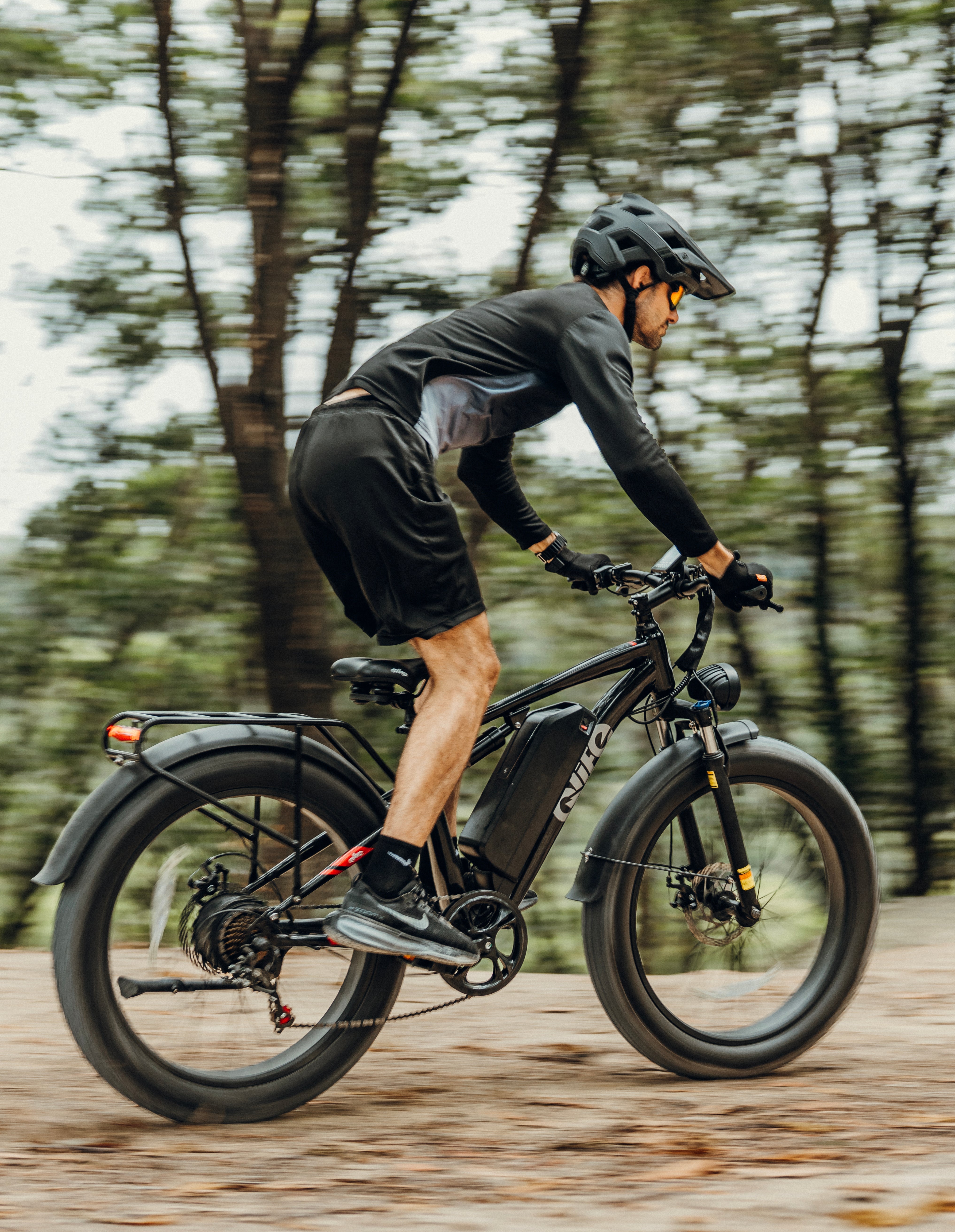
Chunky tires, heavy frame, reliable suspension — it’s not surprising a lot of people are choosing fat tire e-bikes. Just a few years ago, they were relatively rare. But as e-bikes become more popular, a lot of people are opting for thicker tires with a stronger grip.
But don’t just go with the hype. While they’re a cool aesthetic, they’re not always practical. Choosing fat tire e-bikes if you’re just commuting to and from work or want to keep your assist level low means you or your motor is doing more work than necessary.
Below, we’re cutting through the noise to explain the pros and cons of fat tire e-bikes: Are they worth it? How do they compare to regular e-bikes? And what are the main benefits?

What Is a Fat Tire E-Bike?
A fat tire e-bike is defined as any e-bike where the tires are between 3.8-5” wide. For comparison, standard tires are around 1.5-2.5”.
That extra inch or more makes a big difference. More rubber increases rolling resistance. Your bike will grip the road harder, helping to provide traction on difficult terrain. Fat tire e-bikes excel on snow, sand, wet roads, or hills.
But the downside is that it takes a lot more energy to move the wheel one rotation. Either your battery will drain quicker, or your legs will grow more tired.
Why Are Fat Tire E-Bikes So Popular?
Let’s be honest: part of the appeal is the look.
Do most people who own a 4x4 spend their afternoons driving off-road? Of course not. They buy them because they like the rugged aesthetic. The same is true of fat tire e-bikes.
When you’re not the only reason the wheels are turning, opting for thicker, chunkier wheels is a much easier decision. That bulky e-bike look is extremely popular at the moment. It gives the impression of more power.
However, there is a practical reason. Fat tire e-bikes can handle pretty much anything you throw at them. While they might not be quite as efficient during the morning commute, they can withstand rough, rugged terrain. The same can’t be said of most commuting e-bikes.
Pros of Fat Tire E-Bikes
1. Excellent Traction and Grip
Fat-tire e-bikes are almost purpose-made for tackling difficult terrain. Sand, snow, gravel, and wet roads can all present significant challenges for most e-bikes, leading to sliding or loss of control.
Just like a car is fitted with winter tires, fat tire e-bikes increase the contact patch, ensuring you remain stable and secure when you ride. It’s extremely useful if you’re riding throughout the year.
2. More Comfortable Ride (Natural Cushioning)
Thicker tires absorb a lot of bumps and unevenness — they act like a secondary suspension. Indeed, many fat tire e-bikes rely less on their suspension overall (to a certain extent).
The smoother, cushioned ride is one of the first things more riders notice. The only problem is that when you get used to a fat tire e-bike, it can be hard to swap back to a regular bike.
3. Better Stability for Beginners
Beginners often struggle with regular tires. They’re narrow, harder to balance, and offer a firmer riding experience. That’s where fat tires come in.
Because of their wider profile, they feel more planted and forgiving. Despite the increased rolling resistance, it’s easier to kick off and balance, even at low speeds.
4. Strong Off-Road Performance
Fat tire e-bikes might be handy if it snows during your morning commute. But they really come into their own when you head off-road entirely.
Difficult terrain, uneven ground, or loose ground favor thicker tires with a stronger grip. You’ll find yourself less likely to slip or lose control, tackling hills and downhill stretches with comfort and ease.
5. Confidence in Poor Conditions
Who knows what the weather holds? You might ride to work in perfect sunshine only to find a downpour on the way home. Fat tire e-bikes ensure you’re ready for anything the elements can muster.
They’re especially effective for winter riding, wet or icy roads, and unpredictable surfaces.
Cons of Fat Tire E-Bikes
1. Heavier and Harder to Handle
Fat tire e-bikes often come with more weight. It’s not just the tires. The frame is often heavier and the battery bigger. The extra weight might not be a problem if you’re just riding off-road. But if you commute into the city (or bring the bike on public transport), carrying it upstairs or off and on the train is out of the question.
2. Slower and Less Efficient on Roads
More rolling resistance will slow you down and burn through your battery. It’s not on hard trails that you’ll notice the difference. Compared to a regular e-bike, a fat tire e-bike will use more energy on a flat, even road. You’ll require more power just to maintain the same speed.
Most of the time, that’s not an issue. But it can mean your e-bike needs charging every 1-2 uses.
3. Reduced Range
Most aspects of a fat tire e-bike are less efficient on paved surfaces. That applies to the range, too.
The higher energy consumption compared to standard tires means your bike won’t go as far. If you’re currently browsing specs, you might question this statement. Some manufacturers upgrade their battery capacity to compensate, meaning the range is similar or even better than that of other e-bikes.
This usually comes down to larger battery capacity rather than improved efficiency.
As an example, most Qlife fat tire e-bikes are somewhere between 55 and 75 miles. Still impressive, just not the 95 miles you’ll find on some other models.
4. More Expensive (Tires + Components)
Whenever you get more of anything, you can expect to pay more money. The upfront cost is likely to be higher.
In most cases, fat tire e-bikes sit around $200–$800 more than comparable standard models. Entry-level fat tire bikes might start at ~$1,200–$1,800, while more capable setups quickly move into the $2,000–$3,500+ range.
It’s not just the bike itself, either. Replacement tires are larger and more specialized, often costing $60–$150+ per tire, and other components tend to be heavier-duty (and priced accordingly).
So you’re not just paying more upfront — ongoing costs are slightly higher too, especially if you ride regularly.
5. Bulkier Storage and Transport
Fatter tires are cumbersome. You’ll find it harder to fit in cars, racks, or small spaces. That’s an issue if you need to take your bike in your car to a trail. It’s not impossible by any means. Just a bit more hassle than for other bikes.
Fat Tire vs Regular E-Bike: What’s the Difference?
If you’re considering a fat tire e-bike, you’re probably looking at the price, comparing it to regular e-bikes, and wondering if it’s worth the extra. It can be. In simple terms, fat tires offer greater capability and stability at the expense of efficiency and practicality. It’s a fair trade-off. Just not one that’s right for everyone.
Here’s how they compare side-by-side:
|
Feature |
Fat Tire E-Bike |
Regular E-Bike |
|
Speed |
Feels slower due to higher resistance |
Faster and easier to maintain speed |
|
Comfort |
More cushioning from wide tires |
Less natural cushioning (relies more on suspension) |
|
Efficiency |
Lower efficiency, higher battery use |
More efficient, longer range |
|
Terrain Suitability |
Excellent on sand, snow, gravel, rough terrain |
Best for roads, paths, and light trails |
|
Weight |
Heavier overall build |
Lighter and easier to handle |
Are Fat Tire E-Bikes Good for Commuting?
Lots of people commute with a fat tire e-bike. However, it’s not the normal choice. Most people prefer something a bit more efficient, practical, lighter, and faster.
That means going for a standard e-bike.
That being said, there are a few situations where a fat tire e-bike might be preferable. If you live in an area where it can snow heavily or you’re dealing with rough roads, it’s smart to opt for a thicker tire. Even if it snows just a small portion of the year or the rough terrain makes up a fraction of your route, it can still be a benefit, because it gives you the safety and versatility that a traditional e-bike doesn’t.
Versatility is key. If you’re keen to head out onto a trail on the weekend, a fat tire e-bike lets you do that. You might decide to compromise efficiency on your weekday commute for that option.
Speed and Range: What Changes With Fat Tires?
Top Speed Doesn’t Really Change
Fat tire e-bikes are slower to accelerate. But in most use cases, riders will find the top speed similar to that of other e-bikes.
That’s because of the speed limit.
There are three classes of e-bikes. Class 1 e-bikes are restricted to 20 mph and Class 3 e-bikes to 28 mph. (Class 2 e-bikes have a throttle.) Because of this, your general travel times will be very similar regardless of the tire thickness.
But It Feels Slower on the Road
Even with pedal assist, the resistance matters. You’ll be slower to accelerate, which translates to a slower riding experience. It’ll take more effort (and power) to maintain the speed.
Range Usually Takes a Hit
Just as for speed, range also goes down. As mentioned, e-bikes tend to compensate for this with greater battery capacity. But over a longer ride, you’ll notice the battery going down quicker.
How to Offset It
You can stretch the range a bit by keeping your tire pressure properly dialed in, as low pressure creates unnecessary drag. Sticking to lower assist levels when cruising also helps reduce battery drain, saving the higher power modes for hills or rough terrain.
Riding more smoothly, rather than constantly accelerating, makes a noticeable difference, too. Ultimately, it helps to think of a fat tire e-bike as a terrain-focused bike rather than something built for long, efficient rides.
Are Fat Tire E-Bikes Worth It?
They absolutely can be. It really comes down to what you want it for.
They’re a great option if you want more stability and grip. Say you’re an off-road rider or your morning commute can involve hills, trails, or snow. But if your ride is mostly smooth roads, longer distances, or daily commuting, you’re likely paying for capability you don’t really need.
That said, there’s nothing wrong with choosing a fat tire e-bike purely for the aesthetics. The thicker wheels, chunky frame, and comfortable ride are hard to say no to.
FAQs
Are fat tire e-bikes harder to ride?
No, most people find them slightly easier. They are heavier and slower to maneuver. However, the wider tread gives them greater stability, which is helpful for beginners.
Do fat tire e-bikes go slower?
Yes. The higher rolling resistance from the tires means that compared to a similar regular e-bike, they’ll be slower. However, a manufacturer may compensate for this with a stronger motor.
Are fat tire e-bikes good for hills?
Yes, especially with motor assistance. Fat tire e-bikes have greater grip, helping you to climb difficult slopes. You’re less likely to slip.
Can you ride a fat tire e-bike on the road?
Yes, there’s no reason you can’t ride a fat tire e-bike on the road. They’re just not the most efficient option. Nevertheless, many people choose a fat tire e-bike for city riding over the alternatives.
Do fat tires reduce battery range?
Yes, compared to standard tires. The increased rolling resistance will drain the battery faster. For most trips, that’s not noticeable. However, you may find you need to charge the bike more frequently.
Are fat tire e-bikes worth it for beginners?
Yes — for beginners, fat tire e-bikes are often easier to ride because they feel more stable and forgiving. The extra grip helps, especially if you’re not confident or riding on rough surfaces. Just know they’re heavier and a bit slower, so you’re trading efficiency for comfort and control.
Share:
Dual Motor E-Bike Guide
How Do Electric Bikes Work?