
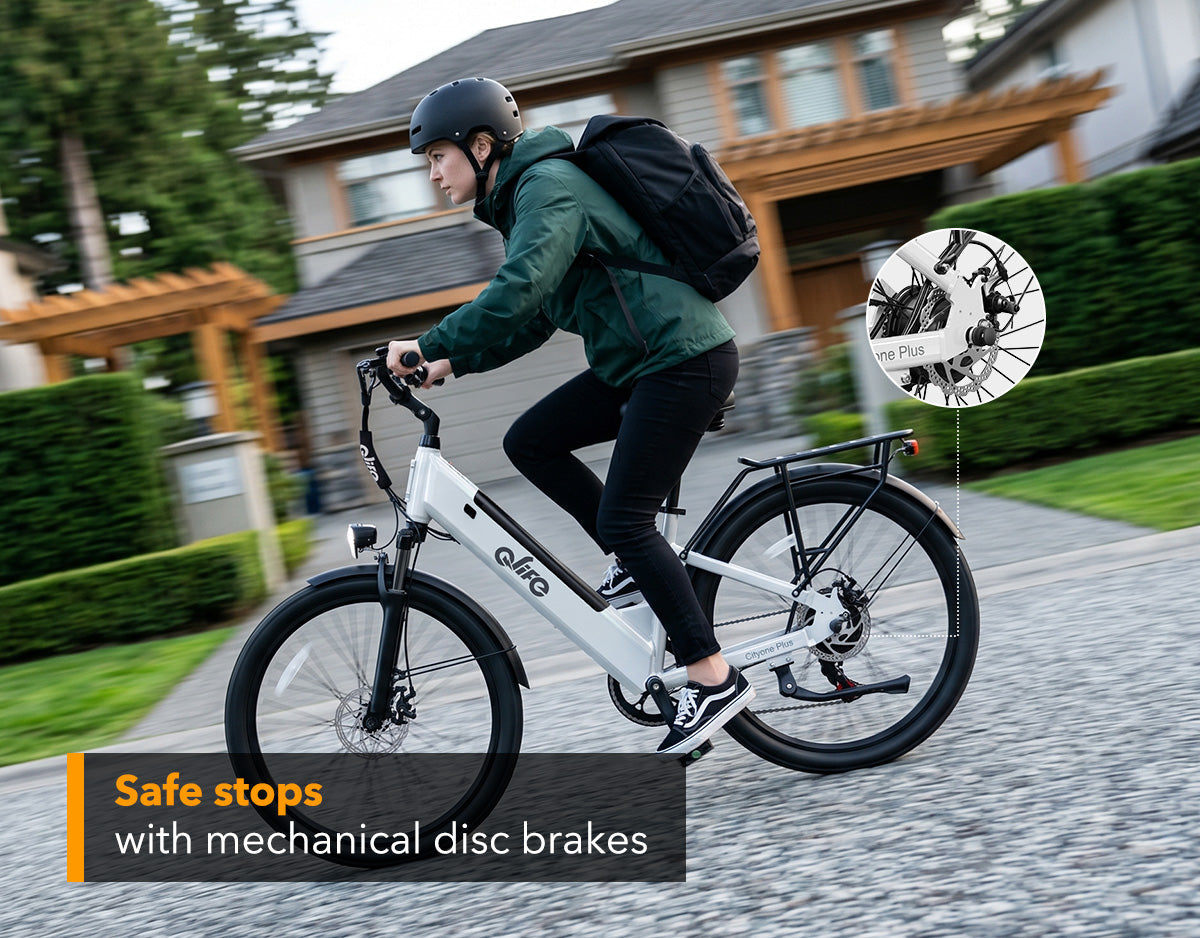
Buying a commuter e-bike isn’t like picking a bike to casually ride on the weekends. It’s got to get you from A to B reliably every day of the week. That means having enough range, carrying capacity, and comfort to be a suitable replacement for a car or public transport.
Most commuter e-bike buying guides focus solely on range. However, if the bike isn’t comfortable, suitable for challenging weather, or doesn’t fit the rider, it won’t be much use on a commute. Below, we take a closer look at what you actually need from a good commuter e-bike.

The Commuter E-Bike Buying Checklist
The best commuter e-bike is one that can complete the full round trip with a sensible battery reserve, carry what you need, and remain comfortable every day. Range matters, but so do the brakes, tires, storage, security, and how easily the bike fits into your routine.
Before buying, run through this commuter e-bike buying checklist:
1. Route. Record the complete round-trip distance, hills, surfaces, stops, and traffic conditions.
2. Range reserve. Make sure the battery can cover the journey under realistic conditions.
3. Fit. Check your height, inseam, reach, riding position, and access to both brake levers.
4. Brakes. Consider the complete load, hills, weather, and required hand pressure.
5. Tires. Check width, pressure range, puncture protection, and replacement availability.
6. Cargo. Add the rider, bags, lock, accessories, and anything else you regularly carry.
7. Visibility. Confirm suitable front and rear lights, reflectors, and side visibility.
8. Security and storage. Know where the bike will be locked and stored at both ends.
9. Charging. Confirm where, when, and how you can safely charge the battery.
10. Service. Check the warranty, replacement parts, local repair options, and likely downtime.
Start With Your Actual Commute
Calculate the Complete Round Trip
Start with the obvious figure: how far is it from your home to work or school? Then double it. A five-mile journey each way means your e-bike needs to cover at least ten miles.
However, the real distance might be longer. Include any regular diversions, such as:
· School drop-offs
· Shops and errands
· Detours to safer cycling routes
· Distance between the entrance and bike parking
· Trips made during lunch or between buildings
Record how many days you’ll ride each week as well. A bike used five days per week needs to be comfortable, reliable, and easy to maintain, not merely capable of completing the occasional journey.
Record the Route Conditions
Ten flat miles along a quiet bike path are very different from ten miles of hills, traffic, and repeated stops. Record:
· Total climbing and the steepest regular hill
· Number of traffic lights and intersections
· Typical traffic speed
· Road, bike-path, gravel, or mixed surfaces
· Headwinds and weather exposure
· Any sections ridden in poor light
Hills, cargo, headwinds, and frequent acceleration all increase the amount of energy required. They also affect the brakes, tires, gearing, and motor you’ll need.
Check Both Ends of the Journey
Finally, think about what happens before and after the ride. Can you store the bike securely at home? Will it fit through the doorway or inside the elevator? If there are stairs, can you safely manage the bike’s weight?
Complete the same check at work or school. Look for a fixed locking point, weather protection, and any rules about bringing e-bikes or batteries indoors. If you plan to charge during the day, confirm that charging is permitted and that a suitable outlet will always be available.
Calculate a Safe Range Reserve
The advertised range shouldn’t be the exact distance you need to travel. If your daily round trip is 30 miles, choosing a bike with a maximum claimed range of 30 miles leaves no room for hills, bad weather, cargo, or an aging battery.
Understand Battery Watt-Hours
Battery capacity is often listed in volts and amp-hours. You can convert these figures into watt-hours using:
Battery watt-hours = voltage × amp-hours
For example:
48V × 15Ah = 720Wh
Watt-hours tell you how much energy the battery stores. A larger figure generally provides more potential range, although it doesn’t tell you exactly how far the bike will travel. The motor, route, rider, and assistance level also matter.
Estimate the Actual Energy Requirement
Start with your complete round-trip distance, including any regular errands or detours. Then consider everything that could increase the amount of battery power you use:
· Higher assistance levels
· Frequent throttle use
· Faster riding
· Hills and repeated stops
· Rider and cargo weight
· Low tire pressure
· Headwinds
· Hot or cold temperatures
· Battery age
This is why two riders can get very different ranges from the same battery. A light rider using low assistance on flat roads may travel much farther than someone carrying cargo over steep hills.
Calculate the Range Reserve
Use the most realistic range estimate available rather than automatically relying on the highest advertised figure. Ideally, that means a documented test using a similar load, route, speed, and assistance level.
Then calculate:
Range reserve = conservative expected range − complete round-trip distance
If you expect the bike to cover 35 miles under your normal conditions and your round trip is 22 miles, you have a 13-mile reserve.
There’s no universal reserve percentage. The right margin depends on the route and the consequences of running out of charge. Workplace charging can increase your options, but don’t depend on it unless you know the outlet will always be available.
Read our guide to real-world e-bike range for a closer look at the factors affecting each charge.
Choose the Right Motor, Class, and Gearing
Hub Motors and Mid-Drive Motors
A hub motor sits inside one of the wheels and drives it directly. Hub motors are common on affordable commuter e-bikes and don’t send motor power through the bike’s gears.
A mid-drive motor sits around the cranks and applies power through the drivetrain. This allows it to use the bike’s gearing, which can be useful on steep hills. However, it also places more strain on the chain, cassette, and other drivetrain components.
Neither design is automatically better. The right choice depends on your route, budget, servicing options, and how much climbing you expect to do.
Torque, Starts, and Hills
Torque describes rotational force. You’ll notice it most when starting, accelerating, climbing, or carrying a heavier load. More torque can help the bike pull away more confidently, although it doesn’t determine performance by itself.
You also need to consider the complete load, gearing, controller, battery charge, traction, and gradient. Peak motor power can provide additional output for short periods, but a large wattage figure alone doesn’t prove that a bike will climb your regular hills comfortably.
Class 2 and Class 3 Commuting
Under the common US three-class system, a Class 2 e-bike can use a throttle to provide assistance up to 20 mph. A Class 3 e-bike generally provides pedal assistance up to 28 mph.
Class 3 can make sense for a longer commute where the route and local rules permit higher assisted speeds. However, faster isn’t always better. It can increase battery use, reduce reaction time, and place greater demands on the brakes and rider.
Rules vary by state, city, trail, campus, and land manager, so confirm where each class can be used before buying. For a closer comparison, read our Class 2 vs Class 3 e-bike guide.
Gearing Still Matters
Electric assistance doesn’t make the gears irrelevant. Lower gears help with hills, loaded starts, and riding when the battery is running low. They can also reduce the amount of work demanded from the motor.
Check that the bike provides a suitable range of gears for your route. Remember that an e-bike is usually much heavier than a conventional bicycle, making it harder to pedal if the battery becomes depleted.
Comfort and Fit for Repeated Daily Riding
A saddle can feel comfortable for five minutes and leave you aching after five miles. The same is true of the handlebars, grips, pedals, and riding position. When you’re using an e-bike every day, comfort needs to last for the entire journey.
Choose a Sustainable Riding Position
Start with your posture. You should be able to reach the handlebars without stretching your shoulders or placing too much pressure through your hands. Your elbows should remain slightly relaxed, while your knees shouldn’t interfere with the handlebars during tight turns.
An upright position can feel more relaxed and provide better visibility in traffic. A more forward position may suit faster or more active riding. Neither is automatically better. What matters is whether you can maintain the position comfortably throughout your commute.
Check that you can also reach both brake levers fully and place a foot down confidently when stopping.
Check the Contact Points
The saddle, grips, and pedals are where your body remains in contact with the bike. Small problems can become difficult to ignore when you repeat the same journey every day.
An oversized soft saddle isn’t automatically more comfortable. The right width, support, position, and pressure distribution matter alongside cushioning. Check the shape of the grips, the angle of your wrists, and whether the pedals support your feet comfortably.
Frame, Tires, and Suspension
A step-through frame can make mounting easier, especially when you’re wearing work clothes or carrying cargo. However, frame style doesn’t determine fit by itself. You still need to check the saddle range, reach, and control position.
Wider tires can add cushioning and grip, although they may increase rolling resistance. Suspension can soften poor road surfaces, but it also adds weight and maintenance. Choose these features based on the roads you actually ride rather than assuming more cushioning will always improve commuter bike comfort.
Brakes, Tires, Lights, and Weather Protection
A commuter e-bike needs to work when the roads are wet, the light is fading, and you’re carrying everything required for the day. Brakes, tires, lights, and weather protection might not be the most exciting features, but they make an enormous difference to everyday use.
Brakes
The two main options are mechanical and hydraulic disc brakes. Mechanical brakes use cables, while hydraulic brakes use fluid to transfer pressure to the calipers.
Hydraulic brakes generally require less hand pressure and offer finer control. However, brake type alone doesn’t determine stopping performance. The pads, rotors, tires, surface, maintenance, and complete load also matter.
Consider how the brakes feel during repeated stops and whether you can operate both levers comfortably. Hills, rain, traffic, and heavier cargo place greater demands on the braking system.
Tires and Puncture Protection
A puncture can turn a straightforward commute into a missed meeting or a long walk home. You can’t prevent every problem, but choosing the right tires and preparing for repairs makes them much easier to manage.
Check:
· Puncture protection. Look for reinforced tires or compatible liners and sealants.
· Tire pressure. Keep it within the manufacturer’s recommended range. Pressure that’s too low increases rolling resistance and the risk of damage.
· Tire condition. Check regularly for worn tread, cuts, cracking, or anything embedded in the rubber.
· Replacement availability. Make sure you can easily find the correct tires and tubes.
· Repair equipment. Carry the right tools, a spare tube or patch kit, and a suitable pump.
It’s also worth practicing a repair at home. Changing a tube for the first time is much harder when you’re standing beside the road in the rain.
Lights and Visibility
Integrated lights are particularly useful because they run from the main battery. Check for a front light, rear light, reflectors, and any side visibility provided by the tires or frame.
Some e-bikes also include a brake light. This can make your intentions clearer to other road users, although it doesn’t replace proper signaling or awareness.
Confirm that the lighting setup meets your local requirements. Built-in lights may improve visibility without necessarily providing everything required by law.
Fenders and Chain Protection
Full-length fenders help keep water and road spray away from you, your bags, and the bike’s components. They’re especially useful if you plan to commute throughout the year rather than only during dry weather.
A chain guard can stop trousers or loose clothing from contacting the drivetrain. Neither feature is essential for every rider, but both can make a commuter much easier to live with.
Cargo Capacity and Everyday Utility
Commuting rarely means carrying nothing. You might have a laptop, lock, lunch, spare clothes, groceries, or everything you need for the gym. Before choosing a bike, work out what you’ll actually carry.
Calculate the Complete Load
Your total payload includes more than your body weight. Use:
Total payload = rider + clothing + lock + bags + accessories + cargo
Compare this figure with the bike’s verified payload capacity. Then check the separate limits for the rack, basket, or other cargo equipment. A bike may support 350 lb in total while its rack supports considerably less.
Plan around the heaviest regular journey, not the days when you travel light.
Choose the Right Cargo Setup
Panniers keep weight lower and avoid placing everything on your back. Rear baskets are useful for groceries and larger items, while front baskets keep smaller belongings within reach. However, a heavily loaded front basket can affect steering.
Laptops and other electronics should be carried in a secure, padded, and weather-resistant bag. Child seats should only be fitted when the bike and rack are explicitly approved for them.
Check Loading Stability
It’s not enough for the cargo to remain below the bike’s payload capacity. It also needs to stay secure and avoid changing the handling too much.
Before setting off:
· Place heavier items low and close to the center of the bike.
· Balance panniers rather than loading everything on one side.
· Secure bags and loose items so they can’t move during the ride.
· Keep straps away from the wheels, chain, brakes, pedals, and spokes.
· Check that the rack, basket, and other accessories remain below their separate limits.
· Make sure the kickstand can support the loaded bike.
Complete a short test ride somewhere controlled. Practice starting, turning, and stopping before entering traffic. If the bike feels difficult to steer or the cargo shifts, adjust the load before continuing.
See our guide to electric bikes with a basket for more help choosing a practical carrying setup.
The Commute Reliability Scorecard
Score Each Candidate Out of 100
A commuter e-bike can look great on paper and still be wrong for your route. Use this scorecard to compare how well each shortlisted model handles your specific commute.
|
Category |
Weight |
What to assess |
Model one |
Model two |
Model three |
|
Range margin |
20 |
Ability to complete the round trip with reserve for hills, weather, cargo, and battery aging |
|
|
|
|
Braking |
15 |
Brake control, complete load, route gradients, and wet-weather use |
|
|
|
|
Puncture resilience |
10 |
Tire protection, suitable pressure range, and replacement availability |
|
|
|
|
Weather equipment |
10 |
Integrated lights, reflectors, fenders, and water-exposure guidance |
|
|
|
|
Cargo capacity |
10 |
Total payload, rack limit, loading stability, and suitable bags or baskets |
|
|
|
|
Storage practicality |
10 |
Bike weight, dimensions, stairs, folding, doorways, and elevators |
|
|
|
|
Security |
10 |
Suitable locking points, removable components, and parking exposure |
|
|
|
|
Charging access |
5 |
Removable battery, charging location, and workplace rules |
|
|
|
|
Serviceability |
5 |
Compatible parts, manuals, local servicing, and manufacturer support |
|
|
|
|
Downtime risk |
5 |
Tire, tube, battery, charger, and electrical part availability |
|
|
|
|
Total |
100 |
|
/100 |
/100 |
/100 |
Score each category from 0 to 5. A 5 fully meets the requirement, 4 has one minor compromise, 3 is usable with planning, 2 is a significant weakness, 1 is a poor fit, and 0 fails or cannot be verified.
Category result = category score ÷ 5 × category weighting
Fit, legal use, safe payload, and battery compatibility are non-negotiable. A high score cannot compensate for failing one of these requirements.
Compare Your Shortlisted Models
Only award points for published specifications or something you have actually verified. If a figure is missing, write unverified rather than assuming it will work. The highest score should be the bike that creates the fewest problems across your real daily routine.
Door-to-Desk Storage and Security Audit
A commuter bike has to work for the complete door-to-desk journey. That includes getting it out of your home, locking it at the destination, charging it where permitted, and bringing it back again. Use the audit below before buying.
|
Stage |
Question |
Yes or no |
Action required |
|
Home storage |
Is there a dry, secure place to keep the bike? |
|
|
|
Home access |
Does the bike fit through every doorway and corridor? |
|
|
|
Stairs |
Can you safely manage the bike’s full lifting weight? |
|
|
|
Elevator |
Does the complete bike fit inside the elevator? |
|
|
|
Battery |
Can the battery be removed without breaking any manual instructions? |
|
|
|
Home charging |
Is there a suitable permitted charging location? |
|
|
|
Daily handling |
Can you walk and maneuver the bike while it is loaded? |
|
|
|
Destination parking |
Is secure parking available at work or school? |
|
|
|
Locking point |
Can the frame be locked to a fixed anchor? |
|
|
|
Theft exposure |
Is the parking area visible, monitored, or access-controlled? |
|
|
|
Workplace rules |
Are e-bikes and removable batteries allowed indoors? |
|
|
|
Workplace charging |
Is charging explicitly permitted? |
|
|
|
Vehicle transport |
Can the vehicle rack support the bike’s actual weight? |
|
|
|
Rack compatibility |
Are the tire width, wheelbase, frame, and attachment points compatible? |
|
|
|
Alternative transport |
Can you get home if the bike becomes unusable? |
|
|
Home Storage
For apartment storage, measure the route from the street to where the bike will live. Check doorways, corridors, elevators, and stairs. A folding frame can save space, but it does not make a heavy bike easy to carry. If you remove the battery for charging, follow the manual.
Workplace or School Storage
Run the same check at work or school. Look for a fixed anchor, weather protection, and enough room to lock the frame rather than only a wheel. If charging is part of the plan, confirm it is explicitly permitted.
Transport and Daily Handling
Check the complete bike weight, folded dimensions, tire width, wheelbase, and any vehicle-rack capacity. If the commute includes stairs or public transport, make sure you can maneuver the bike while it is loaded, not only when the bags are empty.
Security Plan
Plan your e-bike security before the first commute. Use a suitable bike lock through the frame and a fixed anchor, then secure removable components where necessary. Registration, tracking, and insurance may also make sense for a higher-value bike.
Weekday Commute vs Weekend Ride Tradeoffs
|
Feature |
Weekday advantage |
Weekend advantage |
Main tradeoff |
|
Narrower efficient tires |
Lower rolling resistance |
Less cushioning on loose surfaces |
Surface versatility |
|
Fat tires |
Comfort and traction |
Better suited to loose ground |
Added weight and resistance |
|
Full suspension |
Comfort on damaged roads |
Better bump absorption |
Weight and maintenance |
|
Folding frame |
Easier storage |
Easier vehicle transport |
Hinge, weight, and frame compromises |
|
Rack and fenders |
Strong daily practicality |
Useful for picnics or touring |
Additional weight |
|
Commuter motor tuning |
Smooth, efficient assistance |
May feel less aggressive recreationally |
Efficiency versus response |
A bike that works brilliantly Monday to Friday may not be your first choice for the weekend. Narrower tires and a lighter frame usually improve efficiency, while fat tires and full suspension can add comfort and grip on rougher routes at the cost of weight and rolling resistance.
A mixed-use bike makes sense when your weekend riding is reasonably close to the weekday commute in distance and surface. If it involves much rougher terrain, a dedicated commuter can keep the everyday bike lighter and easier to store.
If you are considering wider tires for both uses, read our guide to fat-tire e-bikes for commuting.
Frequently Asked Questions
How far should a commuter e-bike be able to travel?
It should cover the complete round trip with enough reserve for your hills, weather, cargo, detours, and battery condition. Do not choose based on the one-way distance alone.
Can I commute by e-bike in the rain?
Yes, if the model is designed for normal wet-weather use and you follow the manufacturer’s guidance. Rain can reduce traction and braking performance, so ride more cautiously. See Qlife’s guide to riding an electric bike in the rain for more detail.
Should I charge my e-bike at work?
Only if your workplace permits it and you can use the manufacturer-approved charger in a suitable location. Do not make the commute depend on workplace charging unless access is reliable.
How do I protect a commuter e-bike from theft?
Lock the frame to a fixed anchor rather than securing only a removable wheel. Choose visible or access-controlled parking where possible, secure removable components, and consider registration, tracking, or insurance according to the risk.
Is a Class 3 e-bike better for commuting?
Not automatically. A Class 3 e-bike can suit a longer road commute, but only where the route and local rules allow it. Higher speeds also place greater demands on braking and rider confidence. The right class is the one that suits both your journey and the rules for the route.
How much maintenance does a commuter e-bike need?
It depends on mileage, weather, load, and the components. Regularly check tires, brakes, drivetrain, fasteners, wheels, lights, and visible electrical connections. High-mileage commuters or bikes ridden through rain and road salt usually need attention sooner.
Share:
Electric Trike Buying Guide for Seniors and Limited Mobility
Best Qlife E-Bikes Under $1,000 for Commuting and Weekend Riding