
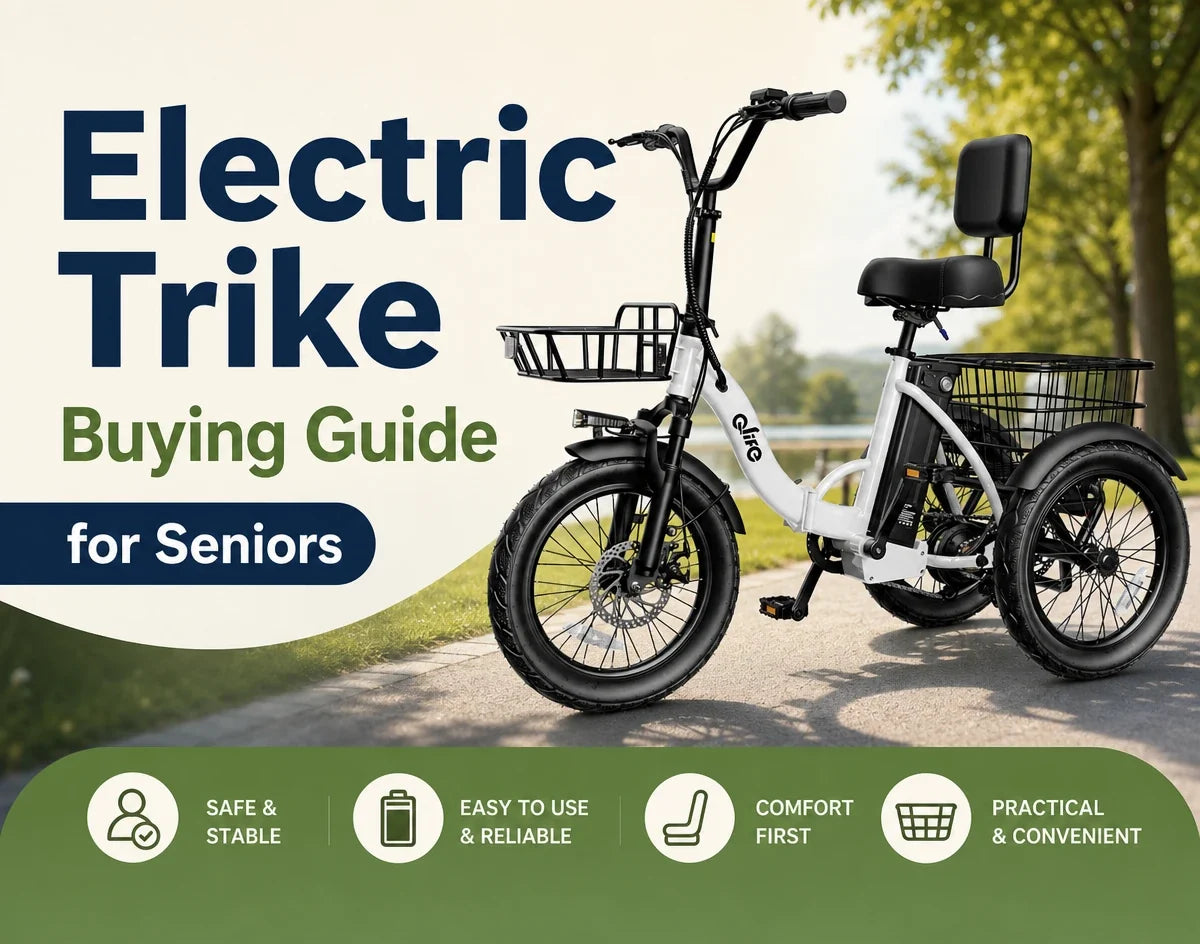
An electric trike buying guide for seniors should begin with access and control, not a giant motor number. Three wheels can make low-speed riding feel less demanding, but a trike still has steering, braking, turning, charging, and storage decisions to get right. I would rather see a rider practice a broad turn in a quiet parking lot than buy a machine based on the word "stable" in a product headline.
The short answer: an electric trike can be a good fit for a senior rider who wants seated support, cargo space, and less low-speed balance work. It is not a cure for every mobility or vision problem, and it is not automatically safer at every speed or on every slope. The right choice depends on mounting, control reach, turning confidence, route conditions, and who will help with charging and maintenance.

This is general buying information, not medical advice. If a rider has recent falls, fainting, major vision changes, difficulty standing from a chair, or uncertainty about transfers, ask a qualified clinician or occupational or physical therapist whether a supervised trike trial makes sense.
Quick Picks Before You Shop
Use this table to decide what to measure and test first. Qlife models are examples to investigate, not independent test winners.
| Rider situation | Prioritize first | Qlife example to investigate |
|---|---|---|
| Wants the easiest two-wheel-free start | Low step-through, back support, parking brake, and reachable controls | Triker 2.0 lists a low step-through frame, adjustable backrest, parking brake, and 18 x 3.0 tires. |
| Wants more tire cushion and cargo capacity | Tire width, seat support, suspension, total payload, and storage width | Triker Plus lists 20 x 4.0 tires, front and seatpost suspension, 500 lb maximum total payload, and a backrest seat. |
| Has to climb stairs or lift into a high vehicle | Actual carry weight and loading height | Triker 2.0 is listed at 97 lb; Triker Plus is listed at 108 lb. Neither is a casual stair-carry machine. |
| Needs a daily caregiver workflow | Parking routine, charging location, route, and service plan | Choose the model the rider and helper can secure, charge, and inspect consistently. |
| Plans trunk or RV transport | Complete folded dimensions, opening width, tie-down points, and loading height | Triker 2.0 lists a 31.5 in folded length but not a complete folded envelope. Triker Plus has no verified folded dimensions in the reviewed data. |
Electric Trike Buying Checklist for Seniors
Before comparing the best electric trike for seniors, answer these questions:
A three wheel electric bike for seniors should pass this practical checklist before price or peak wattage enters the conversation.
- Access: Is the frame genuinely low enough for the rider to step through without twisting or swinging a leg high?
- Fit: Can the rider reach the pedals, brake levers, display, and any throttle while sitting back in the seat?
- Seat support: Does the saddle and backrest support the rider without making it hard to stand up or transfer off?
- Controls: Are the display, assist buttons, throttle, and lights easy to see and operate with the rider's hands?
- Braking and parking: Can the rider squeeze the brake levers and set the parking brake before moving?
- Turning: Can the rider make a slow, wide turn without drifting toward a curb or lifting an inside wheel?
- Payload: Does the listed electric trike weight capacity cover the rider, cargo, baskets, and accessories together?
- Battery and range: Is there a realistic charging spot, and is the advertised range enough with hills, wind, and throttle use?
- Storage and transport: Can the household move and secure the trike without a risky lift?
- Assembly and service: Who will complete setup, adjust the bike, source parts, and handle a flat or brake problem?
For category context, see Qlife's guide to three-wheel electric bikes for seniors. A trike is useful when it solves a specific daily problem. It is not a magic balance button.
Qlife Triker models at a glance

The figures below are manufacturer-listed specifications transcribed from Qlife product data captured August 22, 2026. Verify the current product page and manual before purchase. The editorial tools in this article are worksheets, not Qlife lab tests.
| Model | Listed weight | Motor and battery | Tires, speed, and range | Listed payload and other notes |
|---|---|---|---|---|
| Triker 2.0 Folding 3-Wheel Electric Bike | 97 lb | 350W rated motor, 1200W peak; 48V 10.4Ah battery | 18 x 3.0; 18 mph; advertised up to 55 miles | 400 lb maximum total payload; 120 lb rear-rack capacity; Class 2; IPX5 |
| Triker Plus Folding 3-Wheel Electric Bike | 108 lb | 500W rated motor, 1200W peak; 48V 13Ah battery | 20 x 4.0; 20 mph; advertised up to 65 miles | 500 lb maximum total payload; 120 lb rear-rack capacity; Class 2; IP54 |
Qlife lists front and rear cargo options for both models. Treat total payload as rider plus cargo, not as a promise that the rear rack alone can carry that amount.

What an Electric Trike Can and Cannot Solve
An electric trike for limited mobility can reduce the amount of balance work needed at a stop and at walking pace. The rider has a broad three-wheel footprint, a seated position, and electric assistance for starts and hills. A backrest can make longer errands less tiring, and front or rear cargo space can eliminate the awkward backpack shuffle.
That help has limits. A trike does not decide when a car is approaching, make poor vision disappear, or guarantee that a rider can brake in time. It also does not remove the need to steer around a driveway lip, a sloped road, a pothole, or a crowded path. Three wheels stay upright when stopped, but a fast or abrupt turn can unload an inside wheel. The wider the rear axle and the higher the load, the more important smooth steering and moderate speed become.
The rear differential on Qlife's Triker models is designed to let the two rear wheels rotate at different speeds in a turn. That can reduce tire scrub and make cornering feel less stubborn than a rigid axle. It does not override cornering forces. Slow before the turn, keep cargo low, and do not yank the handlebar to correct a line at the last second.
An electric trike is also not a wheelchair or a substitute for a transfer aid. If the rider cannot safely sit, reach the controls, or stand clear of the trike when dismounting, the problem is fit and transfer safety, not motor power. A helper or clinician should be part of that decision.
Step-Through Access, Fit, and Seating
The best step through electric trike is the one a rider can approach, stop, mount, and leave without a wrestling match. Start with the parking brake set. The rider should walk the trike from the side, place one hand on a stable handlebar area, and step through the opening without twisting around a high top tube.
Triker 2.0's product data specifically lists a low step-through frame, an oversized seat, an adjustable backrest, and a parking brake. Those features may help a rider who has limited hip range or reduced balance confidence, but the rider still needs to try the actual transfer. Triker Plus lists an extra-wide comfort seat with backrest support, but confirm the current frame height and the rider's preferred transfer method before ordering.
Set the saddle so the rider reaches the pedals with a slight bend in the knee, not locked legs and not a cramped hip angle. The rider's feet should have a predictable place to land at a stop. If the seat is too high, mounting becomes a climb. If it is too low, the knees and hips may complain before the battery does.
Check the handlebar reach from the backrest. A rider who must lean forward to squeeze the brakes will have less control when tired. Look for relaxed elbows, a clear view of the display, and brake levers that do not require painful grip strength. Mirrors and lights can help visibility, but they cannot replace a clear head turn and a safe route.
Watch the dismount as closely as the mount. The rider should set the parking brake, stop the motor, place both feet securely, and step away without the trike rolling. If the rider needs to pull hard on the bar, loses balance while pivoting, or cannot stand long enough to clear the pedals, stop the trial and ask for professional fit advice.
Electric Trike Safety: Controls, Throttle, Brakes, and Parking
Controls should be boring in the best possible way. The rider should know which lever stops the trike, which button changes assist, and how to shut the system down without searching for tiny symbols.
Triker Plus product data lists a twist throttle, multi-function LCD display, front headlight, rear brake light, and disc brakes. Triker 2.0 lists an LCD display, front and rear lighting, disc brakes, and a parking brake. If the rider uses pedal assist, make sure the assist buttons are readable and easy to change. Do not assume every control is identical across model years or configurations. Ask for the current manual and let the rider operate the controls while stationary.
Practice this starting sequence:
- Sit fully back and place both feet where they will not catch the ground or pedals.
- Release the parking brake only when the rider is ready to move.
- Start in the lowest assist setting.
- Keep the handlebar straight and use a gentle pedal input or throttle input, if equipped.
- Cover the brake levers and stop after a short, straight roll.
A throttle can be helpful when a rider wants a controlled start or a break from pedaling. It can also surprise someone who rests a hand on the grip and twists it. Keep hands neutral until the rider understands the response. Reverse, if a particular configuration offers it, should be treated as a low-speed maneuvering aid. Verify that feature instead of assuming it is included.
Use the parking brake every time the rider pauses to load a basket, talk to a helper, or mount and dismount. A stopped trike that is not secured can roll away on a mild slope. Check brake lever effort, pad condition, rotor noise, and cable routing after transport.
Stability, Turning, and Road Camber
Electric trike stability is strongest when the rider respects the trike's width and turning behavior. A two-wheel bicycle leans into a turn. A trike stays mostly upright, so the rider must manage speed and steering more deliberately.
Practice broad turns in an empty, flat area. Mark a circle with cones or chalk and approach it slowly. The rider should look through the turn, keep both hands steady, and avoid a sudden bar yank. A tight turning radius is useful in a driveway, but it can tempt a rider to turn sharply at too much speed.
Road camber matters. A street that slopes toward the gutter can pull the trike sideways. A driveway transition can lift one wheel or make the handlebar feel oddly light. Cross slopes, curb cuts, gravel, wet leaves, and potholes deserve lower speed and a straighter approach. If a rear wheel starts to feel light, stop correcting aggressively. Slow down and straighten the trike when there is room.
Keep heavy bags low and centered. A tall load behind the seat raises the center of gravity and can make a turn feel top-heavy. Do not hang a heavy bag from the handlebar unless the manual specifically allows it. It can affect steering and make the front end harder to control.
The rear differential on Triker 2.0 and Triker Plus is a useful design feature for turns, but it is not a permission slip for speed. The rider should finish braking before the tightest part of a corner, keep the inside line clear of obstacles, and leave extra space around pedestrians and parked cars.
Payload, Cargo, Range, and Hills
Electric trike weight capacity means the complete moving load. Add the rider, groceries, baskets, tools, locks, and any mobility equipment before comparing the number in a listing.
Qlife lists Triker 2.0 at a 400 lb maximum total payload and 120 lb rear-rack capacity. Triker Plus is listed at a 500 lb maximum total payload and 120 lb rear-rack capacity. The larger total number on the Plus does not turn the rear rack into a 500 lb platform. A cargo basket still needs a sensible load, a secure lid or strap, and enough clearance from the rider's legs. Keep cargo secured, distribute it between approved areas, and follow the current manual.
Triker 2.0 uses 18 x 3.0 tires and is listed with a 350W motor, 1200W peak output, 48V 10.4Ah battery, and an advertised range of up to 55 miles. Triker Plus uses 20 x 4.0 tires and is listed with a 500W motor, 1200W peak output, 48V 13Ah battery, and an advertised range of up to 65 miles. Those ranges are manufacturer claims. Hills, rider weight, wind, temperature, tire pressure, assist level, and throttle use all change the result.
The Plus's wider tires and dual suspension may suit riders who value a softer feel over broken pavement, while the 2.0's smaller tires and lower listed weight may be easier to place in a garage. Neither model is light at 97 or 108 lb. If a caregiver must lift the trike into a vehicle, measure that loading task before comparing range.
For hills, preserve battery reserve and avoid asking for a hard restart halfway up a steep slope. Use a low gear or steady assist where available, keep the rider centered, and stop if the motor, brakes, or rider feels overheated. A trike that can move a heavy load is still governed by traction, braking distance, and the rider's ability to control it.
Senior Rider Fit and Transfer Assessment
This Senior Rider Fit and Transfer Assessment is an editorial worksheet, not a medical test or a Qlife test result. Use a helper in a traffic-free area. Score each checkpoint as 0, 1, or 2:
- 0: independent and repeatable.
- 1: safe only with a helper, adjustment, or extra time.
- 2: stop and reassess before riding.
| Checkpoint | What to observe | Score |
|---|---|---|
| Approach | Rider can walk up, align, and reach a stable grip | |
| Parking brake | Rider can set and confirm it before transfer | |
| Mounting | Rider steps through without twisting, catching a pedal, or pulling hard | |
| Seat position | Feet and hips feel supported; rider can stand clear | |
| Control reach | Brake levers, display, lights, and assist controls are visible and reachable | |
| Start | Rider moves smoothly in low assist without a panic grab | |
| Straight stop | Rider can stop in a planned line using the brakes | |
| Broad turn | Rider can turn both directions without rushing or drifting | |
| Dismount | Rider stops, sets the brake, and exits without the trike rolling | |
| Walk and park | Rider or helper can move and secure the trike when powered off | |
| Emergency stop | Rider can identify the stop controls and use them calmly |
Interpret the total conservatively:
| Total | Decision |
|---|---|
| 0-4 | Promising for independent practice, with normal supervision |
| 5-10 | Potentially workable with a helper, route limits, or fit changes |
| 11-22 | Do not plan independent riding yet; get professional input and reassess |
Any score of 2 in parking brake, control reach, straight stopping, emergency stopping, or transfer is a stop sign even if the total looks acceptable. A rider does not fail this worksheet. The worksheet tells you what needs attention.
Home, Route, Caregiver, and Service Audit
The second useful test happens before the first ride. Walk the household workflow from delivery to daily use and write down the bottleneck.
| Area | Questions to answer | Pass condition |
|---|---|---|
| Door and storage width | Can the trike clear the narrowest doorway and turn into its storage spot? | Measure the opening and the tightest turn, not just the destination. |
| Charging | Is there a dry outlet where the trike or confirmed removable battery can be charged? | The rider or caregiver can charge without blocking a walkway. |
| Route | Are there slopes, cambered roads, driveway lips, rough crossings, or traffic exposures? | The planned route has a slower alternative and a safe stopping place. |
| Transport | Can the household load and secure the trike without lifting beyond its ability? | Use a ramp or a different vehicle plan when needed. |
| Caregiver checks | Who checks tires, brakes, lights, latch, battery, and parking position? | One named person owns the checklist. |
| Assembly | Who will complete final setup and confirm the controls? | A capable adult or technician follows the current manual. |
| Service access | Can you obtain the correct charger, battery, brake parts, and technical help? | Manufacturer contact and a local repair option are written down. |
| Emergency plan | Who gets called if the rider stops, feels unwell, or has a mechanical issue? | Phone, ID, emergency contact, and route details are available. |
Qlife product pages list a one-year manufacturer's warranty for the original owner, with accessory exclusions. Treat that as a starting point for service planning, not a substitute for reading the current warranty terms. The Triker 2.0 and Triker Plus product data also include chargers, keys, tools, and manuals, but final setup is still a real task. Do not hand a 97 or 108 lb trike to a caregiver and call the assembly problem solved.
For a home audit, score each row as 0 ready, 1 needs a plan, or 2 a blocker. Any blocker in storage width, charging, transport, or emergency response deserves attention before purchase. This is where a caregiver can save a rider from a frustrating and unsafe routine.
Electric Trike vs Two-Wheel E-Bike
An electric trike usually asks less of the rider's low-speed balance and offers a stable seat plus more cargo space. A two-wheel e-bike is narrower, often easier to thread through a doorway, and leans naturally through a turn. It also demands more balance at stops and during slow maneuvers.
| Decision point | Electric trike | Two-wheel e-bike |
|---|---|---|
| Mounting | Step-through access can be easier | Depends on frame height and balance |
| Low-speed balance | Broad footprint helps when stopped | Rider must balance the bike |
| Turning | Wider and more deliberate; slow before corners | Narrower and more natural for leaning turns |
| Storage width | Usually the harder fit | Usually easier in hallways and racks |
| Cargo | Front and rear baskets or racks are common | Capacity varies by frame and rack |
| Learning curve | Controls and turning still require practice | Balance and starts may be harder for some riders |
| Transport | Often heavier and harder to lift | More options for vehicle racks and stairs |
Read Qlife's electric trike vs electric bike comparison, then decide whether the rider's real priority is balance confidence, narrow storage, cargo, or transport. A trike is not automatically the right answer just because it has three wheels.
How to Conduct a Safe First Test Ride
The first ride should be a controlled lesson, not an outing. Choose a flat, traffic-free area with a helper, a helmet, closed shoes, and enough room for broad turns. Keep the phone away and the audience small. Nobody needs a grand opening ceremony for a parking-lot practice session.
Use this sequence:
- Walk beside the powered-off trike and practice steering, parking, and the emergency stop control.
- Set the seat and backrest. Confirm the rider can reach both brake levers without leaning forward.
- Mount with the parking brake engaged and both feet secure.
- Start in the lowest assist setting. Use a gentle pedal or throttle input, if equipped.
- Roll straight for a short distance, cover the brakes, and stop on command.
- Repeat the stop from a slightly higher walking pace. Do not chase top speed.
- Practice wide left and right turns, then a slow approach to a marked stopping point.
- Add a mild driveway transition or gentle slope only after flat-ground control is repeatable.
- Dismount, set the parking brake, and walk the trike back to storage.
Stop the session if the rider cannot reach a brake, panics at throttle response, drifts into a hazard, lifts a wheel, reports pain or numbness, becomes unusually fatigued, or cannot remember the parking sequence. A helper should never grab the handlebar suddenly while the trike is moving. Give a clear verbal cue, then let the rider slow down.
After practice, inspect the tires, brakes, lights, cables, and frame. Keep the battery and charging area dry. The CPSC Micromobility Information Center advises using the supplied or recommended charger, staying present while charging, and unplugging when finished. Follow the current Qlife manual for battery storage and charging.
For additional beginner practice, see how to ride an electric bike for beginners. The controls differ, but the habits carry over: look ahead, brake early, and leave room.
Frequently Asked Questions
Are electric trikes safer for seniors?
They can reduce low-speed balance demands, but they do not remove turning, braking, traffic, or transfer risks. Safety depends on fit, supervision, route, speed, and practice.
Do you need balance to ride a senior electric tricycle?
You need less balance than on a two-wheel e-bike, but you still need enough trunk, arm, and attention control to steer, brake, mount, and dismount. A supervised trial is the honest test.
What is the best electric trike for seniors?
The best model is the one the rider can mount, control, store, and charge consistently. Triker 2.0 may suit riders who value a lower listed weight, 18 x 3.0 tires, a low step-through frame, and a listed parking brake. Triker Plus may suit riders who want 20 x 4.0 tires, dual suspension, and a higher listed payload, provided its 108 lb weight fits the household workflow.
Can an electric trike climb hills?
Electric assist can help with hills, but no listing guarantees every slope or load. Use battery reserve, keep cargo within the total payload, approach a hill with control, and stop if traction, heat, or braking confidence drops.
How much does an electric trike weigh?
Qlife lists Triker 2.0 at 97 lb and Triker Plus at 108 lb. Those weights make vehicle loading and storage planning important. Neither is a casual carry upstairs.
Will a folding electric trike fit in a car trunk?
Do not assume it will. Triker 2.0 lists a 31.5 in folded length but not a complete folded width and height. Triker Plus has no verified folded dimensions in the reviewed data. Measure the opening, the cargo floor, and the loading route with the actual trike.
Do electric trikes need a license?
Rules vary by state, city, trail, and vehicle classification. Qlife lists both Triker models as Class 2, but confirm local speed, helmet, sidewalk, road, and registration rules before riding.
Can seniors with limited mobility ride an electric trike?
Some can, especially when step-through access, seat support, control reach, and a helper plan match their abilities. This article cannot determine individual fitness to ride. Use the transfer assessment and seek professional input when safety is uncertain.
Final Buying Advice
Buy the trike that solves the rider's hardest daily task. If that task is mounting and low-speed confidence, focus on step-through access, seat support, parking, and controls. If it is cargo and rough pavement, compare tire size, suspension, brakes, payload, and route width. If it is transport, start with the lift and tie-down plan. The battery range comes after those basics.
Qlife Triker 2.0 is the lighter of these two listed options at 97 lb and adds a low step-through frame, 18 x 3.0 tires, a rear differential, front suspension, a backrest seat, a parking brake, and a listed 400 lb maximum total payload. Triker Plus is listed at 108 lb and adds 20 x 4.0 tires, dual suspension, a 500 lb maximum total payload, and an advertised range of up to 65 miles. Neither should be treated as effortless to lift, universally trunk-friendly, or automatically safe without practice.
For the wider purchase process, read Qlife's electric bikes with a basket guide and how to choose an electric bike. Then open the current Triker 2.0 or Triker Plus page with your home and transfer worksheets beside you.
Share:
E-MTB Suspension Setup: Sag, Rebound, and Rider Weight