
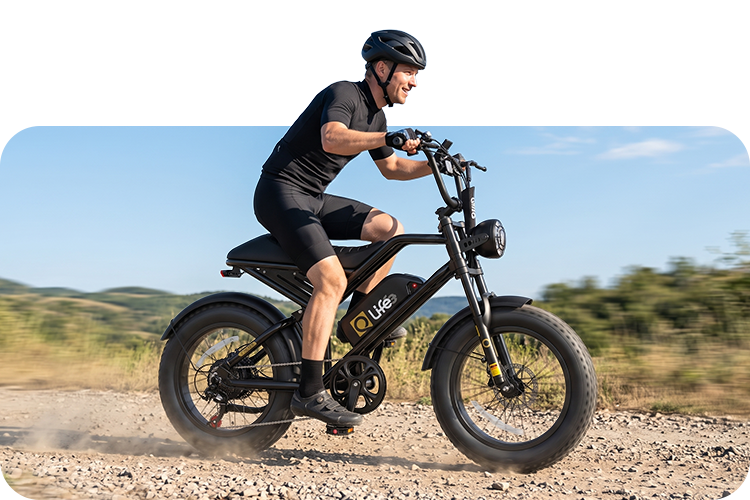
Nobody wants to buy an e-bike advertised for 60 miles of range and discover that their normal ride drains the battery after 30. That can leave you miles from home, forced to pedal the heavy bike up hills and through traffic. Not fun!
The confusion often comes from the difference between the ‘advertised range’ and the ‘real range.’ The advertised range isn’t necessarily false. It’s just determined under favorable conditions that may not resemble the buyer’s commute.
So, how do you know how much range an under-$800 e-bike has? How can you calculate e-bike range in real-world conditions or compare two different batteries? We’ve answered all your questions below.
Start With the One Formula That Actually Helps
Batteries are the basis for range. All other things being equal, the more energy your battery stores, the further your bike will go. But manufacturers don’t always advertise their batteries in the same way. Some talk about volts and amp-hours, others about watt-hours.
What’s the difference? Here’s a quick overview of the terms:
|
Specification |
What it describes |
What it helps you understand |
What it cannot tell you alone |
|
Volts |
Electrical-system voltage |
Power-system configuration |
Battery capacity or mileage |
|
Amp-hours |
Stored electrical charge |
Relative size at the same voltage |
Fair comparisons across voltages |
|
Watt-hours |
Total stored energy |
Battery-capacity comparison |
Guaranteed real-world range |
The main thing to understand is that volts, amp-hours, and watt-hours aren’t separate. They’re related. You can calculate watt-hours by multiplying volts and amp-hours:
Volts × amp-hours = watt-hours
This is important. Two batteries might have different volts and amp-hours, making comparisons extremely difficult. By only using watt-hours, you get an accurate comparison. Just remember that if the e-bike is heavier, it means that a bigger battery capacity won’t necessarily translate to greater range.
Advertised Range Is a Best-Case Story, Not Your Commute
Brands are in a difficult spot. They’ve got to provide an estimate of the range of an e-bike. However, they can’t assume everyone’s daily commute involves a heavier rider, lots of cargo, and endless hills.
That’s why they ride the e-bike under optimum conditions: lightweight rider, moderate assist, flat roads.
It’s actually quite useful. It gives you the maximum range you can expect from an e-bike. However, you should always assume that you’ll get less range than is advertised.
Here are the factors that can reduce your range:
- Pedal-assist level
- Throttle use
- Average speed
- Rider and cargo weight
- Hill frequency and gradient
- Headwinds
- Stop-and-go riding
- Tire width and pressure
- Road or trail surface
- Temperature
- Battery age
- Brake or drivetrain drag
For example, Qlife has lots of e-bikes under $800 that promise exceptional range.
The Spark Moped-Style e-bike can cover up to 75 miles on a single charge. But the e-bike also has a powerful motor, fat tires, and a dual suspension system designed for off-road riding. If you increase the support level, ride over difficult terrain, or carry a heavy backpack, that range will decline.
Volts Tell You How the Electrical System Operates
Think of voltage as electrical pressure. It describes the force available to push electrical current from the battery through the e-bike’s system. Higher voltage can support strong power delivery when matched with the controller and motor. Batteries, chargers, controllers, and motors must be designed for the same voltage system.
Common e-bike systems include 36V, 48V, and 52V. Most Qlife e-bikes use 48V batteries. But voltage isn’t the whole story. A 48V 10Ah battery has less capacity than a 36V 20Ah battery despite its higher voltage.
That’s why you’ve got to consider volts in its full context.
Amp-Hours Need the Voltage Beside Them
Amp-hours is the other part of the equation. It’s the amount of electrical energy the battery can deliver over time.
Like voltage, amp-hours cannot be considered in isolation. If the voltage is the same, a 15Ah battery is larger than a 10Ah battery. But if voltage differs, it can make comparison difficult.
For example:
- 36V × 15Ah gives 540Wh.
- 48V × 15Ah gives 720Wh.
Product pages often emphasize amp-hours because the number is simple and familiar. However, shoppers should always look for the voltage as well.
Watt-Hours Let You Compare Batteries Properly
Watt-hours is the full picture. It details the total amount of energy available from the battery, combining volts and amp-hours.
Here’s an example of some batteries from the Qlife collection. You can see how much the capacity can change.
|
Battery |
Capacity |
|
48V 10.4Ah |
499Wh |
|
48V 13.5Ah |
648Wh |
|
48V 15Ah |
720Wh |
|
48V 15.6Ah |
749Wh |
|
48V 20Ah |
960Wh |
You might be wondering why this matters so much. Converting everything to watt-hours helps compare one battery to another. Bigger batteries generally give you more range or compensate for an e-bike's heavier weight.
But bigger batteries aren’t always an advantage. They cost more, weigh more, and take longer to charge. Plus, if they’re combined with a more powerful motor, it’ll consume energy faster.
Turn Battery Capacity Into a Realistic Mileage Plan
Once you know the battery’s watt-hour capacity, you can make a rough estimate of how far it might take you:
Estimated range = battery watt-hours ÷ expected watt-hours per mile
The difficult part is choosing a realistic energy-use figure. The following numbers are broad planning assumptions, not manufacturer guarantees:
|
Riding scenario |
Planning consumption |
Typical conditions |
|
Efficient |
10–15Wh per mile |
Low assist, active pedaling, flat paved routes |
|
Mixed |
15–22Wh per mile |
Moderate assist, ordinary hills and stop-start commuting |
|
Demanding |
22–30+Wh per mile |
Throttle use, higher speeds, cargo, steep hills or fat tires |
Take a 720Wh battery as an example:
- At 12Wh per mile, it could provide around 60 miles
- At 18Wh per mile, it could provide around 40 miles
- At 25Wh per mile, it could provide around 29 miles
That broad spread explains why one advertised range figure cannot predict what every rider will experience. Qlife’s existing battery guide suggests that e-bikes may consume roughly 10–20Wh per kilometer, but even that is only a general range. Different bikes, riders, and routes can produce very different results.
For commuting, avoid planning around the absolute maximum:
- Calculate your complete round trip.
- Add any regular errands or detours.
- Add a 30–40% reserve.
- Compare the total with the conservative estimate, not the best-case figure.
That reserve gives you room for headwinds, hills, cold weather, and gradual battery aging. It also means you are not relying on draining the battery to exactly zero just to make it home.
Match Your Range Buffer to the Way You Ride
What’s your normal commute? How do you like to ride? Do you just want an e-bike for a weekday commute, or will you take it out on the trail at the weekends? Each of these questions helps narrow down what kind of battery you need.
Consider these scenarios:
Short Commute
A daily commute of 3–8 miles is unlikely to require the largest available battery. In fact, the added weight and lengthy charge times might prove more of a negative than a plus.
Campus Riding
Frequent short trips involve repeated stops and acceleration. That can use up more power than you’d think. A moderate battery size might be beneficial, depending on secure parking and removable charging.
Errands
Bags, baskets, and repeated low-speed starts increase consumption. Calculate range using the loaded bike, not an empty recreational ride.
Weekend Recreation
Weekend riding can be difficult to calculate. Always err on the larger side to ensure you’ve got enough power. Consider whether you’re just riding around the shops, picking up items, or heading onto a trail.
Heavier Rides and Hill Routes
Opt for a more conservative calculation if you’re riding up hills or weigh on the larger side. It’s better to get a bigger battery than find yourself stuck without charge.
The Same Battery Travels Differently on Different Bikes
Batteries aren’t the only thing determining range. The same battery might give up to 70 miles on a lightweight, narrow tire commuter bike, but struggle to hit 40 miles on a fat tire, heavier frame model.
That’s where you’ve got to make a decision about priorities.
There are a few different options to consider:
- City commuter: Efficient tires and pavement-focused geometry generally use energy more economically.
- Folding bike: Smaller wheels and compact dimensions aid storage, although the bike may still be heavy.
- Fat-tire bike: Wider tires improve cushioning and traction but usually create more rolling resistance.
- Moped-style bike: Higher speeds, greater weight and throttle-heavy riding can increase consumption.
- Trike: Additional weight, three contact patches and cargo can reduce range.
Qlife offers a range of different e-bike models for under $800 in each of these categories. We match the right battery to each model, prioritizing range, power, or compensating for the added weight.
Here’s an overview of the models, battery, and capacity:
|
Model |
Battery specification |
Capacity |
Best for |
|
48V 10.4Ah |
499Wh |
Short commutes and paved city routes |
|
|
48V 10.4Ah |
499Wh |
Stability, local errands and light cargo |
|
|
48V 13.5Ah |
648Wh |
Folding storage and mixed everyday riding |
|
|
48V 15Ah |
720Wh |
Longer commuting and easy step-through access |
|
|
48V 15.6Ah |
749Wh |
Comfortable, throttle-heavy urban riding |
|
|
48V 15.6Ah |
749Wh |
Gravel, broken pavement and uneven terrain |
|
|
48V 20Ah |
960Wh |
Longer rides with folding-bike convenience |
|
|
48V 20Ah |
960Wh |
Longer recreational rides and demanding terrain |
 Small Riding Habits Can Add Useful Miles
While the battery size and e-bike weight determine your maximum range, there’s plenty you can do to prolong battery life.
Try these tips:
- Use lower assistance on flat ground. Save higher levels for hills, starts and difficult sections.
- Pedal as you accelerate. Moving the bike from a standstill requires considerable energy.
- Keep tires properly inflated. Low pressure increases rolling resistance.
- Carry only what you need. Extra weight makes the motor work harder.
- Maintain the brakes and drivetrain. Rubbing brakes or a poorly maintained chain waste energy.
- Avoid unnecessary high speeds. Air resistance rises quickly as speed increases.
- Store the battery correctly. Very low temperatures can temporarily reduce available performance.
- Plan before the battery reaches empty. A reserve protects against detours, wind, and unexpected hills.
Buy Enough Range to Stop Worrying About Range
The right battery isn’t always the largest one available. You need a battery that covers your real route, in realistic conditions, with enough reserve to get home comfortably.
Qlife offers a wide range of e-bikes under $800, with batteries that are perfect for everything from short commutes to more intense riding. Check out our under $800 e-bike collection and find a bike that suits your route.
FAQs About Real-World E-Bike Range
What Is Watt-Hour Capacity on an E-Bike?
Watt-hour is defined as voltage multiplied by amp-hours. It represents the total stored battery energy.
Is 48V Better Than 36V?
48V may support stronger performance, but battery capacity and range cannot be judged from voltage alone.
Is a 48V 15Ah Battery Enough for Commuting?
Generally, yes. It contains 720Wh, which should be enough for most round trips, even with some hills, load, and assist use. But if you’re dealing with longer journeys or several difficult hills, it may not be enough for the return journey.
How Far Can a 48V 15Ah E-Bike Travel?
That depends on the e-bike. Generally, you can expect anywhere from 30 to 60 miles, depending on the intensity of battery use.
Why Did I Get Less Range Than Advertised?
Advertised range is measured under optimal conditions. High assistance, frequent throttle use, heavier rider weight, hills, wind and fat tires can all reduce range.
Does Throttle Use Reduce E-Bike Range?
Yes, if you use your throttle repeatedly, it will reduce your overall range.
Do Fat Tires Reduce E-Bike Range?
Yes, fat tires increase rolling resistance and overall weight, increasing energy consumption.
How Much Range Should I Allow for a Daily Commute?
It’s recommended that you calculate the complete round trip and add a 30-40% buffer.
How Does Cold Weather Affect an E-Bike Battery?
Lower temperatures can temporarily reduce performance and available capacity. Refer to the manufacturer's storage and charging guidance to care for the battery correctly.
Should I Buy a Bigger Battery or a More Efficient Bike?
A large battery can help give you more range and compensate for a heavier bike. If you don’t need features like full suspension, a stronger motor, or fat tires, it’s worth going for a more efficient e-bike.
Share:
Cheap E-Bike Battery Safety: UL 2849, Chargers, and Charging Tips
Electric Bike Under $800 vs $1,000 vs $1,200: What Budget Gets You?