
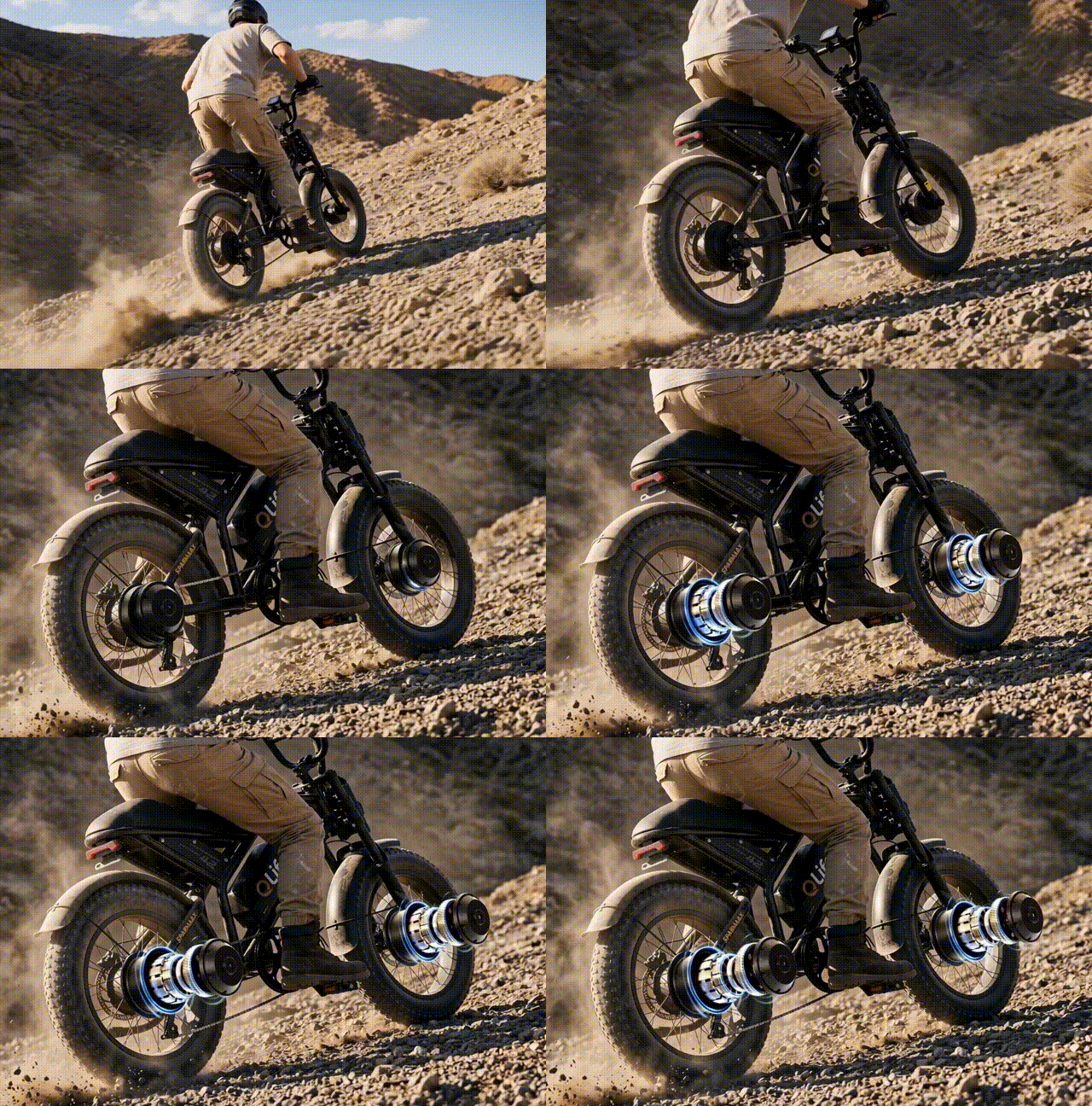
Power is one of the main features advertised on electric bikes. If you’re shopping in the under-$800 category, you might see bikes listed as 500W, 750W, or even 1,200W. It is easy to assume these figures are directly comparable and that more power is always better. That is not necessarily the case.
Motor power is not simply a contest in which the largest number wins. Rated power, peak power and torque describe different aspects of performance. Nor does every rider need the most powerful option. The right choice depends on your commute, hills, rider weight, cargo and battery capacity.
Under $800, choosing a more powerful motor may also mean compromising on other features. That is why it is important to decide how much power you actually need and whether the rest of the bike is equipped to make good use of it.
The Fast Answer: 500W Is Enough for Many Riders
500W is absolutely enough for many riders. It’s a sensible starting point for ordinary commuting, moderate inclines, and riders willing to pedal.
But it’s not right for all riders.
You’ll find you need 750W or even 1,200W (peak power) if you regularly ride hills, carry cargo, or are a heavier rider. Just remember the 1,200W figure isn’t the power the motor can sustain — it’s a temporary maximum output.
That’s important because you can’t compare two bikes accurately if you don’t know whether each figure is rated or peak.
Note: It’s also worth checking your local state and regional rules. They can restrict higher-powered motors, limiting where you can ride.
First, Make Sure You Are Comparing the Same Kind of Watt
Watts measure the rate at which the electrical system can deliver power. The more wattage the system has, the greater the power output.
Put simply, more watts mean the system can deliver more power, although wattage alone does not determine wheel speed or torque.
But wattage isn’t quite so simple. You can’t just read the power level for an engine and assume it compares for all models.
- Rated or nominal wattage is the output the system is designed to provide consistently.
- Peak wattage is a higher short-term output that may appear during acceleration, starting under load, or climbing.
The battery and controller must also be capable of supplying enough current for the advertised output. Peak duration is not typically standardized across brands, so it should not be treated as a universal performance metric.
You can think of wattage as the e-bike equivalent of horsepower: useful for comparing overall power, but not enough on its own to predict acceleration or climbing ability.
Torque is another aspect worth understanding. It is the twisting force produced by the motor, affecting how strongly the bike accelerates and climbs hills. Just having more wattage doesn’t necessarily link to higher torque.
The motor configuration also influences both torque and power. Electric bikes can have either a hub motor (in the wheel itself) or a mid-drive motor. Some e-bikes even have two hub motors, supplying power to both wheels.
500W vs 750W vs 1200W Peak at a Glance
500W, 750W, 1,200W. What’s the real difference? And do you really need loads of power just to get to and from work?
Well, the answer is that more power is more useful. It can help you climb hills, ride with heavier payloads, or accelerate quicker. It’s just that most commuters riding on flat, even ground will find little use for a motor above 500W.
Peak claims above 750W also rarely describe sustained power. A 1,200W peak motor is not automatically twice as powerful as a 500W rated motor. Instead, it may provide short bursts during acceleration or climbing. That’s useful, but it is different from sustained power.
|
Motor claim |
What it usually means |
Best suited to |
Main advantage |
What to check |
|
500W rated |
Power the motor is designed to deliver consistently |
Everyday commuting, moderate terrain and lighter loads |
A practical balance of assistance, efficiency and cost |
Torque, rider weight, hill grade and battery capacity |
|
750W rated |
Higher sustained power than a 500W-rated system |
Heavier riders, cargo, regular hills and stronger acceleration |
More headroom when the bike is under load |
Battery size, controller output, brakes and local rules |
|
1200W peak |
Maximum short-term output during acceleration or demanding sections |
Starting under load, short climbs and temporary bursts of power |
Extra power when demand suddenly rises |
Rated wattage, peak duration, torque and controller specifications |
Where a 500W Motor Makes Perfect Sense
A 500W isn’t the worst option. It’s a perfectly good motor for the majority of commuters and weekend riders.
It can work effectively if your average ride involves:
- Primarily flat or gently rolling commutes
- Paved roads and maintained cycle paths
- Short errands, campus travel and recreational rides
- Riders who expect to contribute through pedaling
- People who prefer smoother, less abrupt acceleration
- Buyers prioritizing efficiency over maximum throttle performance
That said, there are a few drawbacks. If you’re a heavier rider or have a loaded rack, starts may feel quite slow. You’ll also struggle on long or repeated climbs, which can expose limited thermal and power headroom.
It’s best not to pick a 500W motor for heavy frames, fat tires, or low tire pressure, as it can make the motor work harder. But for the average frame and road tires, it’ll work fine.
Why 750W Is the Budget Sweet Spot for Demanding Rides
750W is enough for most riders. The extra power gives you useful headroom, so you can comfortably climb hills or carry additional loads without worrying the motor will struggle.
It works best for:
- Mixed urban routes with regular inclines
- Heavier riders or riders carrying groceries and work equipment
- Fat-tire bikes with greater rolling resistance
- Riders who rely more heavily on throttle or high assist
- Faster acceleration in stop-start traffic
- Maintaining assistance more comfortably on demanding sections
A bigger motor isn’t just good news. More aggressive use can consume battery energy faster. For beginners, it can also feel like a lot of power — especially if you’re used to manual bikes.
Remember: 750W is just the motor power. It does not guarantee a better controller, quieter operation, or stronger brakes, which make riding with a stronger motor much easier.
The Spark D2 is a good example of a 750W motor with extra output. The motor can deliver up to 1,800W of peak output, reaching speeds of up to 30mph. That’s perfect for its reinforced frame and fat tires. But the extra battery capacity (48V 15.6Ah) compensates for the extra weight and stronger motor.
 What 1,200W Peak Can and Cannot Promise
1,200W is a lot of power. You simply don’t need that much power when cruising along. That’s why most motors only deliver 1,200W during peak periods, including:
- Stronger output for starting
- Temporary help when the load suddenly increases
- More immediate acceleration
- Short bursts during an incline
It’s designed to give you that surge you need during difficult moments. On average, however, your wheels won’t receive 1,200W. For example, the Qlife Triker 2.0 has a 350W brushless motor, ideal for casual riding around the neighborhood. But because the e-bike might carry heavier loads or face steeper inclines, it can reach 1,200W. Think of it as added flexibility.
 Qlife’s current under-$800 collection features claims up to 1,800W. Just like for 1,200W, these are peak performance claims. Only opt for more peak power if you expect to carry much heavier loads or face difficult inclines.
Hills and Heavy Loads Expose Weak Power Systems
Hills are one of the clearest reasons to consider a stronger motor. A 500W motor may handle a gradual incline comfortably, but several miles of continuous climbing place much greater demand on the system. The steeper and longer the hill, the harder the motor must work.
A heavier rider, bags, baskets, a child seat, or other cargo can increase that strain further. Starting halfway up a hill is also more demanding than approaching with momentum, as the motor must move the full load from a standstill.
Torque plays an important role here.
Higher torque generally provides stronger low-speed pulling power, helping the bike start and continue climbing under load. Wheel size, gearing, and tire choice also influence performance. Fat or underinflated tires create more rolling resistance, although their wider contact patch can improve traction on loose or uneven surfaces.
Peak motor power can help on short, steep sections. A temporary surge may push the bike through a difficult part of a climb where a lower-output system would slow considerably. However, peak power cannot compensate for poor gearing, a small battery, or a motor that overheats during sustained climbing.
For regular steep hills or heavy cargo, look beyond the headline wattage. Compare rated power, torque, battery capacity, controller output, and the bike’s maximum load rating together.
Here’s a quick breakdown on the best motor for common terrain types:
|
Riding situation |
Sensible starting point |
Most important supporting specification |
Main trade-off |
|
Flat daily commute |
500W rated may be sufficient |
Battery capacity and bike weight |
Less reserve for unexpected hills |
|
Rolling terrain |
500W–750W rated |
Torque and gearing |
Greater use of high assist |
|
Repeated steep hills |
750W or a proven climbing system |
Torque, controller and cooling |
Faster battery consumption |
|
Heavier rider |
Often 750W, depending on route |
Load rating and torque |
Heavier, potentially more abrupt bike |
|
Cargo errands |
750W or purpose-built utility bike |
Frame, rack and brake capacity |
Reduced range under load |
|
Beginner on easy routes |
Well-controlled 500W system |
Predictable assist and brakes |
Less maximum acceleration |
A Big Motor Is Only as Useful as Its Battery and Controller
The battery stores energy. The motor consumes it. The controller determines how much of that energy reaches the motor at any one time.
Batteries have two fundamental factors:
- Voltage affects the electrical system’s operating potential.
- Amp-hours describe charge capacity but cannot be compared properly across different voltages by themselves.
By multiplying volts and amp-hours together, you get watt-hours. Watt-hours are the best way to compare batteries, as both volts and amp-hours can change. For example, a 48V 10.4Ah battery is approximately 499Wh, whereas a 48V 15.6Ah battery is approximately 749Wh.
Just as you can’t accelerate continually in a car without needing to fill up more often, so too does higher motor output increase energy consumption consistently. Of course, you’ll only reach peak output during specific periods when the controller deems it necessary. That’s why a large peak claim paired with an unspecified controller or small battery deserves closer examination.
Faster Acceleration Demands Better Brakes and Handling
A powerful motor sounds great until the rest of the bike cannot keep up with it. Faster acceleration, higher speeds, and a heavier frame can quickly expose weak brakes, poor suspension, or vague handling.
Before buying, compare:
- Mechanical versus hydraulic disc brakes
- Rotor size, where listed
- Bike weight and weight distribution
- Tire width, wheel size and intended terrain
- Frame strength and suspension quality
- Maximum load rating
- Replacement parts and after-sales support
That does not mean every 750W or high-peak e-bike needs the same braking system. It simply means the brakes and handling should make sense for the bike’s weight and performance. There is little value in gaining speed quickly if the bike feels unstable or takes too long to stop.
Motor Power Does Not Decide the Legal Class by Itself
A large wattage figure does not automatically tell you where an e-bike can legally be ridden. Motor output matters, but so do assisted speed, throttle operation and the rules adopted by individual states and local authorities.
The CPSC’s federal definition of a low-speed electric bicycle covers bikes with working pedals, a motor below 750W and a motor-only speed below 20 mph under specific test conditions. However, that is a product definition, not a universal pass for every road, cycle path or trail.
Local rules may also cover helmets, rider age, licensing, registration and access to certain routes. Even limiting the speed through the bike’s settings may not change its legal classification.
The safest approach is simple: check current state and local guidance before taking a higher-powered e-bike onto public roads or paths.
Build Your Shortlist Around the Hardest Part of Your Ride
How much power do you actually need? Do not judge that by the easy five miles of your commute. Judge it by the steep hill you tackle once a week, the grocery run with two loaded bags, or the section where you regularly start from a standstill.
Before comparing bikes, record:
- Your steepest regular hill
- Your total rider and cargo weight
- Your typical daily distance
- Whether you will pedal actively or rely heavily on the throttle
- The surfaces you ride on
- Your preferred tire and wheel size
- The bike’s rated and peak motor power
- Its torque and battery capacity
- The brake type and maximum load rating
- Any local restrictions on speed, throttle use or motor output
This gives you a much clearer picture than simply choosing the bike with the largest number in the product title. A 500W model may be more than enough for a flat commute, while a 750W motor could provide valuable breathing room on hills or under load.
Explore Qlife’s electric bikes under $800 once you know what your hardest ride demands. Compare the complete setup, not just the headline wattage.
FAQs About 500W, 750W and Peak Power
Is 500W Enough for an Electric Bike?
Yes, if you’re primarily a commuter or short-distance rider on flat, paved roads, a 500W motor can work great.
Is a 750W E-Bike Noticeably Better Than a 500W E-Bike?
That depends. A 750W motor will deliver more power under heavier loads, when going uphill, or during acceleration. Otherwise, it will perform similarly to a 500W motor.
What Does 1200W Peak Mean on an E-Bike?
A 1,200W peak means that at specific points such as acceleration or a steep incline, the e-bike will temporarily provide a much larger amount of power. It is not the average power the motor normally delivers.
Is Peak Wattage the Same as Rated Wattage?
No. Peak wattage is the maximum amount of power a motor may provide temporarily. Rated wattage is the amount of power the motor will normally provide.
Does More Wattage Make an E-Bike Faster?
Not necessarily. It can make it faster uphill or provide better acceleration, but it is not the only factor determining top speed.
What Motor Power Is Best for Hills?
At least 750W is best for most moderate-to-difficult hills. If the hill is especially steep, having a higher peak power can help.
Does a Higher-Watt Motor Reduce Battery Range?
It can do. If you aggressively use a stronger motor at full power, it will drain the battery quicker. That’s why it’s best to conserve power on flat terrain.
Are 750W or 1200W Peak E-Bikes Street Legal?
That depends on where you live. Laws around motor power vary between states and local governments. Always check with your local authorities before buying an e-bike.
Share:
Are Electric Bikes Under $800 Worth It? What You Actually Get
Best Electric Bikes Under $1,200 for Hills and Heavier Riders