
Spending $800 on an e-bike is often dismissed as the cheapest option. But it’s still $800. For almost any other item, it’s considered a substantial purchase. Even if other e-bikes can go for $1,200+, you want to find genuine value for your money, rather than just buying a bike that will need replacing.
The good news is that you can absolutely find affordable e-bikes that will last for years and have enough features for your everyday riding. You just need to know what you’re looking for.
This guide gives you everything you need to find a great electric bike for under $800. It’ll help you decide what features to prioritize based on your route, distance, load, and expectations.
The Quick Verdict: Good Enough for the Right Ride
An $800 e-bike is not inherently inferior. More expensive e-bikes will stack on features that aren’t much use to the majority of riders. Stronger motors, heavier frames, and better suspension only really matter if you’re doing the distance or tackling the difficult trails and roads where they’re needed.
An electric bike for under $800 is great for:
- First-time e-bike owners
- Students and campus riders
- Short- and medium-distance commuters
- People replacing local car journeys
- Casual weekend riders
- Apartment or RV owners considering a compact model
- Riders who want to test whether e-bike ownership suits them
However, if you’re a heavier rider, carry substantial cargo, tackle steep hills, cover long distances or want an advanced mountain bike, you may have fewer suitable options under $800. Check the payload, motor, battery and braking specifications carefully.
What $800 Buys You — and Where the Savings Show
$800 buys you more than you’d think. Many of the features that were once reserved for advanced models are now commonplace at all price points.
That said, at lower prices, you’re unlikely to get as many advanced features. Most brands will optimize one or two features like range, power, or suspension, offering riders a choice of what matters most.
Here’s an overview of what you can expect:
|
Feature |
Realistic expectation |
Likely compromise |
What to verify |
|
Motor |
Useful everyday assistance |
Peak figure may dominate the marketing |
Rated power, torque and controller |
|
Battery |
Enough capacity for local riding |
Real range below ideal test claims |
Watt-hours and replacement availability |
|
Brakes |
Disc brakes are common |
Mechanical systems on some models |
Brake type, rotor size and bike weight |
|
Suspension |
Front suspension is widely available |
Less refined adjustment and damping |
Intended terrain and rear suspension |
|
Tires |
Commuter and fat-tire choices |
Wider tires add weight and resistance |
Width, tread and replacement cost |
|
Frame |
Several practical formats |
Frequently heavier than premium bikes |
Bike weight, fit and load rating |
|
Display |
Core speed and battery data |
Limited apps or navigation |
Assist settings and readability |
|
Support |
Warranty and manuals available |
Smaller service network |
Exclusions, parts and contact options |
Spend Your Budget on the Parts You Feel Every Ride
Do you need a high-power motor if you’re only riding on flat, even roads? What use is a 70-mile range if your average journey is 4 miles?
You should focus on buying an e-bike that reflects how you ride. Not just maximizing what specifications you can get.
Motors and batteries get the most attention. For motors, the big factor is how much acceleration and climbing ability you need on the hardest route of the week. If you repeatedly climb a steep hill, it might be worth upgrading from 500W to 750W. High outputs usually refer to peak output — how much power the motor can temporarily provide as opposed to how much power it provides on average. As for range and battery power, match to your real daily mileage with a reasonable reserve.
Brakes become more important the higher the speed and power. Mechanical disk brakes can be entirely practical at conventional speeds. But if you’re descending hills or traveling up to 28mph, investing in hydraulic brakes can provide smoother operation and require less hand pressure.
Tires and suspension offer greater comfort. Narrower commuter tires generally suit paved routes and easier storage. Fat tires offer greater cushioning and stability but add weight and rolling resistance. Meanwhile, adding a rear shock suspension can improve comfort and traction — just don’t expect it to be equivalent to a premium mountain-bike system.
Frame and fit are among the least considered factors. Opting for a step-through frame can make the stop-start commuter much more bearable. You should also select a bike that’s right for your height and build. It needs to be light enough but have a high enough load capacity to withstand your weight. Folding e-bikes are a great option for commuters, but they can still be heavy and awkward to lift.
Always check the warranty length, exclusions, replacement-part availability, manuals, and contact options. Qlife, for example, currently offers a one-year frame warranty and a one-year pro-rated battery warranty.
Choose the Bike Shape Before You Chase the Specifications
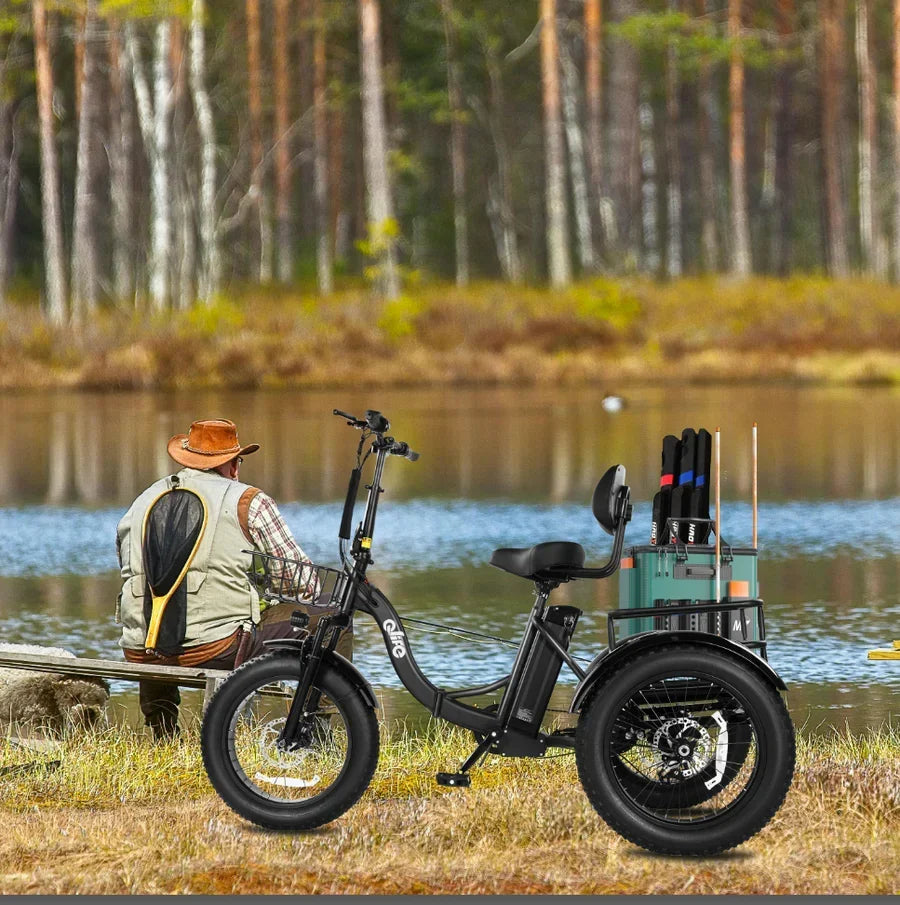
Motor power and battery size matter, but the shape of the bike often has a bigger effect on how it feels to own. A folding bike may suit a small apartment but still be awkward to carry. Fat tires can smooth out rough roads, yet add weight and resistance. A trike offers more stability, but needs more storage space and handles differently through turns.
Start with how and where you plan to ride, then compare the specifications within that category. The right frame style can make an average component list feel practical, while the wrong one can make even impressive numbers feel like a poor fit.
|
Bike type |
Best for |
Main benefit |
Main drawback |
Qlife example |
|
Commuter |
Roads, campuses and errands |
Familiar handling |
Less suited to rough trails |
Cityone |
|
Step-through |
Frequent stops and easier mounting |
Accessible frame |
Can be less compact |
Cityone Plus |
|
Folding |
Apartments, vehicles and mixed travel |
Easier storage |
Still potentially heavy |
Hunter |
|
Fat tire |
Broken pavement and gravel |
Grip and cushioning |
Weight and rolling resistance |
Racer Fat Tire |
|
Full suspension |
Rougher routes and recreation |
Greater comfort and control |
More components to maintain |
Racer Ultra |
|
Moped style |
Comfort and acceleration |
Stable, substantial ride |
Heavy and legally complicated |
Spark |
|
Trike |
Stability and cargo |
Three-wheel support |
Wider storage and different turning |
Triker 2.0 |
Where a Cheap E-Bike Starts to Feel Cheap
Not all e-bikes under $800 are the same. Some just feel plain cheap. You’ll normally notice one or two features that aren’t quite as good as more expensive models. That’s just part of the compromise.
You should not automatically expect:
- A lightweight frame that is easy to carry upstairs
- Premium torque sensing
- High-end hydraulic brakes
- Sophisticated suspension damping
- App integration or navigation
- Dealer-level local servicing
- The maximum advertised range in ordinary conditions
- Premium refinement at higher speeds
- Every accessory to be included
- Batteries and chargers to be interchangeable between models
Qlife always tries to opt for the best quality parts for the price point. Many under $800 models include features such as full suspension, hydraulic brakes, or larger batteries. Such features are not impossible at this price, but it normally means other features haven’t been prioritized.
For example, the Cityone Step Over 2.0 has a peak motor power of 1,200W and up to 55 miles of range. But it doesn’t have a full suspension system or fat tires because it’s primarily designed to get you around urban areas.
 Remember: an e-bike isn’t poor quality because of the price tag. It’s poor quality when it doesn’t suit your ride or when you have to replace major components or upgrade several parts immediately.
Check the Safety Basics Before You Check Out
There’s a popular belief that cheaper e-bikes mean the manufacturer opted for shortcuts on some components. Unfortunately, that’s sometimes true. That’s why it’s crucial to complete a safety check on all components before buying any bike.
- Check the battery and charger documentation. Look for clear safety information and use only the charger supplied or approved by the manufacturer.
- Confirm the brake type. The brakes should make sense for the bike’s weight, potential speed and the hills on your route.
- Check the rider and load limits. Include your own weight as well as bags, baskets, child seats or any other cargo.
- Make sure the bike fits properly. Review the recommended rider height, frame dimensions and standover height rather than relying on wheel size alone.
- Look for proper support after purchase. A clear warranty, replacement parts, manuals and accessible customer service can make a major difference if something goes wrong.
When Another $400 Buys More Than Better Numbers
A more expensive e-bike isn’t automatically better. But sometimes it is. If your average journey is relatively short, on flat terrain, and you’ve got plenty of storage space, an e-bike under $800 will be more than enough.
That’s not always the case, however.
Even on a regular commute, riders may travel 10 miles either way, tackle steep hills, and carry heavy cargo. Together, these factors may necessitate investing a little more in your e-bike. Spending an extra $400 can make a lot of sense.
The question is where you spend the money. Most of the time, it’s worth getting a more powerful motor, especially a dual-motor configuration. These setups give you more power and traction, so you can carry more and ascend more difficult inclines.
|
Decision factor |
Stay under $800 |
Move towards $1,200 |
|
Distance |
Short or moderate daily rides |
Longer, frequent journeys |
|
Terrain |
Flat to moderately hilly |
Repeated steep or difficult terrain |
|
Cargo |
Light bags and occasional errands |
Regular heavier loads |
|
Brakes |
Practical everyday stopping |
Greater braking refinement needed |
|
Suspension |
Roads and mild uneven surfaces |
More demanding trails or rough routes |
|
Motor system |
Single-motor everyday assistance |
Specialized or dual-motor performance |
|
Ownership goal |
First bike or casual use |
Intensive, long-term use |
Turn Your Daily Ride Into a Five-Point Shortlist
Understanding your route can help narrow down your options. You might think you’ve thought of everything, until you ride along the route for the first time and realize that hill is a little steeper than you thought it was. Or the combined weight of your bike and cargo soon adds up.
It’s sensible to complete a quick checklist before committing to an e-bike.
- Map the route. Record mileage, hills and riding surfaces.
- Calculate the load. Include the rider, bags, baskets and other cargo.
- Choose the priority. Decide whether portability, comfort, power or stability matters most.
- Compare the whole bike. Record battery capacity, rated and peak power, torque, brakes, tires, weight and fit.
- Check ownership support. Review the warranty, manuals, replacement parts and customer-service options.
Affordable Does Not Have to Mean Disposable
The best under $800 e-bike is the one that handles your normal route, fits properly, and has sufficient support behind it. Don’t be tricked into spending more than necessary on features you’ll never use.
Pick a handful of different e-bikes, understand your regular route, and apply the criteria described above. You’ll find an incredible, reliable bike for the money.
Explore Qlife’s electric bikes under $800 and find the model that fits your ride without paying for features you do not need.
FAQs About Electric Bikes Under $800
How Long Does an Electric Bike Under $800 Last?
That depends. An e-bike can last for 10 years or more if properly maintained. It’s important to store the battery in a dry, temperate location and avoid overcharging.
Is a 500W E-Bike Enough for Commuting?
Yes, for simple riding in urban areas it’s often sufficient. However, for moderate journeys, hills, heavier riders, and more cargo, a more powerful motor may be necessary.
Are Cheap E-Bikes Safe?
Price alone does not determine safety. Buyers should check electrical certification, brakes, tires, fit, documentation, and charging instructions.
How Far Can an Under-$800 E-Bike Go?
That depends on the bike weight and battery size. You can expect e-bikes to have a range anywhere from 40 miles to over 70 miles.
Should I Buy a Used or New E-Bike Under $800?
Buying new is generally the safer option. With a used e-bike, you may not know the battery’s health, whether the warranty is still valid or how the bike was charged or stored.
Are Fat Tires Worth It on a Budget E-Bike?
They can be. Fat tires offer greater comfort and traction. That’s great if you’re going off-road, but it can slow the bike down and add to its weight.
Do I Need Hydraulic Brakes at This Price?
Hydraulic brakes can be advantageous but are not mandatory for every moderate commuter. Brakes must be judged against bike weight, speed, and terrain.
Should I Choose an E-Bike Under $800 or Under $1,200?
Stay lower for ordinary commuting or recreation. Upgrade for specific features like more powerful motors or better suspension when range, hills, cargo, or component demands justify it.
Share:
Why Is an Electric Moped Considered an Electric Bicycle?
500W vs 750W vs 1200W Peak: How Much Motor Power Do You Need Under $800?