
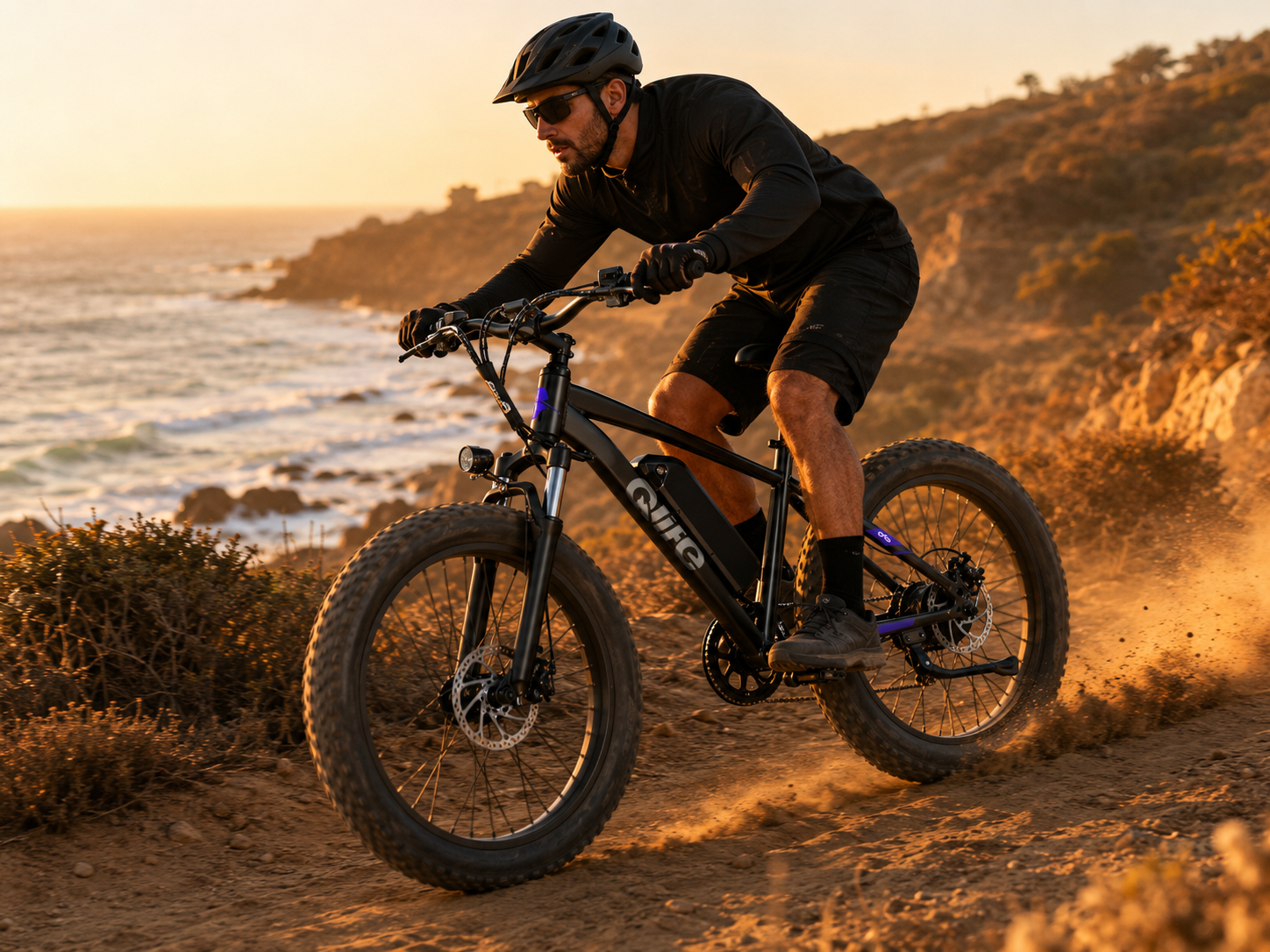
E-bikes behave very differently under pressure. A bike that feels fast and powerful on a flat test ride may respond very differently once it has to carry a heavier rider up a long hill. Suddenly, it is no longer powering along. The motor is heating up, the battery is draining quickly, and the bike is struggling to maintain momentum.
If you are looking for an e-bike under $1,200, you need to prioritize the right features. Heavier riders and anyone regularly tackling hills should look for sufficient torque, a realistic payload rating, adequate battery capacity, effective gearing and brakes suited to the bike’s total weight.
Do not choose by peak wattage alone. The motor, controller, battery, tires, frame and brakes all need to work together.
Below, we explain which features matter most, how motor power affects hill climbing, and how much payload capacity you are likely to need.
Start With the Weight Limit, Then Work Backward
It’s no good choosing an e-bike for under $1,200 with extra motor power, a bigger battery, and powerful brakes if you’re heavier than the payload capacity (especially with bags or other cargo).
That’s why you should always start with your weight. Include the rider, bags, locks, baskets, and cargo. If you pick up groceries once a week, that counts. Just remember to leave a little spare capacity. You don’t want to always ride a bike near its limit.
Once you’ve got this in mind, you can decide between the available options based on more specific criteria.
Consider these factors:
- Think about the fit. Check the rider-height range, frame access, saddle position and payload limit before worrying about motor figures.
- Buy climbing force, not a flashy peak number. Strong torque and useful low gears matter more on a hill than an impressive burst of power.
- Give the battery some breathing room. Compare watt-hours and leave extra capacity for steep climbs, heavier loads and unexpected detours.
- Make sure the bike can stop what it carries. The brakes and tires must suit the combined weight of the bike, rider and cargo.
- Move beyond the first ride. Consider the bike’s weight, legal speed settings, warranty and availability of replacement parts.
|
Specification |
What to check |
Why it matters |
|
Payload |
Rider and cargo below the stated limit |
Affects frame, motor and brakes |
|
Torque |
Clearly stated Nm figure |
Helps compare low-speed pulling support |
|
Motor rating |
Rated and peak figures |
Separates sustained from temporary output |
|
Battery |
Total watt-hours |
Hills and load increase consumption |
|
Gearing |
Useful low mechanical gears |
Allows more effective pedaling uphill |
|
Brakes |
Type, rotor size and support |
Descents increase braking demand |
|
Tires |
Width, tread and pressure range |
Affects grip, resistance and stability |
|
Fit |
Height range and dimensions |
Payload capacity does not guarantee fit |
|
Bike weight |
Storage and handling implications |
Powerful models may exceed 90 pounds |
|
Legal settings |
Speed, throttle and class |
Determines where the bike may be used |
Hills Magnify Every Weakness in the Bike
Think about walking uphill. You might think you’re fit, but it isn’t till you have to climb a mountain that you know how fit you really are. The same is true of e-bikes.
A hill — even a relatively small incline — forces a motor to move the mass against gravity. The longer the climb, the more sustained demand on the motor and controller. Cargo adds even more difficulties by changing the weight distribution and handling. Then there’s the challenge of starting on the incline rather than approaching with momentum.
There’s also a big difference between climbing one short ramp successfully and tackling repeated or prolonged hills. They do not place the same demands on the bike. Peak output can help the bike get moving or cross a difficult section, but it does not reveal how the electrical system performs throughout a long climb.
The Best Hill Motor Is More Than a Big Watt Number
Brands love a big number. It is easy to advertise, and Qlife is no exception when it comes to emphasizing motor power. Depending on the product page, that headline figure may refer to rated power or peak power.
Both numbers matter. Rated power describes the output a motor is designed to deliver more consistently, while peak power is the temporary surge available during acceleration, heavy loads, or difficult climbs.
Neither tells the whole story.
Torque affects how strongly the motor pulls from low speeds. The controller limits how much electrical power reaches the motor, while gearing and wheel diameter influence how effectively that force reaches the ground.
There is also the option of a dual-motor e-bike. Driving both wheels can provide stronger acceleration and more support on loose ground, steep starts and heavy loads. The trade-off is additional weight, complexity and battery consumption.
Qlife offers both approaches. The single-motor Hunter Plus is listed with an impressive 110Nm of torque, while the dual-motor Racer Max is listed at 200Nm. That additional pulling force gives the dual-motor model considerably more climbing potential, although it also makes it heavier and more demanding to ride.
Give a Hill Route More Battery Than the Math Suggests
Watt-hours is calculated by multiplying volts by amp-hours. It’s how we compare batteries.
For example:
- 48V × 20Ah = 960Wh
- 52V × 20Ah = 1,040Wh
A larger battery gives the rider more energy to work with, but it does not guarantee a fixed range. Hills, additional weight, cargo, high assistance, throttle use, wind, and fat tires can all increase consumption.
You shouldn’t ever rely on the minimal battery amount. Real-world conditions will almost always demand more.
Try this simple planning method:
- Calculate the complete round trip.
- Include every significant climb.
- Add routine cargo and detours.
- Estimate range using demanding rather than efficient conditions.
- Add a substantial reserve before comparing models.
There isn’t a universal buffer for heavier riders (or even for hills). Every rider and hill is different. But around a 20-40% reserve is sensible. It means you’re never worried about whether you’ve got enough charge to make it home.
The Descent Tests the Brakes More Than the Climb
We can focus too much on getting up a hill when comparing e-bikes. Motors, batteries, and controllers are all critical. But there is also a safety concern: stopping as you travel back down.
Controlling the mass on the way down is the role of the brakes. Most basic e-bikes rely on mechanical brakes. They are fine on flat, even ground. However, they may not provide the same stopping confidence if you are carrying considerable weight or traveling quickly downhill.
The alternative is hydraulic brakes. They can provide smoother modulation and require less lever effort, which may be useful on a heavier or faster e-bike. That is not to say hydraulic brakes are always safer. But it is an important trade-off to consider as part of the buying decision.
Tires, Suspension, and Frame Fit Keep the Power Usable
If you’re selecting a bike for hills or a heavier rider, you’re probably going for a bigger motor. But raw power only gets you so far. How that power feels on the road depends on the tires, suspension, and frame fit.
Fat tires can add grip and stability, especially on loose or uneven ground, although they also bring more weight and rolling resistance. Suspension can take the sting out of rough climbs, but it cannot rescue a bike that feels awkward beneath you.
Check the rider-height range, saddle position, reach and mounting access. A bike may look perfect on paper yet still feel clumsy or difficult to control.
Best Qlife E-Bikes for Different Riders and Hill Routes
|
Model |
Best suited to |
Key strengths |
Main trade-off |
|
Heavier commuters facing paved hills |
400-pound payload, 48V 20Ah battery, 110Nm torque and a folding frame |
Still heavy and awkward to lift despite the folding design |
|
|
Riders wanting a conventional fat-tire e-bike for moderate hills |
26×4-inch tires, 70Nm torque, stable handling and a familiar bike shape |
Smaller battery and mechanical brakes may be less suited to long, steep routes |
|
|
Riders prioritizing moped-style comfort and stronger braking |
Hydraulic disc brakes, 1,040Wh battery, full suspension, and a padded seat |
Weighs around 93 pounds, while its higher speed requires careful legal checks |
|
|
Experienced riders wanting maximum two-wheel climbing support |
Dual motors, 200Nm torque, hydraulic brakes, full suspension and a 400-pound payload |
Heavy, complex and likely to consume battery quickly when both motors are used |
|
|
Riders prioritizing payload capacity and low-speed stability |
500-pound capacity, three-wheel support and useful cargo potential |
Requires more storage space and handles corners differently from a two-wheel bike |
 When Staying Under $800 Still Makes Sense
$1,200 is not a compulsory amount you have to spend. You should only spend more if you’re investing in a feature you specifically need. That might mean a stronger motor for hills or a heavier rider, better brakes, or greater torque.
An under-$800 bike may still suit:
- Short rides
- Moderate rather than sustained hills
- Light cargo
- Riders comfortably below the payload limit
- Active riders willing to pedal through climbs
- Routes that do not demand hydraulic brakes or large batteries
Here’s a quick decision matrix to help you decide:
|
Requirement |
Under $800 may be enough |
Move toward $1,200 |
|
Hills |
Occasional moderate inclines |
Frequent or sustained climbs |
|
Payload |
Rider and light cargo |
Higher combined load |
|
Battery |
Short local journeys |
Longer or hill-heavy routes |
|
Brakes |
Moderate speeds and terrain |
Heavier or faster configurations |
|
Motor |
Ordinary single-motor support |
Greater torque or dual motors |
|
Comfort |
Basic fork or commuter frame |
Fat tires or full suspension |
|
Use pattern |
Casual or first e-bike |
Frequent, demanding transport |
More Power Creates More Responsibility
A powerful e-bike can flatten hills, carry heavier loads, and make difficult routes feel almost effortless. It can also build speed surprisingly quickly. Once you move beyond ordinary commuter performance, the rider has to keep up with the machine.
Before heading out:
- Know which mode you are using. Check the assisted-speed limit and how the throttle behaves before joining traffic.
- Test the brakes somewhere quiet. Learn how quickly the bike stops with your full weight and cargo onboard.
- Respect the descent. Slow down before corners rather than relying on hard braking halfway through them.
- Check the tires and load. Correct pressure and balanced cargo make a powerful bike easier to control.
- Know the local rules. Higher-output or faster models may not fit ordinary e-bike classifications on every road or trail.
Explore Qlife’s electric bikes under $1,200 and compare the motor, brakes, battery, and payload as one complete system.
FAQs About E-Bikes for Hills and Heavier Riders
What E-Bike Motor Is Best for Hills?
There isn’t a specific set of criteria; it depends on the hills. Opting for a 750W motor might be sensible, but you should also look at torque, controller capacity, and gearing.
Is 750W Enough for Hills?
It can be. It depends on the hill length, gradient, rider weight, cargo, and rider input. Under average conditions, a 750W motor will be strong enough for most hills.
Is a Dual-Motor E-Bike Worth It for Hills?
It can be. Dual motor e-bikes generally provide greater traction and pulling support. However, that extra power comes alongside additional weight, cost, energy use, and complexity.
How Much Battery Do I Need for Hill Riding?
You should never take the advertised range if you’re riding hills. Instead, calculate watt-hours from the battery specs and use a demanding-consumption estimate with a reserve.
Are Fat Tires Good for Heavier Riders?
Fat tires can offer more traction, cushioning, and stability for heavier riders. While they do add weight, they can be a sensible alternative to a full suspension system.
Are Hydraulic Brakes Worth It for Heavier Riders?
Hydraulic brakes can be worth it for heavier riders because they provide smoother control and require less hand pressure, particularly on long or steep descents. They are not automatically safer, however, as rotor size, maintenance, bike weight, and rider technique still matter.
What Weight Capacity Should I Check?
Most e-bikes list a maximum payload capacity. That includes not just the rider weight but any locks, bags, baskets, and all cargo. Avoid riding at or near the bike’s stated maximum as it can impair performance.
Does Rider Weight Reduce E-Bike Range?
Generally, yes. Greater weight forces the motor to move more mass. That requires more energy, particularly during acceleration and climbing.
Should Heavier Riders Spend $800 or $1,200?
There is no right budget. For heavier riders, it’s worth investing in a more powerful motor, higher payload capacity, and stronger brakes.
Are High-Power E-Bikes Street Legal?
High-power e-bikes are not automatically street legal, as motor wattage, assisted speed, throttle operation, and vehicle classification all vary by state and local law.
Bikes that exceed the usual e-bike limits may be treated as mopeds or motor vehicles, so check the exact model and local rules before riding on public roads.
Share:
500W vs 750W vs 1200W Peak: How Much Motor Power Do You Need Under $800?
Cheap E-Bike Battery Safety: UL 2849, Chargers, and Charging Tips