
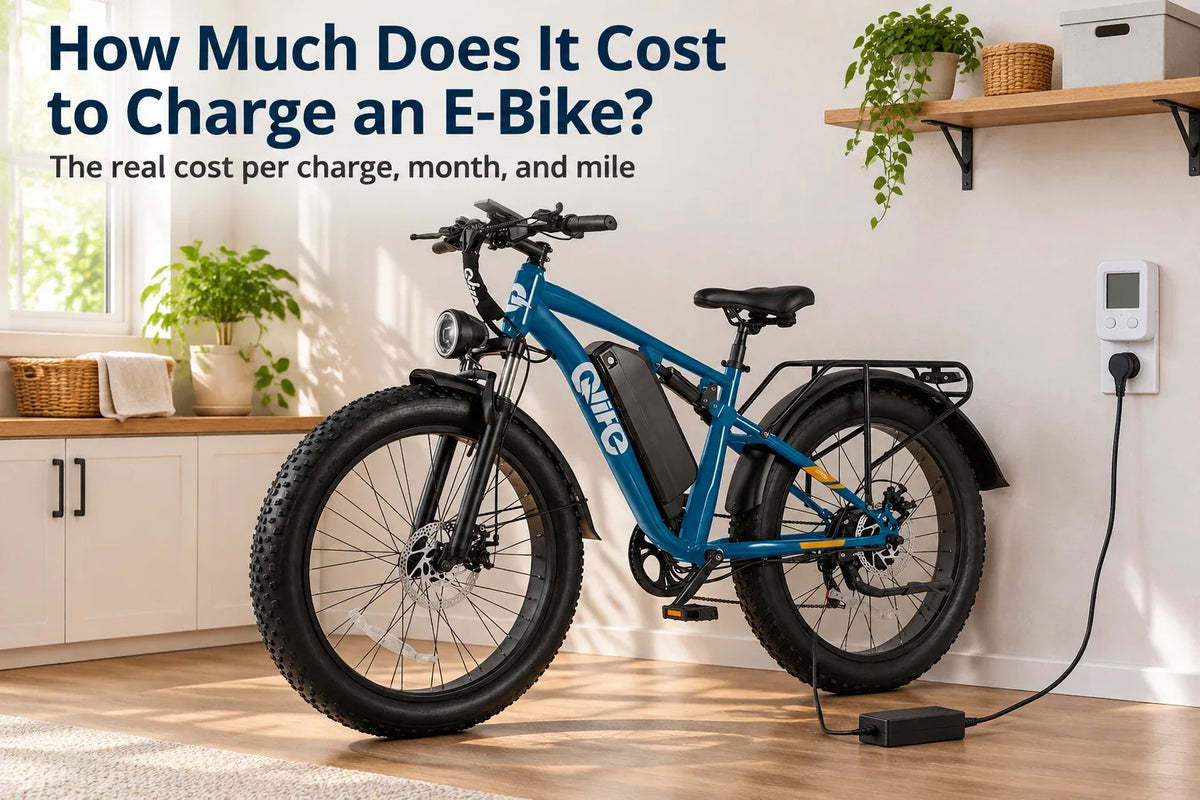
How much does it cost to charge an e-bike? Multiply the electricity your charger draws from the wall by your utility's per-kWh rate. At $0.20/kWh, a 0.60 kWh charge costs $0.12. Your monthly cost depends on total wall use and your local rate.

You can measure wall use with a plug-in electricity monitor. If you only know your battery's volts and amp-hours, you can estimate the stored energy in a few seconds.
Here is how the math works, what real electric bills measure, and what charging costs across common battery sizes and monthly riding routines.
The Short Answer: Use the Electricity Your Charger Actually Draws
How much does it cost to charge an e-bike? The basic formula is straightforward:
Charging cost = Wall energy used (kWh) x Applicable electricity rate ($/kWh)
For example, if a plug-in meter shows that your charger pulled 0.60 kWh from the wall during a charging session, and your utility rate is $0.20 per kWh:
0.60 kWh x $0.20/kWh = $0.12
At that rate, the session adds 12 cents in usage-based electricity cost. A larger battery or a different utility rate changes the total.
A meter plugged into the wall measures the real electrical energy drawn from your home. An estimate based on your battery's nameplate watt-hours calculates the energy stored inside the pack, which is a helpful lower-bound estimate, though it leaves out normal charger conversion losses.
What Your Bill Measures: kWh, Not Battery Watt-Hours
To calculate your personal e-bike charging cost, you need to understand the unit on your power bill: the kilowatt-hour (kWh).
Electric bike batteries are labeled in watt-hours (Wh), which measure total stored electrical capacity. Power companies bill you in kilowatt-hours, where 1 kWh equals 1,000 watt-hours. As the U.S. Energy Information Administration (EIA) explains in its electricity measurement guide, running a 40-watt light bulb for five hours uses 200 watt-hours, or 0.2 kWh. An e-bike charger works on the same basic energy arithmetic over the hours it takes to fill the battery.
When you look at your utility bill to find your electricity rate, check the supply and delivery charges:
- Usage-based cents per kWh: Add the per-kWh supply rate and the per-kWh delivery charge together. If supply is $0.11/kWh and distribution is $0.07/kWh, your variable rate is $0.18/kWh.
- Fixed monthly fees: Ignore fixed monthly account or meter fees that you pay regardless of how much electricity you use. An e-bike does not change those base charges.
- Time-of-use tariffs: If your utility charges different rates for off-peak and on-peak hours, use the rate that applies when you actually plug the bike in. Charging overnight on an off-peak rate is often noticeably cheaper than plugging in during late-afternoon peak hours.
- Public charging networks: Dedicated commercial charging pedestals or pay-per-hour charging lockers follow their own fee schedules and are completely separate from residential home rates.
Use a Plug-In Meter for the Cost You Actually Pay
The most accurate way to know what a charge costs is to measure it at the wall outlet with a basic plug-in electricity monitor.
Here is how to run the test:
- Plug the power meter into a standard 120V wall outlet, and plug your factory e-bike charger into the meter.
- Connect the charger to the battery and reset the meter's accumulated kilowatt-hour counter.
- When the charger's indicator light turns green to signal a full charge, note the total accumulated kWh displayed on the meter.
- Multiply that number by your utility's per-kWh rate.

For example, if your meter reads 0.60 kWh after a normal charge cycle and your local utility rate is $0.20 per kWh, that session cost exactly $0.12.
Two practical details help keep your measurement clean:
- Standby power: Once the battery is full, chargers drop into a low-power maintenance or standby state. If you leave the charger plugged in overnight, the meter may log a tiny trickle of standby power, but that extra draw is negligible compared to the active charging cycle.
- Top-ups vs. empty packs: If you plug in after a short five-mile errand, your charger might only draw 0.15 or 0.20 kWh before shutting off. Do not apply a full-capacity calculation to every plug-in event if your daily riding routine consists of small partial top-ups.
Always use an approved, properly rated plug-in meter, follow the safety instructions for both your charger and the meter, and never leave charging batteries completely unattended.
Estimate From Battery Capacity When You Don't Have a Meter
If you do not have a plug-in power meter, you can calculate a reliable baseline directly from the battery label.
First, find the battery's nominal watt-hours (Wh). If the label only lists voltage (V) and amp-hours (Ah), multiply them together:
Volts x Amp-hours = Nominal watt-hours
Next, divide by 1,000 to convert watt-hours into kilowatt-hours:
Nominal watt-hours / 1,000 = Nominal kWh
Finally, multiply by your electricity rate to find the cost of the energy stored inside the battery pack:
Nominal kWh x Electricity rate ($/kWh) = Stored-energy cost
For example, a common 48V 14Ah battery has a nominal capacity of 672 Wh (48 x 14 = 672). Divided by 1,000, that equals 0.672 kWh. At a rate of $0.20 per kWh:
0.672 kWh x $0.20/kWh = $0.134
Keep in mind that this is a lower-bound capacity estimate. No electrical charger is 100% efficient; charging transfers lose a small percentage of energy as warmth in the transformer brick and battery cells. While some third-party guides apply blanket assumptions of 10% or 15% losses, actual efficiency varies across charger designs, battery age, and ambient room temperature. The battery capacity formula shows you the minimum energy entering the pack, while a plug-in wall meter captures the full energy drawn from your home.
Two Qlife Battery Examples
To see how battery capacity math works on real bikes, look at the published specifications for two models in our lineup:
| Listed Qlife configuration | Nominal battery energy | Estimated cost of battery energy at $0.20/kWh |
|---|---|---|
| Our Racer Plus 2.0 (selected 48V 20Ah setup) | 960 Wh = 0.96 kWh | $0.192 stored-energy equivalent |
| Our Spark Plus (52V 20Ah setup) | 1,040 Wh = 1.04 kWh | $0.208 stored-energy equivalent |
These are capacity-based estimates of energy stored in the packs. A wall meter also captures charging losses.
At this rate, the energy represented by each listed battery capacity is about twenty cents. The amount drawn from the wall to recharge it will be higher because some energy is lost during charging. The larger Spark Plus example adds about 2 cents to the capacity-based estimate compared with the Racer Plus setup.

What Does a Month of Charging Cost?
A monthly charging budget depends on how often you ride and how deeply you deplete the pack between charges.
For one example, suppose you ride three or four days a week and plug in about 13 times over a month. If your charger draws an average of 0.30 kWh per session, your monthly wall use is:
13 charging sessions x 0.30 kWh/session = 3.9 kWh per month
At an electricity rate of $0.25 per kWh:
3.9 kWh x $0.25/kWh = $0.98 per month
Even if you doubled that riding routine to 26 sessions per month, your total monthly electricity expense would still hover around $2.00.

Because utility rates and charging habits vary across households, the table compares different monthly wall-use totals at several rates:
| Monthly wall energy drawn | At $0.15/kWh | At $0.25/kWh | At $0.40/kWh |
|---|---|---|---|
| 3.9 kWh (e.g., 13 partial top-ups of 0.30 kWh) | $0.59 | $0.98 | $1.56 |
| 7.8 kWh (e.g., 13 medium sessions of 0.60 kWh) | $1.17 | $1.95 | $3.12 |
| 11.7 kWh (e.g., 13 deep charges of 0.90 kWh) | $1.76 | $2.93 | $4.68 |
This table highlights why treating every plug-in event as a full charge skews your budget. Twenty small top-ups after brief neighborhood errands draw far less total power than twenty full charges from an empty battery. If you are planning an e-bike purchase around a fixed daily commute, see our commuter e-bike buying guide to match battery capacity to your real weekly riding schedule.
Use a Rate From the Right Month and State
When people search for e-bike charging costs, articles frequently quote a generic national average rate. However, residential electricity prices vary significantly by region and season.
EIA Table 5.6.A lists preliminary state estimates for August 2026, released October 23, 2026. That month's average residential prices were 13.37 cents per kWh in Idaho, 14.63 cents in Washington, 15.91 cents in Texas, and 19.38 cents in Ohio. California averaged 29.75 cents, Connecticut 24.51 cents, and Hawaii 47.18 cents per kWh.
These state averages provide regional context, not your personal electric bill. Local utility charges, seasonal adjustments, and tiered rates affect what you pay. For the most accurate estimate, use the variable rate on your latest bill.
Cost per Mile Requires Matched Energy and Distance
To calculate your true electricity cost per mile, you must match your actual measured wall energy to the actual miles you rode over the same period:
Cost per mile = Total charging cost over period / Total miles ridden over matching period
For example, if you logged 100 miles on your odometer across a month where your plug-in meter recorded 5.0 kWh of wall draw, and your electricity rate is $0.20/kWh:
5.0 kWh x $0.20/kWh = $1.00 total charging cost
$1.00 / 100 miles = $0.01 per mile (one cent per mile)
Dividing battery capacity by advertised maximum range gives a theoretical energy-per-mile figure, not your measured cost per mile. If your riding conditions produce less range than the advertised figure, your actual cost per mile will be higher. Range figures assume favorable conditions, such as low assist, flat ground, and a light rider. Headwinds, cold weather, throttle use, hill climbing, and rider weight all affect how far a charge takes you.
To see what realistic battery consumption looks like across different terrain and assist levels, read our breakdown of real-world e-bike range.
Electricity Is One Ownership Cost, Not the Whole Budget
Electricity is so inexpensive that riders sometimes make the mistake of assuming an e-bike has zero running costs. While charging costs pennies, electricity is only one slice of total vehicle ownership.
Over several seasons of riding, other wear-and-tear items will demand budget room:
- Tires and tubes: Fat tires, puncture-resistant commuter tires, and sealant wear down and need replacement every few thousand miles.
- Brake pads and rotors: Stopping a heavy electric bike from 20 mph wears brake pads much faster than an acoustic bicycle, requiring routine pad replacements and adjustments.
- Drivetrain maintenance: Chains, cassettes, and shift cables stretch and wear under combined motor and human torque.
- Battery replacement: Lithium-ion battery packs naturally lose capacity over several years of regular charging cycles.
When budgeting for an e-bike over a three-to-five-year horizon, battery replacement and routine mechanical upkeep will always represent a larger financial investment than the wall electricity used to charge it. For practical advice on maximizing pack longevity, check our guide on e-bike battery life.
FAQ
How much does it cost to charge a 500Wh e-bike battery?
At $0.20 per kWh, the nominal stored energy in a 500 Wh battery is worth about $0.10 (0.50 kWh x $0.20). A full charge costs more at the wall because of charging losses. To find the actual cost, multiply your plug-in meter's kWh reading by your rate.
Does it cost more to charge a larger e-bike battery?
Yes. A 1,000 Wh battery holds twice the energy of a 500 Wh pack. At $0.20/kWh, that is $0.20 versus $0.10 in stored-energy cost, before charging losses.
How much does an e-bike cost to charge each month?
Multiply the month's total wall kWh by your billed per-kWh rate. For example, 3.9 kWh at $0.25/kWh costs about $0.98. The table above shows how other usage totals and rates change the result.
Does a partial e-bike charge cost less than a full one?
Yes. An electric bike charger only pulls energy from the wall to replace what was used. Topping off a battery that is half-full draws roughly half the kilowatt-hours of charging an empty pack, cutting that session's cost in half.
Does an e-bike charger draw electricity after charging is complete?
Yes, but only a tiny amount. Once the battery reaches 100% and the indicator turns green, quality chargers drop into a standby state that typically draws less than a couple of watts. While it is good practice to unplug chargers when finished, standby power adds only negligible pennies over an entire month.
Calculate Your Own Charge Cost
Plug your own numbers into the formula: multiply your measured wall kWh (or your battery's nominal kWh as a lower-bound estimate) by the variable rate on your latest electric bill. The result is the usage-based cost for that charging session or period.
Sources consulted:
- U.S. Energy Information Administration (EIA), "Measuring electricity": https://www.eia.gov/energyexplained/electricity/measuring-electricity.php
- U.S. Energy Information Administration (EIA), Table 5.6.A (Average Price of Electricity to Ultimate Customers by End-Use Sector, by State): https://www.eia.gov/electricity/monthly/epm_table_grapher.php?t=epmt_5_6_a
- U.S. Energy Information Administration (EIA), "Electricity prices and factors affecting prices": https://www.eia.gov/energyexplained/electricity/prices-and-factors-affecting-prices.php
Electricity rates and state averages reflect preliminary EIA data for August 2026, released October 23, 2026. Always check your actual utility bill for current local pricing.
Share:
Do E-Bikes Charge While You Pedal? Regen Explained