
An electric tricycle and an electric bike are both pedal-assisted and battery-powered, but they're built for different people and situations. The right choice for you depends entirely on who's asking. Choosing the wrong one is easy if you're going on specs alone without thinking about how you plan to ride.
This guide breaks down the real differences between an electric trike and an electric bike, covers who each one suits, and looks at the Qlife trike range for adults who want the stability and comfort of three wheels.
 What's the Difference Between an Electric Tricycle and an Electric Bike?
The most obvious difference between the 2 type of bike is the number of wheels, but that's only a small part of it. The third wheel changes everything about how the bike handles, who can ride it, and what you can do with it.
An electric bike has two wheels, so just like with a regular bike, you need to balance it at low speeds and when you stop. That's second nature for most cyclists, but it can be tricky for riders who haven't been on a bike in years, have balance problems, or are recovering from an injury. The advantages of the two-wheel design make electric bikes lighter, faster, and more maneuverable in tight spaces.
As you would expect, an electric trike has three wheels. This means it is less likely to tip over. Also, you can stop at a junction, take your hands off the bars, and the bike stays upright. Electric trikes are ideal for riders who want to get out and ride without worrying about balance.
The trade-off is that trikes are wider, heavier, and slower. They're not built for speed or for weaving through tight traffic. They're built for comfort, stability, and confidence.
Who Should Choose an Electric Bike?
If you're reasonably fit, comfortable on two wheels, and want to use your e-bike for commuting, fitness, or riding longer distances efficiently, an electric bike is the better choice.
Electric bikes are lighter, which makes them easier to carry, store, and transport. They're faster, with most Class 2 and Class 3 models topping out at 20 to 28 mph, compared to 18 to 20 mph for most electric trikes. They handle better in traffic, since the narrower profile lets you filter through gaps and navigate bike lanes without taking up excessive space.
For riders who are already confident cyclists and want the efficiency gains of a motor without changing their riding style, an electric bike is the right choice.
Who Should Choose an Electric Trike?
An electric trike makes the most sense for riders who want the cycling experience without the worry of losing balance. That appeals to a wider group than most people assume.
Seniors who want to stay active but aren't confident on two wheels anymore will benefit, as will riders recovering from injuries or living with conditions that affect their balance. Heavier riders who find two-wheel e-bikes feel unstable at low speeds also benefit from three wheels. Anyone who wants to carry a large amount of cargo, including groceries, equipment, and pets, without worrying about the load affecting their balance is also a good fit for a trike, as are riders who want to ride at a relaxed pace on local paths, beach boardwalks, or quiet roads.
People who simply haven't ridden a bike in a long time are another group of people that benefit from getting around on an electric trike. Getting back on two wheels after 20 years is intimidating for many adults. A trike removes that barrier entirely.
Stability: The Biggest Practical Difference
Stability is the main reason why people opt for electric trikes over regular e-bikes.
On a two-wheel e-bike, you're constantly balancing, and at low speeds, that takes a lot of active effort. At a stop, you need to put a foot down. On loose surfaces or downhill sections, you need to manage the bike's tendency to lean. Most cyclists do all of this without thinking about it, but for riders who aren't fully confident or inexperienced, it can be quite stressful.
When you ride an electric trike, you don't have to worry about any of that. The three-wheel base keeps the bike stable at any speed, including when you're stationary. You can start and stop without wobbling dangerously, and you can carry heavy loads without the weight distribution changing how the bike handles. On gravel, grass, or uneven paths, the trike stays stable where a two-wheel bike might feel unpredictable.
However, you still need to know that an electric trike can tip over. For example, if you take a corner too fast with your weight in the wrong place, or if you've loaded it up with the weight of cargo in an imbalanced way.
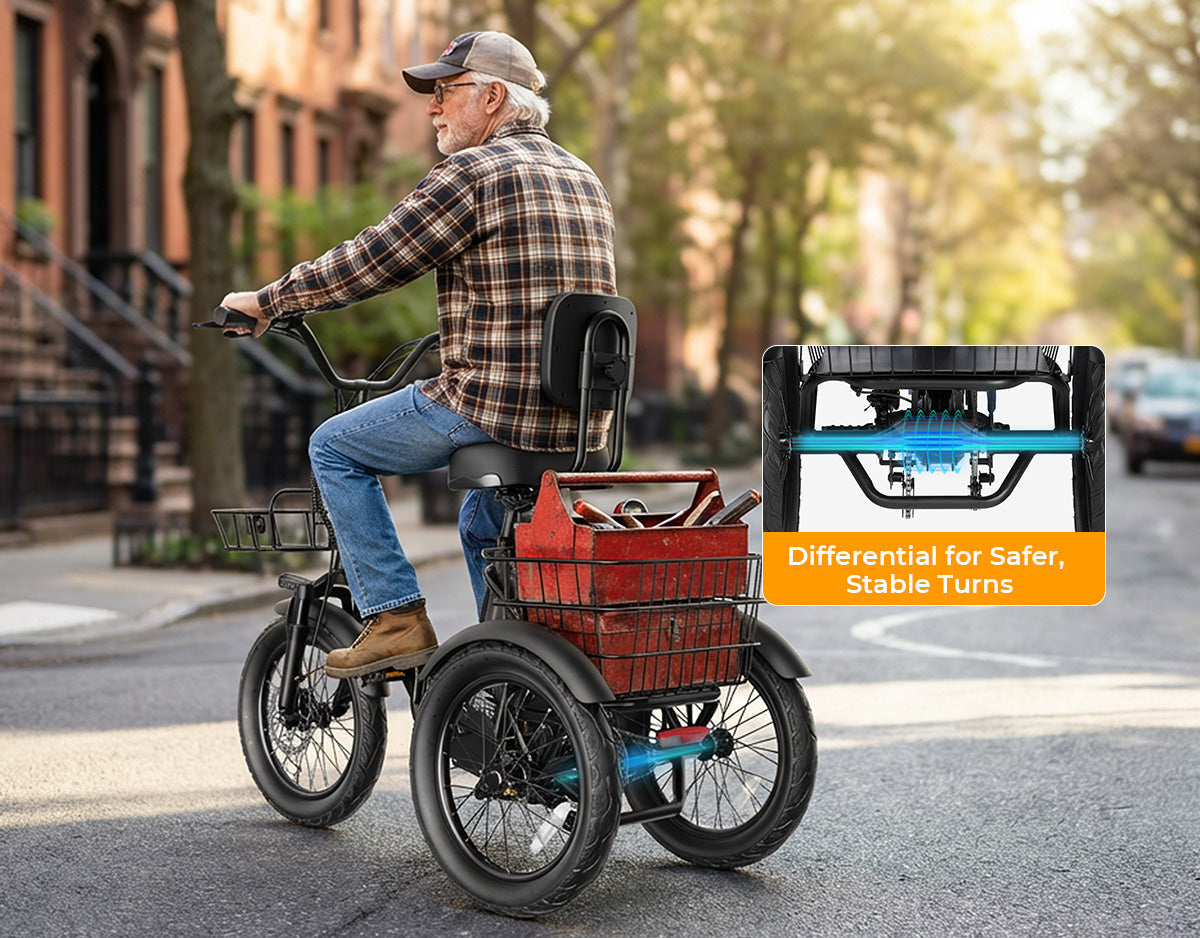
 The Qlife Triker 2.0 improves stability with a rear differential mechanism. Most basic trikes have a fixed rear axle, which causes problems when turning. The inside wheel and the outside wheel need to travel different distances, but a fixed axle prevents that. The differential on the Triker 2.0 lets each rear wheel rotate independently, so it corners more like a vehicle and less like a rigid platform being dragged around a bend.
Speed and Range: Where the Bike Has the Edge
Electric bikes are faster. That's simply true. A typical commuter e-bike tops out at 28 mph, and Class 3 models can go higher. Electric trikes are designed to be capped at lower speeds. The Qlife Triker 2.0 tops out at 18 mph, and the Triker Plus at 20 mph.
If you often commute in traffic, how fast you can ride can make a difference to your safety and the way you get to and from work. An electric bike can keep up with urban traffic flow in a way a trike can't. If your commute involves busy roads or you need to cover distance quickly, an electric bike is the more sensible choice.
When it comes to range, the Qlife Triker 2.0 gets up to 55 miles on pedal assist with its 48V 10.4Ah battery. The Triker Plus gets up to 65 miles with the larger 48V 13Ah battery. Those figures are comparable to most entry-level electric bikes. For leisure riding, local errands, and shorter commutes, neither type has a significant range advantage unless you buy a higher-end electric bike.
Carrying Capacity: The Trike's Practical Advantage
This is where the electric trike becomes more practical.
A two-wheel electric bike can carry cargo on a rear rack, but there are limits to how much weight you can add before it starts to affect handling. A heavy rear load on a two-wheel bike shifts the center of gravity, making the bike harder to balance at low speeds.
An electric trike doesn't have that problem. The three-wheel base handles heavy loads without compromising handling. The Qlife Triker 2.0 has front and rear cargo racks, and its stable platform lets you load up without worrying about balance. For riders who want to use their e-bike for grocery runs, market trips, or carrying equipment, a trike is considerably more practical.
The Qlife Electric Trike Range
If stability, comfort, and carrying capacity are what you're looking for, Qlife's electric trike range gives you two great options.
 The Qlife Triker 2.0 starts at $699. It has a 1200W peak motor, a 48V 10.4Ah battery, up to 55 miles of range, and a top speed of 18 mph on 18x3.0-inch tires. The rear differential is the main feature, with a noticeable effect on how the bike corners compared to a fixed-axle trike. Front and rear cargo racks are included, and the folding design means it fits in a car trunk for transport. The wide padded seat with a removable, height-adjustable backrest is noticeably more comfortable than the saddles on most two-wheel commuters. For most adults looking at their first electric trike, this is the right place to start.

The Qlife Triker Plus is now $999. The motor is the same 1200W peak, with a 500W rated output and 70Nm of torque, making it more capable on hills than the Triker 2.0. The 48V 13Ah battery extends the range to 65 miles, the tires step up to 20x4.0-inch fat tires for better traction on varied surfaces, and the top speed increases to 20 mph. For riders who want more range, better hill performance, or who will be riding on surfaces other than flat tarmac, the Triker Plus is worth the extra cost.
Which One Is Right for You?
The reasons people choose a trike, including stability, no balance requirement, heavy carrying capacity, and a relaxed riding experience, aren't things an electric bike can replicate. So if any of these are your priority, there's a good chance that an electric trike is the perfect choice for you.
If you're on the fence, ask yourself this: would you feel confident on a two-wheel electric bike in the riding conditions you have in mind? If the answer is yes, an electric bike gives you more speed, a lighter weight, and better maneuverability. If the answer is no, or even maybe, a trike removes the uncertainty entirely.
For seniors, riders with balance concerns, anyone who wants to carry a lot of cargo, or riders who simply want a relaxed, stable ride without the learning curve, the Qlife Triker range is a practical, well-priced option.
Final Thoughts
An electric trike isn't a compromise. It's a different tool for a different purpose.
Electric bikes are better for riders who want speed, efficiency, and the familiar feel of two-wheel cycling with a motor assist. Electric trikes are better for riders who want stability, comfort, and a cycling experience that doesn't require balance or confidence on two wheels.
Qlife's trike range covers both ends of the adult trike market. The Triker 2.0 at $699 is the practical starting point for most riders. The Triker Plus at $999 is the better choice for anyone who wants more range, more torque, and the grip advantage of fat tires on varied terrain.
Browse the full Qlife electric trike range to find the right fit for your riding.
FAQ
Is an electric trike easier to ride than an electric bike? Yes, for most adults. An electric trike doesn't require balance, so you can start, stop, and ride at low speeds without any of the skill that two-wheel cycling requires. For riders returning to cycling after a long break, or anyone with balance concerns, a trike is considerably easier.
Can an electric trike keep up with traffic? On most urban roads, yes. The Qlife Triker 2.0 tops out at 18 mph and the Triker Plus at 20 mph, which is adequate for most city riding. For faster roads or commutes where keeping up with traffic flow matters, an electric bike is the better choice.
Is an electric trike good for seniors? Yes. The three-wheel design provides stability that makes it suitable for older riders who aren't confident on two wheels. The Qlife Triker Plus is specifically noted as suitable for seniors and riders with limited mobility.
How far can an electric trike go on a single charge? The Qlife Triker 2.0 gets up to 55 miles on pedal assist. The Triker Plus gets up to 65 miles. Real-world range will be lower depending on rider weight, terrain, and assist level, so budget for around 60 to 70 percent of the claimed figure in typical conditions.
Can I carry cargo on an electric trike? Yes, and it's one of the main advantages over a two-wheel bike. The Triker 2.0 comes with front and rear cargo racks. The stable three-wheel base means heavy loads don't affect handling the way they would on a two-wheel bike.
Is the Qlife Triker 2.0 or Triker Plus the better buy? For most riders, the Triker 2.0 at $699 is enough. The Triker Plus at $999 is worth the extra cost if you want more range, better hill-climbing performance, or fat tires for riding on mixed surfaces.
Share:
10 Best E-Bikes Under $800 in 2026: Budget-Friendly Qlife Models
Best Fat Tire Ebikes 2026: Top Picks for Every Terrain