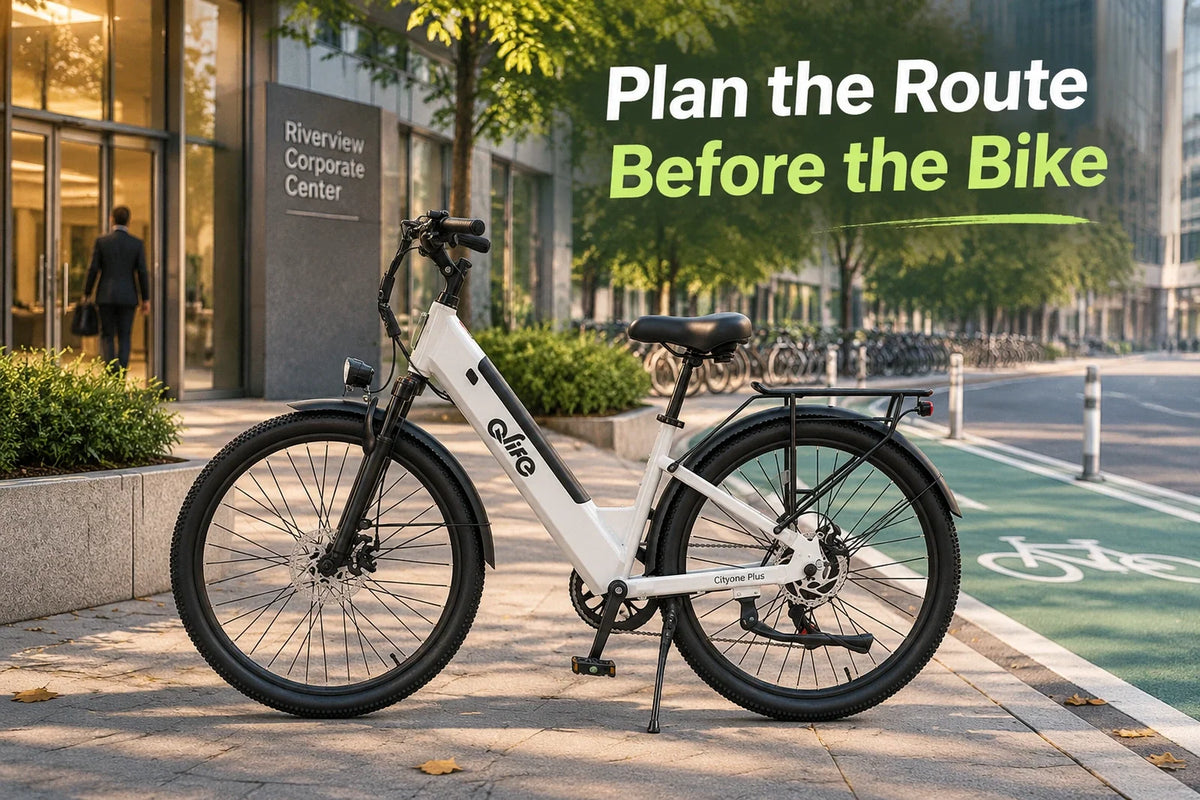
Is an E-Bike's Advertised Range Enough for Your Daily Commute? A Fill-In Check

The Short Answer: Usually Yes for Short Commutes—If You Check Your Own Conditions
When an electric bike spec sheet promises "up to 80 miles" or "up to 90 miles" per charge, it is natural to ask whether that headline number holds up on your weekday commute. For most short commutes—especially routes around 3 to 8 miles each way—an e-bike's advertised range is usually more than enough, even without buying the largest battery on the market.
However, an advertised "up to" figure is not a guarantee for every road. Manufacturer range ratings are not fake numbers, but they are recorded under favorable conditions: a light rider, flat pavement, mild air, few stops, and low pedal assist. Commuters run into trouble at the edges—when a longer round trip stacks up against steep hills, fast pacing, heavy cargo, or freezing temperatures all at once.
Instead of guessing how much of the label survives on your streets, walk through this five-step chain:
- Convert the battery label into watt-hours (Wh) and check the implied energy rate behind the "up to" claim.
- Place your commute into one of three conservative energy buckets (Low, Mixed, or Demanding).
- Shift your bucket upward if cold weather, heavy load, or battery age apply.
- Divide battery watt-hours by your bucket's energy rate and compare against your complete round-trip mileage—leaving a comfortable range reserve.
- Read your verdict (Enough, Borderline, or Not Enough) and fill in the 10-line check table.
Step 1: Write Down What the Label Actually Promises
Before judging whether a bike covers your commute, look past the "up to X miles" banner and write down what the battery label actually promises. Watch out for three common traps on spec sheets:
- The "Up To" Ceiling: "Up to" means the top of the range spectrum under light power draw, not high-speed riding into a headwind.
- Unstated Test Inputs: Spec sheets rarely state the exact rider weight, assist level, or grade used to reach the headline number.
- Comparing Amp-Hours (Ah) Alone: You cannot compare a 15Ah pack against a 20Ah pack without checking voltage (V). True battery capacity is measured in watt-hours (Wh): Volts (V) × Amp-Hours (Ah) = Watt-Hours (Wh).
Compare two models from our QLife product knowledge base—the commuter-focused Cityone Plus Step-Thru Electric Commuter Bike (_assets\qlife-product-knowledge-base\cityone-plus-step-thru-electric-commuter-bike.md) and the higher-capacity folding all-terrain Hunter Plus All-Terrain Folding Electric Bike (_assets\qlife-product-knowledge-base\hunter-plus-all-terrain-folding-electric-bike-for-adults.md, which sits in our folding all-terrain product line rather than the city commuter line):
| Specification | QLife Cityone Plus Step-Thru | QLife Hunter Plus (20Ah Version) |
|---|---|---|
| Battery Rating (V × Ah) | 48V × 15Ah | 48V × 20Ah (also documented in a 48V 13.5Ah / 65-mile version) |
| Battery Capacity (Wh) | 720 Wh | 960 Wh |
| Advertised Range | Up to 80 miles | Up to 90 miles |
| Implied Draw at Max Claim (Arithmetic: Wh ÷ Advertised Miles) | 9.0 Wh / mile (720 ÷ 80) | 10.7 Wh / mile (960 ÷ 90) |
That bottom row is pure arithmetic derived from the library specs—not a field test—and it shows why headline numbers are best-case figures. Travelling 80 miles on 720 Wh requires sipping about 9 Wh per mile; travelling 90 miles on 960 Wh requires about 10.7 Wh per mile. Once you ask the motor to climb hills or cruise faster, your watt-hours per mile rise and real-world range adjusts.
Step 2: Put Your Commute Into One of Three Energy Buckets
Rather than guessing a random discount off the advertised mileage, translate your battery's watt-hours into a conservative expected range using a realistic consumption tier. In our site's real-world range guide, we use three planning energy buckets: 10–15 Wh/mile, 15–22 Wh/mile, and 22–30+ Wh/mile. Note that these three intervals are our site's internal planning intervals, not a universal industry standard.
Use the mapping table below to place your commute into one bucket. Conservative rule: This mapping is our recommended conservative planning method, not a manufacturer specification—if any single row of your ride falls into Demanding, place your entire commute in the Demanding bucket instead of averaging.
| Commute Input | Bucket 1: Low (10–15 Wh/mi planning interval) | Bucket 2: Mixed (15–22 Wh/mi planning interval) | Bucket 3: Demanding (22–30+ Wh/mi planning interval) |
|---|---|---|---|
| Assist & Throttle | Low assist (PAS 1–2), steady pedaling | Moderate assist (PAS 2–3), brief throttle starts | High assist (PAS 4–5) or heavy throttle use |
| Hills & Grade | Flat streets or gentle bike paths | Rolling grades or one short bridge climb | Steep or sustained hills along the route |
| Stops & Traffic | Few stops; steady cruising | Typical city stoplights every few blocks | Heavy stop-and-go traffic with frequent restarts |
| Cruising Speed | Casual pace (≤15 mph) | Class 1/2 pace (up to 20 mph assist limit) | Fast Class 3 pace (near 28 mph assist limit) |
| 720 Wh Planning Output (site 720 Wh example) | ~60 miles | ~40 miles | ~29 miles |

Why does speed shift the bucket so quickly? Under US e-bike rules, Class 1 and Class 2 bikes assist up to 20 mph, while Class 3 models reach 28 mph. Pushing through wind resistance near 28 mph draws far more power per mile than cruising at 14 mph. On the same 720 Wh battery, our site's planning output shifts from 60 miles in Low to 40 miles in Mixed and 29 miles in Demanding.
Step 3: Adjust for Temperature, Load and Battery Age
Your road profile and speed set your baseline bucket in Step 2. Next, check three conditions that increase energy draw or trim usable battery capacity. Because no fixed percentage deduction applies across every bike and climate, treat these as directional upward shifts—moving your estimate up one bucket (or toward the upper 30 Wh/mile end of Demanding) rather than applying an arbitrary percentage cut.
- Cold Weather: Cold temperatures reduce usable lithium-ion battery performance while denser air adds drag. According to Bosch eBike Systems' official battery guidance, cold weather reduces battery performance, and below 32°F (0°C) riders should keep the battery in a heated indoor area before setting out rather than leaving it in a freezing shed. If you ride through cold mornings, shift up one energy tier and see our winter e-bike riding guide.

- Rider and Cargo Load: Hauling extra weight up grades or away from stoplights draws more watt-hours. In our product knowledge base, the Cityone Plus Step-Thru supports a 350 lbs max payload capacity (with a 120 lbs rear rack capacity and 70.55 lbs e-bike weight), while the Hunter Plus supports a 400 lbs payload capacity (with a 79.3 lbs e-bike weight). When combined rider and cargo weight pushes toward the upper half of your bike's payload rating, shift your planning bucket upward.
- Battery Age: A battery cycled through several years of commuting holds less capacity than a brand-new pack. Factor aging into your buffer and check our guide on how long an e-bike battery lasts.
Step 4: Compare With Your Round Trip, Not Your One-Way Distance
Never compare your conservative expected range against your one-way trip. Total every mile the bike covers between wall charges: one-way distance × 2, plus fixed daily detours (like a daycare drop-off or grocery stop) and midday errands.
Then apply the reserve formula from our commuter e-bike buying checklist:
Range reserve = conservative expected range − complete round-trip distance
Leaving a comfortable range reserve protects your commute against unexpected headwinds, road detours, cold evenings, and battery aging so you never arrive home on an empty meter.
Two Worked Examples (Planning Illustrations)
Using the 720 Wh battery example (48V 15Ah, matching the Cityone Plus Step-Thru) and our site's planning figures (illustrative examples, not field-test guarantees):
- Example A (12-Mile Round Trip, Mixed Bucket): You ride 5.5 miles each way plus a 1-mile errand (12 miles total) at moderate speed with city lights in mild weather (Mixed: 15–22 Wh/mile). Using our site's 720 Wh Mixed planning figure of 40 miles, your range reserve is 40 − 12 = 28 miles—enough buffer to cover two full workdays per charge with reserve to spare.
- Example B (22-Mile Round Trip, Demanding + Cold): You ride 11 miles each way (22 miles total) with a steep hill, fast Class 3 pacing, loaded panniers, and 35°F air (Demanding: 22–30+ Wh/mile). Using our site's 720 Wh Demanding figure of 29 miles (or ~24 miles at 30 Wh/mile), your reserve shrinks to 2 to 7 miles—a tight margin if a headwind hits on the ride home.
Step 5: Read the Verdict — Enough, Borderline, or Not Enough
Sort your range reserve into one of three verdicts:
- Enough: Your conservative expected range covers your complete round trip and leaves a healthy range reserve—including enough power to climb a hill on the final mile home. You can ride at your normal assist setting and recharge overnight (on the Cityone Plus Step-Thru, charging takes 6–7 hours with the 54.6V / 2A charger).
-
Borderline: Your conservative range covers calm days, but your reserve drops to just a few miles when cold weather, cargo, or high assist stack together. If you land in Borderline, use one of four fixes:
- Drop one assist level on flat stretches to move energy draw from Demanding back toward Mixed.
- Charge at work by plugging in the removable battery during your shift.
- Leave a spare charger at your desk so each leg is a separate one-way trip.
- Step up in battery watt-hours: Compare how the same route looks across battery sizes. In our product knowledge base, the Hunter Plus offers a 48V 20Ah (960 Wh) battery rated up to 90 miles (alongside a 48V 13.5Ah / 648 Wh variant rated up to 65 miles). In the Demanding bucket (around 25–30 Wh/mile), moving from 720 Wh (Cityone Plus) to 960 Wh (Hunter Plus 20Ah) lifts conservative range from roughly 24–29 miles to 32–38 miles, adding 8 to 10 miles of reserve on the exact same route.
- Not Enough: Your round trip equals or exceeds your conservative expected range and you cannot charge at work. Step up to a larger battery capacity or split the trip with transit before buying.
The Fill-In Commute Range Table
Copy this 10-line table to check any e-bike against your commute. The first two columns show illustrative planning examples (examples only, not measured test results), and the third column is blank for your route:
| # | Check Item | Example 1: Short City Commute (Cityone Plus 48V 15Ah) | Example 2: Hilly Commute (Hunter Plus 20Ah vs. 720 Wh) | Your Commute |
|---|---|---|---|---|
| 1 | Battery (V × Ah = Wh) | 48V × 15Ah = 720 Wh | 48V × 20Ah = 960 Wh (vs. 720 Wh) | ___V × ___Ah = ___Wh |
| 2 | Advertised Range | Up to 80 miles | Up to 90 miles (vs. 80 miles) | Up to ___ mi |
| 3 | One-Way × 2 | 4.5 × 2 = 9.0 miles | 10.0 × 2 = 20.0 miles | ___ × 2 = ___ mi |
| 4 | Detours + Errands | + 2.0 mi (11.0 mi round trip) | + 2.0 mi (22.0 mi round trip) | + ___ (Total: ___ mi) |
| 5 | Assist & Speed | PAS 2–3, up to 20 mph | High PAS / fast pace + throttle | PAS ___ / ___ mph |
| 6 | Baseline Bucket | Flat city → Mixed (15–22 Wh/mi) | Steep hill + stops → Demanding (22–30+ Wh/mi) | Low / Mixed / Demanding |
| 7 | Cold / Load / Age Shift | Mild air, light bag → Keep Mixed | Cold morning + gear → Upper Demanding | Keep / Shift up |
| 8 | Conservative Range | ~40 miles (site 720 Wh Mixed figure) | ~32–34 mi on 960 Wh (vs. ~24–29 mi on 720 Wh) | ___Wh ÷ ___ = ___ mi |
| 9 | Range Reserve (L8 − L4) | 40 − 11 = +29 miles reserve | +10–12 mi on 960 Wh (vs. +2–7 mi on 720 Wh) | ___ − ___ = ___ mi |
| 10 | Verdict | ENOUGH | ENOUGH (960 Wh) / BORDERLINE (720 Wh) | ENOUGH / BORDERLINE / NO |
If the Answer Is "Borderline": Two Ways to Test It Before You Rely on It
If your worksheet lands on Borderline, run two checks before depending on the bike for a tight workday schedule:
- Use your table to pick your "stress-test day": Check Lines 6 and 7 and pick a non-critical day that combines your toughest inputs—a cold morning, your loaded work bag on the rear rack, and your steepest hill. Ride the full round-trip distance on a weekend or flexible day at that temperature and check how much battery remains when you get back.
- Feed one real ride back into Line 8: After riding your actual route once, log the battery consumption over your exact round-trip mileage and update Line 8—see our step-by-step walkthrough on how to measure your real-world range.

When you translate an "up to" claim into watt-hours and match it to your energy bucket, you can compare models with clear eyes—whether your route fits an everyday city commuter like the Cityone Plus Step-Thru (48V 15Ah / 720 Wh, up to 80 miles advertised range, 350 lbs payload, 120 lbs rear rack capacity, Class 3 / 28 mph) or calls for the extra watt-hour buffer of a folding all-terrain model like the Hunter Plus (48V 20Ah / 960 Wh, up to 90 miles advertised range, 400 lbs payload, 32 mph top speed, 37.01 × 19.69 × 31.10 in. folded dimensions; check official product pages for current pricing).