
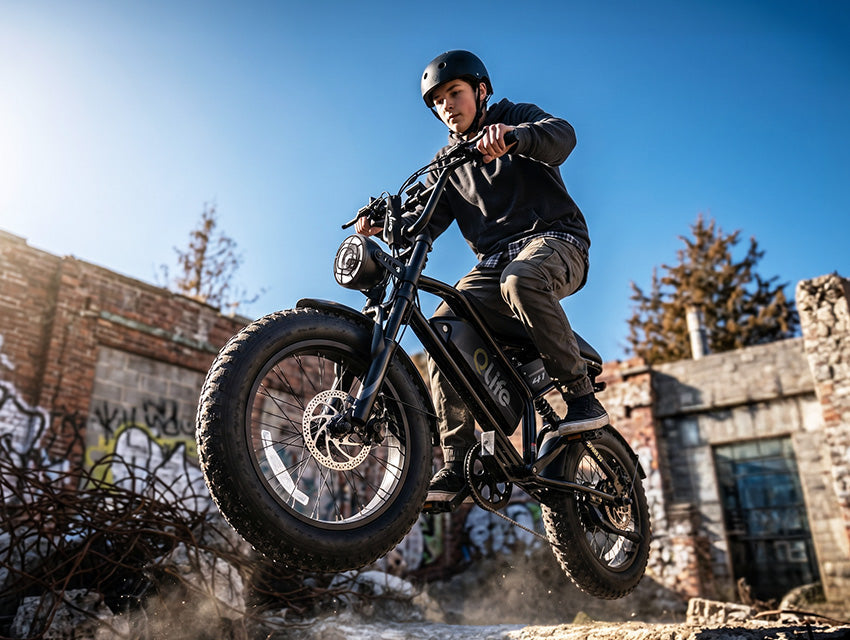
Look online for an electric bike, and you’ll find some models that appear more like small mopeds or mini motorcycles than traditional bicycles. They have fat tires, long seats, strong frames, and even the characteristic headlight. Many wonder whether these models are mopeds or e-bikes.
Despite their appearance, many moped-style e-bikes can still be considered e-bikes. They might look unusual. But appearance isn’t the main factor. Classification instead depends on features such as pedals, motor output, speed, throttle behavior, and local laws.
It’s important to understand the difference. If an e-bike slips into the moped category, it can require a license, registration, and insurance to ride on public roads. That’s why we’ve outlined how to tell the difference below.
What is a Moped-Style e-Bike?
Moped-style e-bikes are electric bikes designed with moped or motorcycle-inspired styling. Beneath the appearance, they’ve still got the same motor, battery, and suspension systems common to many other e-bikes.
Common features include:
- Long bench-style seat
- Fat tires
- Upright handlebars
- Larger frame
- Front and rear suspension
- Headlight and brake light
- Throttle support
 Take the Spark Moped-Style e-Bike, for example. It has fat, heavy tires, a front headlight and rear brake light, and a long bench-like seat. At first glance, it looks like a stripped-back motorcycle. However, the pedals, chain, and overall specs mean it’s much closer to being an e-bike.
Why Can a Moped-Style e-Bike Be Considered an Electric Bicycle?
A moped-style e-bike can look like a moped, but the key legal question is whether it still operates like a compliant electric bicycle. A moped-style e-bike is considered an electric bicycle because it has bicycle-like operation features.
The primary factors are:
- It has fully operable pedals.
- It uses an electric motor for assistance.
- It can be ridden like a bicycle.
- Its assisted speed and motor output fall within local e-bike limits.
- It does not require fuel, registration, or motorcycle-style controls in many places.
Just because it’s considered an e-bike doesn’t mean it will be legal to ride on every road, trail, or bike lane. Many moped-style e-bikes have a higher top speed or motor power than is legally allowed. However, you can usually adjust the settings to limit the available power from the motor.
It’s always sensible to check your local rules before riding, especially on roads and bike trails.
Electric Moped vs Electric Bike: What’s the Difference?
An electric moped is much closer to a motor vehicle. Legally, they often require registration, insurance, a license, a plate, mirrors, indicators, and any other road-approved equipment.
That’s not the case with a moped-style e-bike. It’s treated closer to a regular bicycle as long as it stays within the e-bike limits.
|
Feature |
Moped-Style E-Bike |
Electric Moped |
|
Pedals |
Usually has working pedals |
Often has no pedals |
|
Legal category |
Usually treated as an e-bike if it meets local limits |
Usually treated as a motor vehicle |
|
Power source |
Pedal assist and/or throttle |
Motor-powered |
|
License and registration |
Often not required for compliant e-bikes |
May require a license, registration, insurance, or plate |
|
Best for |
Short commutes, errands, casual rides, and riders who want a moped-like feel |
Road-based travel where higher speed and motor-only riding matter more |
The Role of Pedals, Motor Power, and Speed
Pedals
Pedals are one of the biggest differentiators between a compliant e-bike and a motor vehicle such as a moped or motorcycle. If it cannot be pedaled, it is much less likely to be treated as an e-bike. In contrast, even if it has a throttle, as long as it has pedal-assist, it can be classed as an e-bike. However, the bike still needs to meet local limits for motor power, assisted speed, and permitted use.
Motor Power
Motor power is where things get complicated.
In the US, the federal definition refers to an electric motor of less than 750W. However, many e-bikes have a much higher advertised motor power.
 For example, the Spark has a 1,800W peak motor power, and the Spark Max Dual Motor can hit as high as 3,000W, well above the legal limit.
That does not automatically tell you how the bike is classified where you live, but it does mean you should check the rated motor output, not just the headline number.
Speed
Speed is often the biggest gray area.
Under the federal definition, the motor-only speed must be less than 20mph on a paved, level surface, while bikes can reach up to 28mph on roads.
Broadly, the US uses a three-class system:
- Class 1: Pedal-assist only, with motor assistance up to 20 mph. No throttle.
- Class 2: Throttle-assisted e-bike, with motor assistance up to 20 mph. It may also have pedal assist.
- Class 3: Pedal-assist e-bike, with motor assistance up to 28 mph. Usually, no throttle, depending on state rules.
Most moped-style e-bikes don’t fall neatly into these categories. Some models allow speed or assist settings to be limited, but riders should not assume that changing settings automatically makes a bike legal in every location. Local rules may consider the bike’s rated output, labelled class, or actual capability.
Are Moped-Style e-Bikes Legal on Roads and Bike Lanes?
They can be.
If the moped-style e-bike meets the speed limit and other limits, it may be allowed on roads and bike lanes. However, the rules vary by state, city, trail system, park, and even bike path. Class 1, 2, and 3 e-bikes may also be treated differently.
You’ll want to look for maximum motor power limits, throttle rules, and speed limits before heading out. The last thing you want is a hefty fine.
Why Riders Choose Moped-Style e-Bikes?
With so much legal complexity, you might wonder whether they’re more of a headache than they’re worth. Yet, moped-style e-bikes are extremely popular.
It’s not hard to see why. They’re great for riders who want comfort, stability, and a relaxed seated position. Plus, they just look a lot cooler than your average e-bike.
They’re best for:
- Short commutes
- Campus travel
- Local errands
- Weekend rides
- Riding on rougher streets
- Riders who prefer a larger frame feel
- People who want an e-bike that feels less like a traditional bicycle
So, Is an Electric Moped Really an Electric Bicycle?
In short, a true electric moped is not the same as an electric bicycle. It might be easy to confuse it with a moped-style e-bike, but the pedals, motor, and overall speed and power are very different.
That being said, it’s not always so clear-cut.
If an e-bike crosses the speed and power limits, it may be treated more like a moped, motorcycle, or motor-driven cycle. The question is whether there’s a way to self-limit power and speed when riding in a public location. Don’t worry; you’re still able to dial up your e-bike to the max on private land (just as long as you have the owner’s permission).
Find a Moped-Style E-Bike That Actually Fits Your Ride
The best e-bikes aren’t always the ones with the biggest motor or the highest top speed. Those things matter, but only if they match how you actually ride.
A bench-style seat, fat tires, full suspension, and a front headlight can transform a regular e-bike into something special. They give you the comfort and presence of a small moped, with the flexibility of an electric bike.
Qlife’s moped-style e-bike collection is a good place to compare that kind of design. You’ll find models built for everyday trips, rougher roads, weekend rides, and riders who want more power and comfort than a traditional city e-bike usually offers.
Explore Qlife’s moped-style e-bikes and find the model that fits the way you actually ride.
FAQs
Is a moped-style e-bike the same as a moped?
No. A moped-style e-bike borrows the look of a moped but may still be classed as an e-bike. Look for pedals and whether they meet local e-bike limits.
Do moped-style e-bikes need a license?
Generally, no. As long as the e-bike complies with local rules for e-bikes, you won’t need a license. However, rules vary by location, especially for faster or more powerful models.
Can you ride a moped-style e-bike in a bike lane?
Sometimes. If the e-bike is compliant with the local rules, you may be able to ride in a bike lane. However, the rules can prevent bikes with throttles or high speeds from using the lane.
Why do some e-bikes look like motorcycles?
A combination of aesthetic appeal and comfort. Many riders prefer the stability, comfort, and road presence that comes from a motorcycle-inspired design. But it also looks cool.
What makes an e-bike different from an electric motorcycle?
The main difference is the presence of working pedals. If an e-bike can be pedaled (even if it has a throttle), it’s generally categorized as an e-bike. However, things can become more complicated if it exceeds the federal or local motor and speed limits.
Share:
Has an Electric Bike Changed Your Life?
Are Electric Bikes Under $800 Worth It? What You Actually Get