
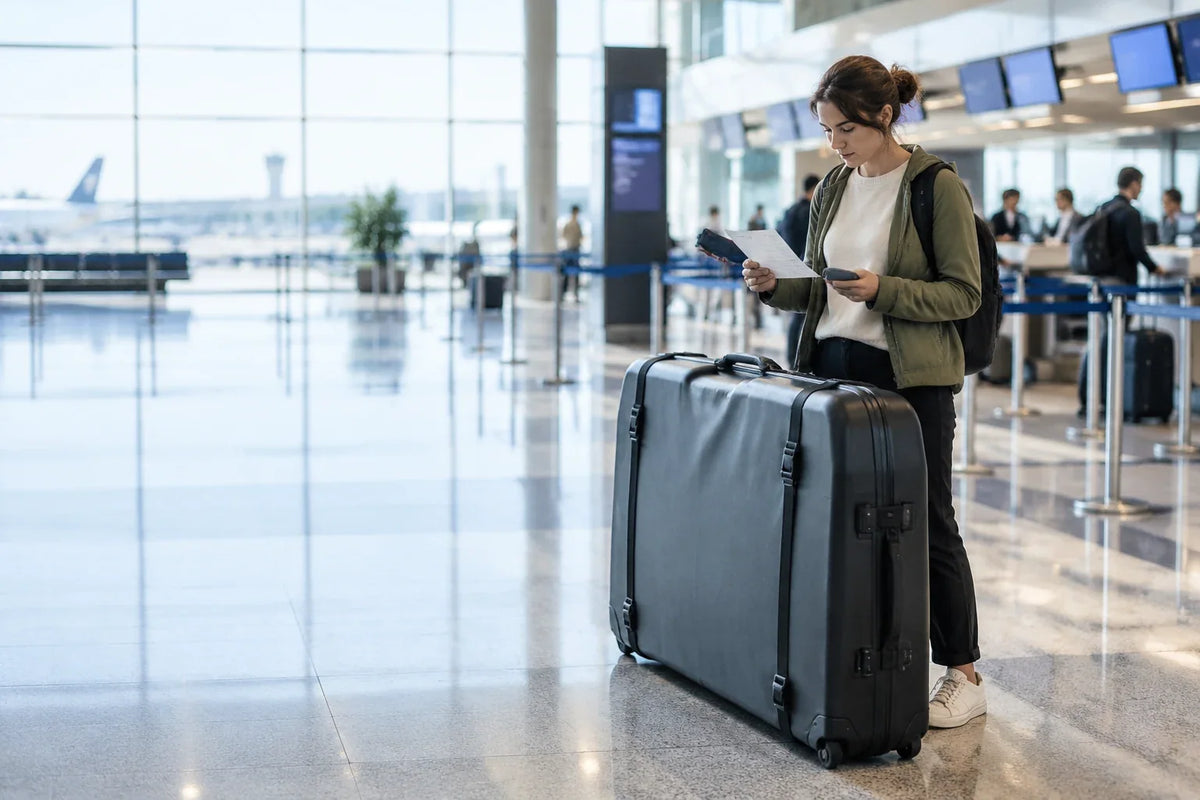
You're planning a bike trip across the country, and you want to bring your e-bike. The airline's website says it accepts bicycles. Great. Except your bike has a 500Wh battery, and the carrier's sporting equipment page doesn't say anything about the motor or battery strapped to the downtube.
Here's the problem: an airline's regular bicycle policy does not automatically include e-bikes. The battery faces federal passenger limits, and the complete bike faces the carrier's vehicle rules. You need both checks before you book.
This guide walks through the FAA passenger battery limits, shows you how to find your bike's watt-hours, explains what removing the battery does and does not change, and tells you what to verify with the operating airline. I'll use published Qlife battery specs as worked examples.
The Short Answer: Check the Battery and the Bike Separately
The FAA's passenger battery guidance sets watt-hour limits for lithium batteries in passenger baggage. Batteries between 0 and 100 watt-hours (Wh) are generally allowed in devices. Batteries between 101 and 160 Wh need airline approval, and batteries above 160 Wh are not allowed as passenger baggage under the FAA battery rules.

That's the battery. Now the bike.
Airlines maintain separate rules for motorized vehicles, battery-powered devices, and sporting equipment. A carrier might accept standard bicycles as checked baggage while explicitly prohibiting battery-assisted bikes or electric scooters in the same policy document. Removing the battery does not convert your e-bike into a regular bicycle for policy purposes. The frame still has a motor.
The FAA passenger battery page does not name e-bikes or decide whether a carrier accepts the complete bike. Check both the battery rules and the operating airline's current policy on electric or motorized bicycles.
What the FAA Passenger Battery Limits Say
The FAA page is marked "Last updated: Friday, October 2, 2026." It gives these passenger battery rules:
| Battery capacity | Installed in device | Spare batteries | Carry-on or checked |
|---|---|---|---|
| 0-100 Wh | Allowed | Allowed (protection required) | Carry-on only for spares |
| 101-160 Wh | Allowed with airline approval | Allowed with airline approval (max 2 spares) | Carry-on only for spares |
| Above 160 Wh | Not allowed | Not allowed | Not allowed as passenger baggage |
| Wheelchair/mobility aid batteries | Special provisions apply | Special provisions apply | Check FAA mobility aid guidance |
The FAA guidance warns that airlines can be more restrictive. Spare lithium batteries must travel in the cabin, not checked baggage.
Notice what this table does not say: it doesn't name e-bikes. It covers batteries in general. The airline's bike policy is a separate question.
Can you take an e-bike battery on a plane? The FAA's general passenger battery limits allow batteries up to 100 Wh, require airline approval for batteries between 101 and 160 Wh, and do not allow batteries above 160 Wh as passenger baggage. Those limits do not establish whether an airline accepts the e-bike itself.
That gets the battery into the cabin or checked hold. It does not get the bike itself accepted as baggage.
Find the Battery's Watt-Hours Before You Call
Your battery label or owner's manual will list voltage (V), amp-hours (Ah), and sometimes watt-hours (Wh) directly. If you only see volts and amp-hours, the math is:
Volts x Amp-hours = Watt-hours
Example: a battery marked 36V and 10Ah is 360 Wh (36 x 10).

If the label shows milliamp-hours (mAh) instead of amp-hours, divide by 1,000 first. A 48V battery rated at 13,500 mAh is 48V x 13.5Ah = 648 Wh.
Don't guess watt-hours from the bike's range estimate or the motor's rated power. Range depends on terrain, rider weight, assist level, and wind. Motor wattage is not battery wattage. Read the label.
If your battery case, manual, and product page give conflicting numbers, call the manufacturer before you pack. Keep a clear photo of the physical label in case the airline asks you to verify the rating.
Removing the Battery Does Not Guarantee the Bike Can Fly
You might think: "I'll remove the battery, check the bike, and carry the battery separately." That is not a universal workaround. Some airlines prohibit motorized bikes outright, while others may accept the bike with its battery removed, subject to separate limits for any battery carried in the cabin.
Here are three examples from official carrier pages checked on 2026-10-29:
| Airline | E-bike or motorized bike status | Page checked |
|---|---|---|
| Alaska Airlines | Electric or motorized bicycles may be accepted as checked baggage with the battery removed. The removed battery must be no more than 160 Wh, protected from short circuit, marked with its Wh rating, and carried in the cabin. Devices weighing 100 lb or more are not accepted as checked baggage. | Batteries and electronic devices |
| Air Canada | Battery-assisted bikes, electric scooters, and motorized bicycles are not accepted in checked or carry-on baggage. Standard bicycles have separate acceptance rules. | Special Items |
| Delta | Its battery page gives generic battery rules. Its bicycle allowance is specifically for non-motorized bicycles; the reviewed pages do not say whether a battery-removed e-bike is accepted. | Battery or Fuel-Powered Items and Sporting Equipment |
These examples show why "bicycles accepted" is not a complete answer. This is not a survey of every airline; check the current policy for every carrier operating your itinerary.

What to verify with the airline
- Operating carrier on every segment. Your ticket might say United, but the regional flight is operated by SkyWest. Check SkyWest's rules.
- Codeshares and connections. If you connect through Toronto on an Air Canada flight, Air Canada's prohibition applies even if your departing U.S. carrier is silent.
- E-bike, not just bicycle. Find the page that names battery-assisted bikes, motorized bicycles, or electric scooters. The standard bicycle page is not enough.
- Written confirmation. If the rule is vague or missing, get a dated email or reference number from the airline before you book.
FAA guidance provides separate battery provisions for wheelchairs and other mobility aids used by passengers with disabilities. Those provisions apply to the mobility device, not a recreational e-bike, and do not create an e-bike battery exception. See the FAA's wheelchair and mobility-device guidance.
If the Airline Accepts the Bike, Check Its Packing and Baggage Terms
Let's say you found an airline that explicitly allows e-bikes as checked baggage. You still need the carrier's packing rules, size limits, weight limits, fees, and advance-registration requirements.

Air Canada's standard bicycle page (not the e-bike prohibition page) gives this example for regular bikes: pedals removed or turned inward, handlebars fixed sideways, tires partially deflated, bike in a hard or soft case. Maximum dimensions and fees vary by route and fare class.
I'm not going to copy those specs here because they change, and I can't verify that any carrier applies the same packing steps to an approved e-bike. If your airline gives you a green light for the bike, follow its published case, weight, size, and check-in instructions exactly. Print the policy page and bring it to the airport.
Don't rely on old packing guides. Fees and limits can change, so check the current terms for your route.
Qlife Battery Examples: Why the Exact Model Matters
Here's why you need your bike's actual watt-hour rating. Qlife's product pages list two models with different battery sizes:
| Model | Battery spec | Calculated Wh | Compared to FAA passenger limits |
|---|---|---|---|
| Qlife Hunter | 48V / 13.5Ah | 648 Wh | Above the FAA passenger battery limit; the battery is not allowed as passenger baggage. |
| Qlife Hunter Plus | 48V / 20Ah | 960 Wh | Above the FAA passenger battery limit; the battery is not allowed as passenger baggage. |
Both published capacities exceed the FAA's general 160 Wh passenger battery ceiling. The FAA table covers batteries generally; it does not state a separate e-bike ban. Check the airline's policy for the bike with the battery removed as well as for the battery itself.
Specifications are from the manufacturer product pages, checked 2026-10-29. Verify the rating on your exact battery's physical label before travel.
Both packs exceed 160 Wh, so neither can travel as passenger baggage. An airline may still accept the bike with its battery removed under a separate baggage policy. Air-freight shipment has requirements outside this passenger guide. Otherwise, rent a similar bike at your destination or use ground transport.
For more on e-bike battery safety basics, see the UL 2849 and charging guide.
If the Carrier Says No
If the airline prohibits your bike, or you cannot travel with its battery, consider these alternatives:

- Rent at your destination. Many bike shops and tour companies rent e-bikes by the day or week. You skip the baggage hassle and the airline question entirely.
- Check whether the manufacturer offers a compatible pack at or below 160 Wh. Don't treat this as an available option until the manufacturer confirms the exact pack fits your model. Then confirm the airline accepts the bike in that configuration.
- Drive or take a train. If the trip allows it, transporting a heavy e-bike by car on a hitch rack avoids the airline battery question. Check the rack and vehicle ratings, and secure or remove the battery as directed by the bike maker.
- Consider a folding e-bike only after checking its battery. A compact frame does not change the battery limit or the carrier's motorized-bike rules. See the folding e-bike size and weight guide.
What about air freight or battery shipping? That's a separate process with requirements this passenger guide does not cover. Contact the carrier's cargo desk or a qualified shipper for current guidance.
Pre-Booking Checklist
Before you buy a ticket:
- Identify every operating carrier and flight segment. The booking brand may not be the airline operating each leg.
- Document the battery. Photograph its label, record voltage and amp-hours, calculate Wh if needed, and compare it with FAA passenger limits.
- Find each airline's e-bike rule. Check whether the complete bike is accepted with the battery installed or removed; a standard bicycle page may not cover it.
- Verify the baggage details. Confirm registration, case, size, weight, fees, and check-in requirements for the accepted configuration.
- Keep written evidence and recheck. Save the policy page and any email or reference number, note when you checked, and confirm again about a week before departure.
FAQ
Can I bring an e-bike battery in carry-on baggage?
It depends on the battery's watt-hours. Under FAA passenger rules, batteries between 0 and 100 Wh are generally allowed; batteries between 101 and 160 Wh require airline approval, and batteries above 160 Wh are not allowed as passenger baggage. Spare batteries must be carried in the cabin and protected from short circuits.
Even if the battery clears FAA limits, the airline can still refuse the complete e-bike. Check the carrier's motorized-vehicle or e-bike policy separately.
Can I check an e-bike if I remove its battery?
Possibly, if the operating airline explicitly accepts the battery-removed bike. See above for the battery Wh limits. The key point here is that removing the battery does not convert the bike into a standard bicycle for airline-policy purposes: Air Canada prohibits motorized bicycles, while Alaska publishes conditions under which it may accept them without the battery.
If the policy is silent, ask the airline and get written confirmation before packing.
Does a folding e-bike count as a regular bicycle?
Not automatically. Folding changes the packed size, but it doesn't change the fact that the bike has a motor and a battery. The airline's e-bike or motorized-vehicle policy still applies.
A folding e-bike might fit carry-on dimensions when packed, but that alone does not make it eligible. You still need to meet the battery limits and confirm the airline allows the complete motorized bike in the cabin.
For folding bike details, see the folding e-bike buying guide.
Can I take a 500Wh e-bike battery on a passenger flight?
No. A 500 Wh battery exceeds the FAA's 160 Wh passenger-battery limit and is not allowed as passenger baggage, in carry-on or checked baggage.
If your bike uses a 500Wh pack, you cannot fly with that battery under the passenger rules reviewed here. Air-freight shipment has separate requirements outside this guide's scope.
What if my flight is operated by a different airline?
Check the operating carrier's rules for every segment. A United ticket might put you on a SkyWest regional jet. A Delta codeshare might be operated by KLM over the Atlantic. The operating airline's policy controls, not the ticket brand.
Look at your booking confirmation for "operated by" language, then find that carrier's e-bike or battery-powered vehicle page. If you're connecting through a hub in Canada or Europe, the foreign carrier's rules apply to that leg.
Is air-freight shipping the same as checking a bike?
No. Air-freight shipment is a separate process with requirements outside this passenger-baggage guide.
If passenger baggage doesn't work and you want to ship the bike, contact the carrier's cargo desk or a qualified shipper for current guidance.
Final Thoughts
Can you fly with an e-bike? Sometimes. The answer depends on the battery's watt-hours, the operating airline's explicit e-bike policy, the route, and whether you can document the accepted configuration before check-in. Use this guide as a framework, not boarding clearance; the airline's current rules determine what it will accept.
I've flown with standard bikes plenty of times. E-bikes are harder. The battery rules are federal. The bike rules are per-carrier. The two questions don't always line up.
If your battery is 100 Wh or less and the airline explicitly allows e-bikes, follow its packing and registration rules. For a battery between 101 and 160 Wh, get the airline's approval before you book. A battery above 160 Wh is not allowed as passenger baggage under the FAA rules reviewed here, though a carrier may have a separate policy for accepting the bike with its battery removed.
If I want to travel with a large-battery e-bike, I'm renting or driving unless I can confirm a compliant plan for both the bike and battery.
Check the rules. Save the pages. Get it in writing. And have a backup plan.
Share:
Qlife Spark vs Spark D2 vs Spark Plus: Which Fits Your Ride?