
Full suspension e-bikes often cost significantly more than standard e-bikes. Customers can find it confusing just how much the price can spike from a rear shock absorber, with prices ranging from $2,500 to well over $10,000, depending on the model.
The higher prices aren’t just branding. Full suspension e-bikes are much more complicated to engineer and manufacture, with adjustments needed to the frame, battery, and even the motor.
This article takes a closer look at full suspension e-bikes, explaining why they’re so pricey and what you should look for if you’re considering buying one.
What Is a Full-Suspension E-Bike?
All e-bikes come with suspension, usually in the form of a front suspension fork. This cushions the bike as it heads downhill or moves over uneven ground. They’re generally known as hardtail e-bikes.
However, only full suspension e-bikes have both a front suspension fork and a rear shock absorber. This reduces bouncing at the rear of the bike, increasing traction and rider control.
Here’s a breakdown:
· Front suspension: Uses a suspension fork to absorb impacts through the front wheel, improving comfort and steering control on rough roads and trails.
· Rear suspension: Uses a rear shock and linkage system to absorb impacts beneath the rider, creating a smoother and more stable ride over uneven terrain.
You’ll commonly find full-suspension systems on mountain bikes or serious off-road models. But they also help with long-distance comfort and rider fatigue that comes with persistent vibration.
Suspension Systems Are Expensive to Build
Rear Suspension Adds Mechanical Complexity
Rear shock absorbers aren’t as simple as a front suspension fork. It works relatively simply by allowing the front wheel to travel up and down. However, rear shocks require pivot points, linkages, and bearings to handle the constant vibrations and uneven terrain that the back wheel experiences.
Plus, parts of the frame might need to be reinforced as a result.
High-Quality Shocks Cost a Lot
Not all suspension systems are equal. Higher-end full suspension e-bikes often use premium air or coil shocks designed to handle greater weight, speed, and repeated impacts. Air shocks are lighter and more adjustable, while coil shocks are prized for durability and downhill performance.
Many premium models also use suspension components from brands like Fox and RockShox. These systems offer better tuning, smoother responsiveness, and longer-lasting performance — but they add significantly to the overall cost of the bike.
Stronger Frames Are Required
You might think that a better suspension system puts less stress on the frame. That’s partly true. But the systems also increase the weight on the rear wheel, requiring reinforced aluminum or carbon fiber frames.
E-Bike Motors and Suspension Must Work Together
Suspension systems don’t exist in isolation. They’ve got to work alongside the motor. Added motor torque naturally puts more stress on the frame. The suspension system must accommodate this while maintaining proper weight distribution and handling. Engineers must consider where to put the battery and how to allow for suspension travel.
Get it wrong, and it could lead to a seriously uncomfortable ride or awkward handling.
Batteries Increase Weight and Engineering Challenges
Full suspension systems can add as much as 10 kg to an e-bike. The extra weight also increases power demands, often requiring larger batteries to maintain range. Considering batteries are one of the most expensive parts of an e-bike, it further increases the price.
There’s also the difficulty of integrating the battery with rear suspension layouts. Many manufacturers opt to put the batteries inside the frame, but that increases complexity. Otherwise, as mentioned, there are weight distribution issues to factor in.
Research and Development Costs Are Higher
One of the factors customers forget about is R&D.
E-bike manufacturers (more than most brands) spend a lot on making new models. After all, there’s a lot of competition between brands to introduce new features, push the limits of modern technology, and offer something no one else has.
That R&D process drives up the final cost of the bike. Manufacturers aren’t just factoring in the cost of materials and labor, but the time it takes to turn the e-bike from idea into reality.
Nor is it just building and integrating the full suspension system. E-bikes undergo:
· Geometry testing
· Suspension tuning
· Durability testing
· Software tuning for motor response
Cheaper models usually mean the manufacturers cut corners, either in testing, R&D, or materials. That’s not necessarily bad. It just means the quality standards aren’t what you’d expect from a full suspension e-bike.
Can You Buy a Good Budget Full Suspension E-Bike?
There definitely are models on the cheaper end of the spectrum that offer a solid full suspension system. However, as explained, lower prices have to come from somewhere. Often, it means the bike is heavier, uses more practical components, or has less refined suspension tuning than premium downhill-focused models.
Budget models can still be a great option. But riders should understand what “budget” really means in this category. It doesn’t always mean poor quality. More often, it means the bike is designed for everyday comfort, mixed-terrain riding, and recreational adventure rather than professional-level trail performance.
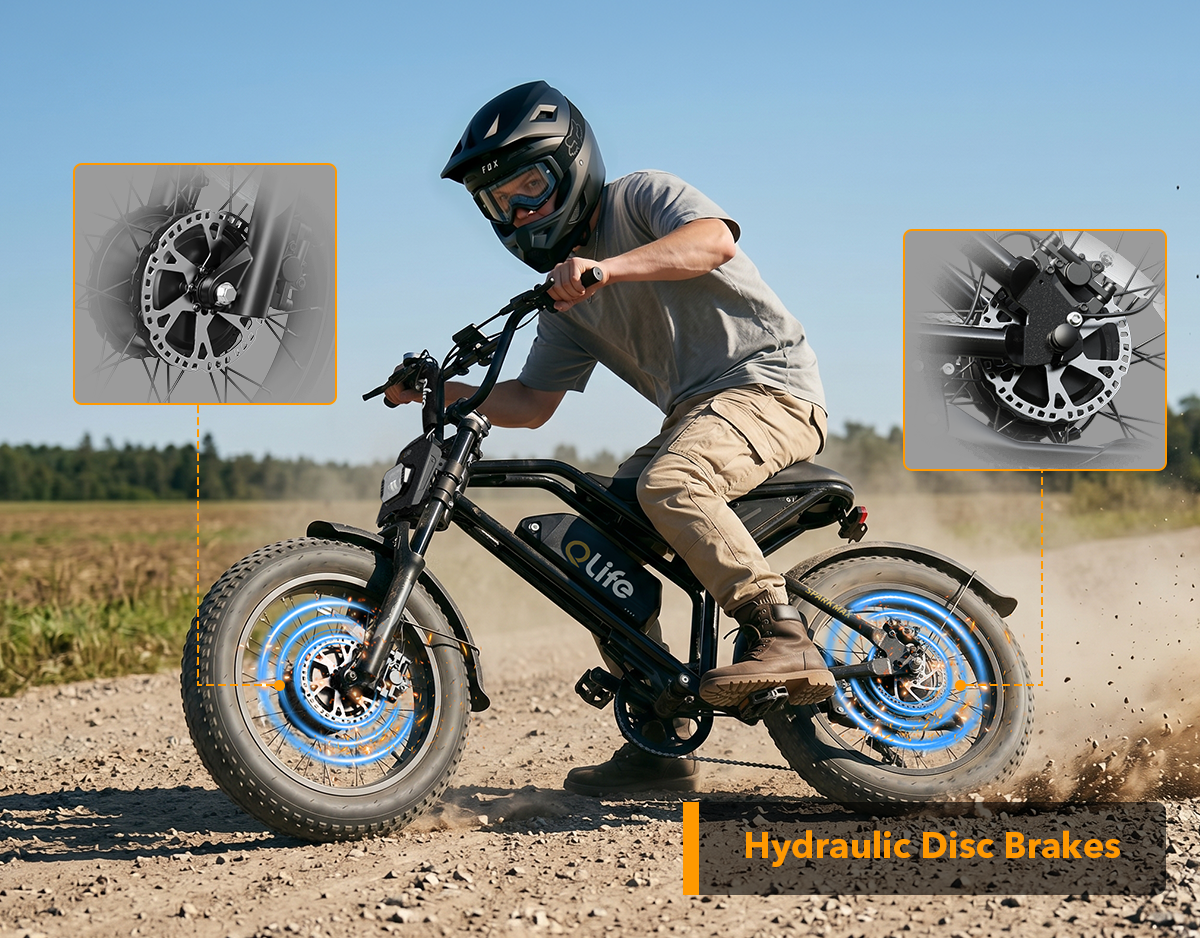
A good example is the Qlife Racer Fat Tire 2.0, which starts at $659. Instead of trying to compete with high-end mountain e-bikes that cost several thousand dollars, it focuses on the features most everyday riders actually feel: comfort, traction, power, and range.

The Racer Fat Tire 2.0 uses a full suspension setup with a hydraulic front fork and rear shock absorber, helping reduce bumps and vibration on rough roads, gravel paths, light trails, and uneven city streets. It also pairs that suspension system with 20 x 4.0-inch all-terrain fat tires, which add extra cushioning and grip. For riders who want a smoother ride without paying premium full-suspension prices, that combination makes a lot of practical sense.
Performance is another reason it fits the budget full suspension category well. The bike comes with a 1200W peak motor, a 28 mph top speed, a 48V 13Ah removable battery, and up to 60 miles of range with pedal assist. It also supports up to 350 lbs of payload capacity, which makes it useful not only for casual rides, but also for riders carrying gear, commuting essentials, or accessories.
Of course, a $659 full suspension e-bike should not be confused with a $5,000 performance eMTB built around premium suspension brands and advanced trail geometry. But that is not the point. For many riders, the real question is not “Can this replace a professional downhill bike?” It is “Can this make daily rides, rough pavement, weekend trails, and mixed terrain feel more comfortable?” In that context, the Racer Fat Tire 2.0 is a strong example of how budget full suspension e-bikes can still deliver real-world value.
Are Expensive Full Suspension E-Bikes Actually Worth It?
In short, yes — if you need what they offer.
Full suspension systems are one of the main areas that can justify a higher price tag. They offer a smoother, more comfortable ride that cushions the bike on mountain trails, rough terrain, or during long rides. If you deal with back, joint, or comfort issues, they can be a sensible pick, even if you’re not riding aggressively downhill.
That being said, not every rider needs to spend several thousand dollars. If you mostly ride short distances on smooth roads, a premium full suspension e-bike may be overkill. If you ride across rough pavement, gravel, dirt paths, sand, snow, or mixed urban terrain, a more affordable model with full suspension and fat tires may be the better value.
That’s where bikes like the Qlife Racer Fat Tire 2.0 make the category more accessible. It gives riders a practical way to experience the comfort benefits of rear suspension, the stability of fat tires, and the power of a high-output motor without jumping into premium eMTB pricing.
The best choice depends on how and where you ride. Serious mountain bikers may still want a high-end full suspension eMTB. Everyday riders, commuters, and weekend explorers may find that a well-equipped budget model offers the comfort and capability they need at a much more reasonable price.
Share:
Aventon vs. Himiway vs. Qlife: Are Premium e-MTBs Worth the Extra Cash?
Trek vs Polygon vs Qlife: Is a Premium Full Suspension E-Bike Always Better?