
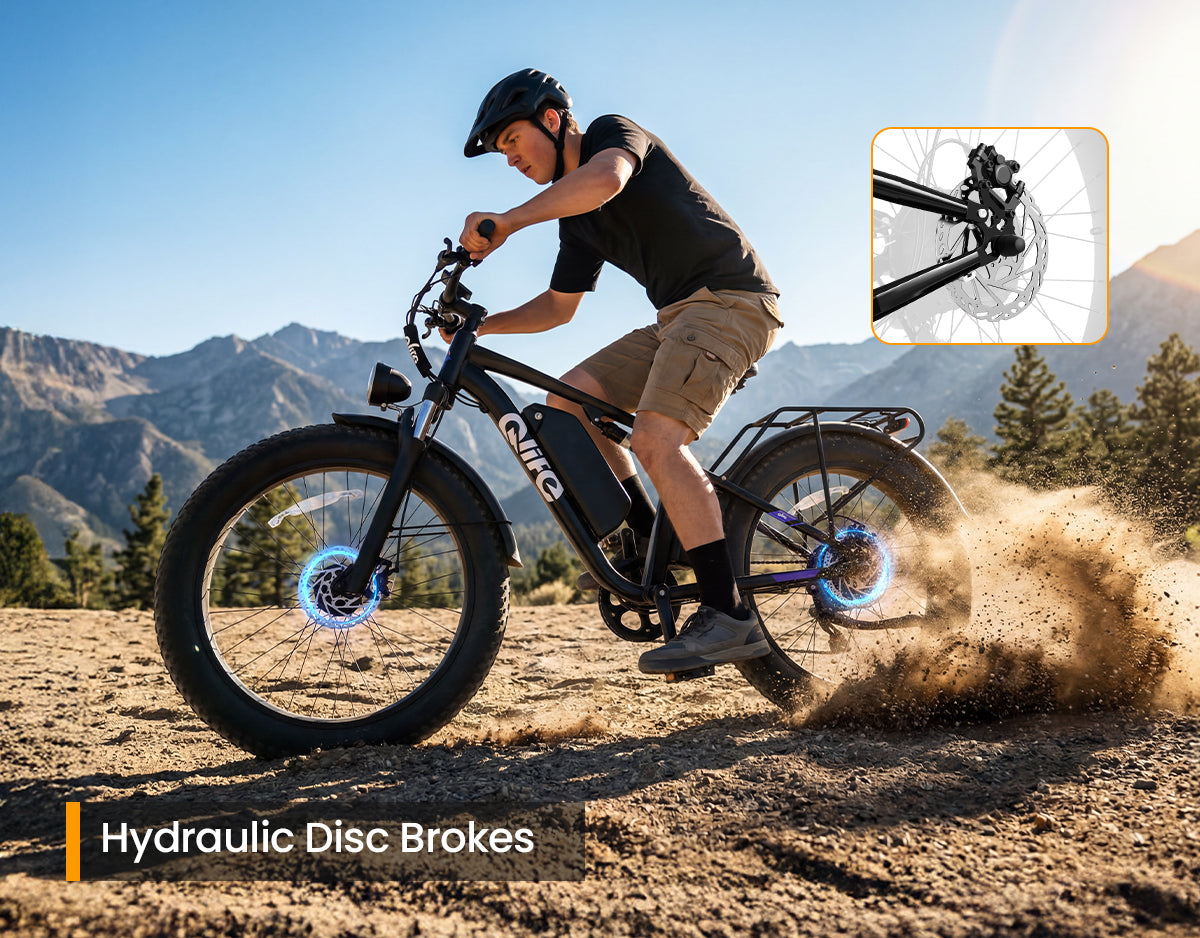
The electric mountain bike market has split into two fairly clear camps. There are the premium brands pushing mid-drive motors, trail-tuned geometry, and component specs borrowed from high-end mountain bikes. And then there are accessible brands building capable fat-tire and full-suspension bikes at prices that don't require a second mortgage.
Aventon and Himiway sit at the higher end, and Qlife sits at the accessible end. All three brands make a real case for their approach. This comparison breaks down what you get from each, what you give up, and who each brand builds for. More importantly, it should help you decide whether the premium is actually worth paying for the riding you plan to do.
What Each Brand Is Trying to Do
Before getting into specs and prices, it's worth understanding the philosophy behind each brand.
Aventon has built its e-MTB range around trail-specific performance. The Ramblas ADV is a proper hardtail with trail geometry, a mid-drive motor, and mountain bike components from SRAM and RockShox. The Current ADV is a full-suspension eMTB that competes directly with bikes costing two or three times as much. Aventon is going after riders who want to ride real trails on a real eMTB.
Himiway occupies the middle ground. It builds fat-tire bikes for all-terrain riding, full-suspension models for more demanding use, and mid-drive models for riders who want a more natural pedaling feel. The D5 series covers everyday riders and adventurers, while the Cobra Pro is built for serious off-road use.
Qlife builds capable e-MTBs at the lowest possible prices. The electric mountain bike range includes fat-tire hardtails from $569, full-suspension bikes from $549, and moped-style bikes up to $1,099. These are bikes for people to ride every day, for light trail riding, and for riders who want off-road capability without paying premium prices.
Aventon: Trail-Ready Performance
Aventon's eMTB range has two models that need to be in this comparison.
Ramblas ADV: $2,899
The Ramblas ADV is what happens when a brand that knows e-bikes decides to build a proper mountain bike. This isn't a commuter bike that can handle some dirt. It's a hardtail e-MTB with trail geometry, a mid-drive motor that works through the gears like a real mountain bike motor should, and components (RockShox suspension, SRAM drivetrain, four-piston hydraulic brakes, a dropper post) that you'd normally find on bikes costing considerably more.
The A100 motor gives you 100Nm of torque, which is plenty for climbing, and it's powered by a 708Wh battery that provides up to 90 miles of range. The 29-inch Maxxis tires are tubeless-ready, and the geometry is built for singletrack, not city streets.
This e-bike delivers a riding experience that most hub-motor bikes can't quite replicate on technical terrain. The motor feels like an extension of your effort, and the bike corners and descends like a mountain bike should. For the money, it's a serious piece of kit.
The trade-off is price. At $2,899, it costs more than twice as much as the most capable Qlife model.
Current ADV: $4,599
The Current ADV is Aventon's full suspension electric mountain bike, and it's a more ambitious machine than the Ramblas. This bike has front and rear suspension, a more powerful Ultro X motor with 110Nm of torque, an 800Wh battery, and up to 105 miles of range. It also comes with GPS tracking, 4G connectivity, a touchscreen on the top tube, and an integrated alarm system for security.
At $4,599, it's priced significantly below what comparable full suspension e-MTBs from established trail brands cost. For riders who want to ride demanding trails on a proper full-suspension bike without spending $8,000, it makes a strong case. For riders comparing it to the rest of this article, it's a different category.
Go with Aventon if: you want a dedicated trail electric mountain bike with proper mountain bike components, a mid-drive motor, and trail geometry. The Ramblas ADV is the best value in the sub-$3,000 hardtail e-MTB category.
Himiway: Power and Versatility
Himiway's electric mountain bike range covers more people's needs than Aventon's, with options from just under $1,500 through to nearly $4,000.
D5 2.0: $1,999
The D5 2.0 is where most riders start with Himiway, and it's easy to see why it's their most popular model. Full suspension, fat tires, hydraulic disc brakes, and a 48V 15Ah (720Wh) battery that gives you up to 65 miles of range, all for $1,999. That's a lot of bike for the money.
It's not a trail bike in the Aventon sense. It has a more relaxed geometry, and the hub motor doesn't feel as natural as a mid-drive on technical climbs. But for mixed terrain, gravel paths, heavier riders, and anyone who wants to ride off-road all day, it's hard to argue with what you get for the price.
D5 Pro: $1,799
If the D5 2.0 appeals but the hub motor puts you off, you should check out the D5 Pro. At $1,799, it uses a mid-drive motor with a torque sensor, which changes how the assistance feels. The power scales with your effort instead of just switching on when you pedal. On longer climbs and more varied terrain, this bike has a more natural and less mechanical feel. It has the same 960Wh battery and 80-mile range, but a noticeably different experience.
D7 Cobra Pro: $3,999
The Cobra Pro is Himiway's most capable model, built for riders who want more. This is delivered with a 1000W mid-drive motor with 160Nm of torque, enormous 26x4.8-inch fat tires, full suspension, hydraulic brakes, and the same large 960Wh battery as the rest of the D-series. It's heavy, and it's not trying to be a trail bike. This is the kind of bike used by hunters, backcountry riders, and anyone who needs maximum traction and range in conditions where most bikes would struggle.
Go with Himiway if you want a fat-tire eMTB with full suspension and a good range at a lower price than Aventon's trail bikes. The D5 2.0 is the entry point; the D5 Pro adds torque-sensor assistance; and the Cobra Pro is for riders who need maximum power and all-terrain capability.
Qlife: Accessible Performance
Qlife's electric mountain bike range isn't trying to compete with Aventon's trail bikes or Himiway's flagship models on performance. It competes on value, and it does that well.
 Let's start with the Racer Ultra 27.5" at $549. This is a full-suspension bike with 27.5-inch wheels, a capable motor, and up to 55 miles of range. For a beginner who wants to try trail riding without committing a lot of money, this is the most accessible full suspension e-MTB you'll find anywhere. The geometry is closer to a traditional mountain bike than any of the fat-tire options, making it a familiar and more comfortable starting point for riders coming from regular mountain bikes.
 The Racer Plus Fat Tire 2.0 at $749 takes things up a notch with 26x4.0-inch fat tires, a 1500W peak motor, and a 36 mph top speed. The fat tires allow you to ride on more surface types than the Racer Ultra can, making it more versatile. On top of this, the extra motor power makes a noticeable difference on steeper or more demanding ground. For riders who spend time on gravel, dirt roads, light trails, and loose surfaces, this is the Qlife model worth looking at.
 At the top of Qlife's electric mountain bike range sits the Racer Max Dual Motor at $1,099. This is a different beast, with two motors giving you 3000W peak output, a 52V 20Ah battery, and a 37 mph top speed on 26x4.0-inch fat tires. It sits outside Class 1 limits, so it's not a trail bike in the traditional sense. But for riders who want extra grunt for hunting, backcountry exploring, or simply covering long distances on varied terrain, there's nothing close to this spec at this price.
The honest trade-off with Qlife is the motor system. Hub motors and cadence sensors don't feel as connected to your effort as mid-drive motors with torque sensors. On mellow terrain, you won't notice much. But when you ride technical trails, you will. That's not a criticism. It's just the reality of what these bikes are built for, and at these prices, the gap is understandable. A mid-drive torque sensor adds cost, and Qlife has chosen to pass those savings to the buyer rather than add to the cost.
What Qlife does deliver is real performance at prices Aventon and Himiway simply can't get near. When you buy one of these bikes, you're not buying a compromise. You're getting a different kind of bike for a different kind of riding.
Go with Qlife if: budget is the priority, you're new to eMTB riding, or your riding consists mostly of light trails, gravel, and mixed terrain. The performance is real, the price is hard to argue with, and for the riding most beginners do, it's more than enough.
How Do They Compare?
The table below shows where each brand sits across the key factors. It's worth noting that entry price for Qlife reflects the Cityone Step Over 2.0, not a dedicated eMTB. The fat tire and full suspension models start higher. Aventon and Himiway's entry prices are their lowest dedicated eMTB models.
|
|
Qlife |
Himiway |
Aventon |
|
Entry price |
$469 |
$1,499 |
$2,899 |
|
Motor type |
Hub |
Hub / Mid-drive |
Mid-drive |
|
Torque sensor |
No |
D5 Pro and above |
Yes (all eMTBs) |
|
Full suspension |
From $549 |
From $1,999 |
From $4,599 |
|
Max range |
100 miles (claimed) |
65+ miles |
105 miles |
|
Trail geometry |
No |
Partial |
Yes |
|
Warranty |
365 days |
2 years |
2 years |
Are Premium e-MTBs Worth the Extra Cash?
It depends entirely on how you plan to ride.
If you're new to riding electric mountain bikes, exploring local trails and gravel paths, or looking for an e-bike that handles light off-road use without a premium price tag, a Qlife is a sensible starting point. Spending $2,899 on a Ramblas ADV before you know what kind of riding you enjoy is a significant commitment. Starting with a $549 Racer Ultra 27.5" or a $659 Racer Fat Tire 2.0 lets you discover what you want from an electric mountain bike before going further. You may find that you don't use it enough, or don't like it at all.
 If you've already spent time on trails and know you want mid-drive performance, trail geometry, and proper mountain bike components, the Aventon Ramblas ADV is hard to beat at $2,899. The quality of the motor, components, and handling is a significant step up.
If you want fat tire capability with more power and range than Qlife provides, but don't need trail-specific geometry, Himiway's D5 range sits in a useful middle ground. The D5 Pro's mid-drive torque sensor at $1,799 offers a more natural riding experience than any hub-motor bike, at a price that's still considerably lower than Aventon's range.
Premium e-MTBs are worth the extra cash when you'll use what they offer. For most beginner and intermediate riders, you won't. But if you find yourself wanting more after a season on a Qlife, that's a good problem to have. You'll know exactly what you want from the upgrade, and you'll spend wisely because of it.
Final Thoughts
Aventon, Himiway, and Qlife are all building capable electric mountain bikes. They just build them for different riders.
Aventon is for riders who want real trail performance. Himiway covers the middle ground with more power and range options. Qlife is for riders who want to get out and ride without spending a lot.
If you're starting out or want the most e-MTB for the least money, Qlife's electric mountain bike range is where to look. If you know you want to take trail riding seriously and are ready to invest in it, Aventon's Ramblas ADV sets the standard for what's possible under $3,000.
Share:
Is an Electric Mountain Bike Good for Beginners?
Why Are Full Suspension E-Bikes So Expensive?