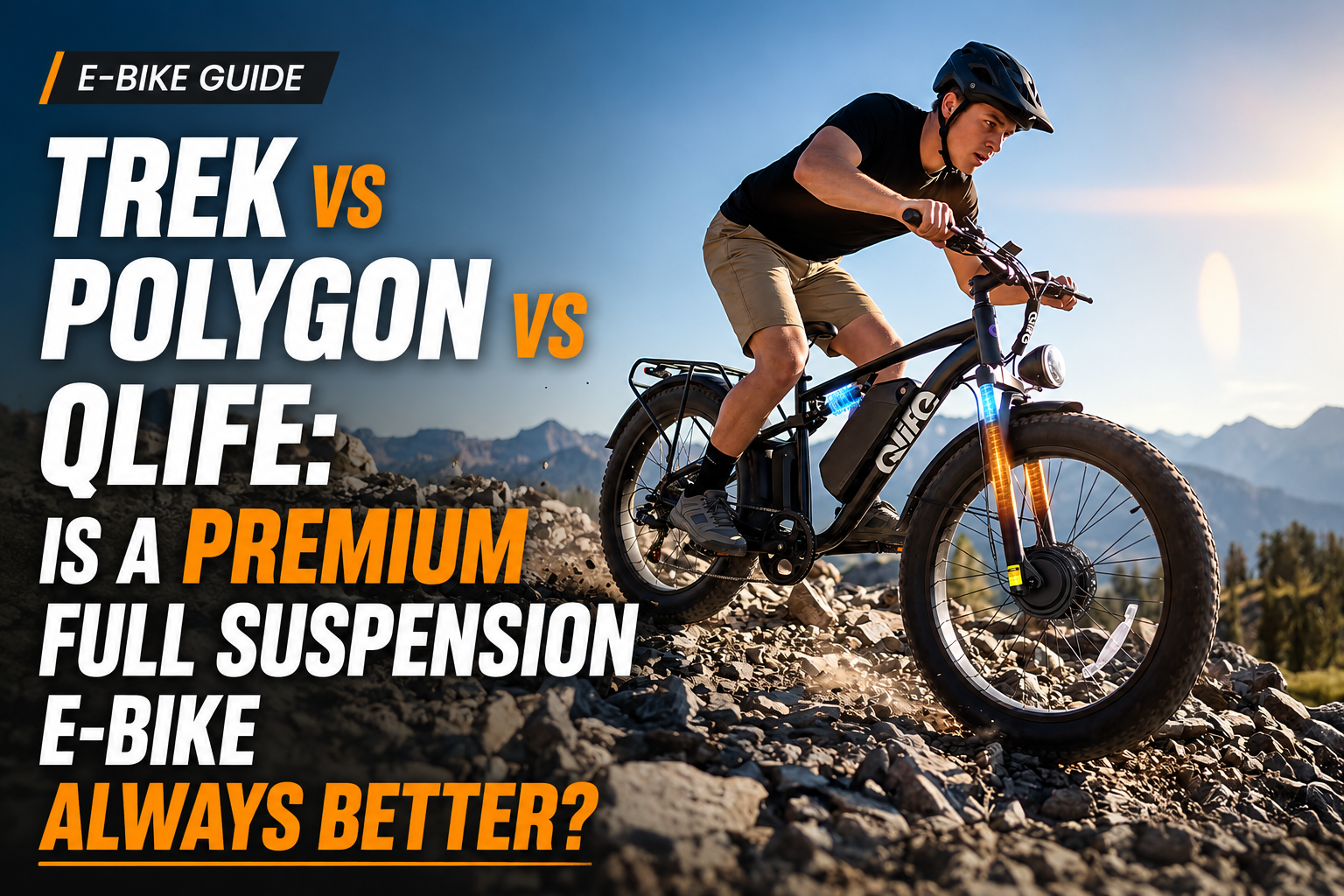
Full suspension e-bikes provide the most cushioning and comfort. Once, you could only get a full suspension e-bike at the highest price points. Now, it’s available for pretty much every rider, from casual commuters to experienced mountain bikers.
But what’s better — a premium or more affordable full suspension e-bike? Many people will tell you it’s always better to spend more money. However, while premium brands like Trek and Polygon dominate enthusiast discussions, for the average commuter or weekend trail rider, that level of suspension is unnecessary.
It all depends on what you want the suspension for — control or comfort. Below, we examine this question, comparing three leading brands of full suspension e-bikes for ride quality, suspension performance, and other factors.
What Makes a Full Suspension E-Bike “Premium”?
Quick Brand Overview
|
Feature |
Trek |
Polygon Bikes |
Qlife |
|
Typical Price |
Premium pricing ($4,000+) |
Mid-range to premium ($2,000–$5,000) |
Budget-friendly ($900–$1,600) |
|
Ride Feel |
Precise, refined, trail-focused |
Sporty and balanced |
Comfortable, relaxed, and easy to ride |
|
Motor & Power |
Smooth mid-drive systems |
Strong all-around performance |
Punchy acceleration and impressive power for the price |
|
Suspension Performance |
Excellent on technical terrain |
Very capable for mixed riding |
Best for comfort, gravel, and light trails |
|
Best For |
Serious mountain bikers |
Riders wanting premium feel at lower cost |
Commuters, beginners, and everyday riders |
|
Overall Value |
High-end performance with a premium price tag |
Strong balance of quality and cost |
Outstanding feature-to-price value for most riders |
Suspension Quality — The Biggest Real Difference
Suspension is one of the main areas in which premium bikes justify their price. The choice is often between a hardtail (front suspension alone) or a full suspension system (front fork and rear shock). Generally, for casual riders, a hardtail is a reasonable option. But if you’re heading off-road or riding long distances, a full suspension makes a real difference to comfort and rider fatigue.
Trek’s Suspension Performance
Not all Trek e-bikes offer a full suspension system. They’re pretty much standard on their mountain and off-road bikes, with high-quality front forks and rear shocks. The brand relies on sophisticated linkage systems for better small bump sensitivity, helping give riders greater control over a technical descent.
What’s interesting is how they handle commuter bikes. The Charter+, for example, uses a front suspension system alongside a suspension seat post. Rather than installing a full rear shock — unnecessary for city riding — this combination works together to smooth out rough roads.
Polygon’s Approach
Polygon is all about pushing your riding skills to the uttermost limits. For that, riders need the traction that only comes with a full suspension system. These ultra-performance e-bikes almost exclusively use front forks and rear shocks that minimize bumps on the trail. The rear wheel, therefore, maintains close contact with the ground, allowing riders to handle tough descents they wouldn’t dare try with other models.
Take the Polygon Siskiu TE. With 140/150mm travel, it offers precision balance and control for technical climbs, flowy descents, and everything in between. Meanwhile, the heavier-duty Collosus NE comes with a 160mm travel front fork and 205mm x 65 mm Trunnion Mount Shocks that are designed for this specific model. It’s nothing short of a boulder dominator.
Qlife Suspension Reality
Qlife doesn’t offer full suspension systems on most of its e-bikes. (The main exceptions being folding and commuter e-bikes.) Generally, riders are given the option of a front or full suspension.
 The Racer Max, for instance, is equipped with a front and rear dual suspension system designed for rugged mountain paths, forest trails, or rough off-road terrain. While it’s not as advanced as either Trek or Polygon, it’s also a fraction of the price. The Racer Plus is quite literally a tenth of the price of some Trek models, giving beginners and those on a tighter budget the chance to enjoy off-road riding.
Motor Systems: Mid-Drive vs Hub Motor
Motors are more than just speed or power. Where the motor is positioned on the bike affects everything from climbs and corners to handling and even how natural the ride feels overall.
Mid-Drive Motors (Trek and Some Polygon Models)
Premium full suspension e-bikes usually use mid-drive motors mounted low and central in the frame. That matters because the weight sits near the rider’s center of gravity, rather than being concentrated in the rear wheel.
The Trek Rail+ 9.9 X0 AXS T-Type Gen 5 is a good example. It uses a Bosch Performance Line CX system, paired with an 800Wh battery and 160mm of front and rear suspension travel. That makes it a serious e-MTB setup, built for controlled climbing, descending, and rough terrain rather than just straight-line speed.
Similarly, the Collosus TLE relies on a Bosch Performance Line SX motor with a Bosch CompactTube 400 battery.
In plain terms, Trek and Polygon are built for riders who want the e-bike to feel like a proper mountain bike first, with electric assistance layered on top.
Hub Motors (Common on Qlife)
Qlife takes a different approach. Its bikes are more focused on accessible power, everyday usability, and strong value.
 The Cityone 2.0, for example, uses a 1,200W peak brushless motor positioned at the rear hub. It’s intended for commuting, city rides, and comfort, rather than expecting the front wheel to grip onto the terrain and drag the bike forward. It’s simply unnecessary.
The Racer Max, however, pushes the hub-motor formula much further. It uses a dual motor system with up to 3,000W peak power, made up of a 1,800W front motor and 1,200W rear motor. It delivers strong climbing power and traction, just at a much lower price.
Components Matter More Than Raw Power
A lot of budget e-bikes focus heavily on wattage numbers and top speed. That matters. But real ride quality usually comes down to the components surrounding the motor. After all, it’s rare to truly push a motor to its limits.
Brakes
Premium brands like Trek and Polygon typically use higher-end hydraulic brake systems with larger rotors and better modulation. That means smoother braking control and more confidence on descents.
That becomes much more important if you’re tackling technical trails or cruising at high speeds. However, for most riders, mechanical disc brakes are good enough. Qlife offers solid hydraulic brakes on many bikes, but they’re usually less refined under aggressive riding.
Drivetrain
Premium drivetrains shift more smoothly under power and tend to last longer under hard riding. Features like clutch derailleurs also help reduce chain slap and improve chain retention on rough terrain.
That matters more than many riders realize, especially on full suspension bikes where drivetrain stress is higher.
Wheels and Tires
Riders rarely look at the wheels or tires first unless they fall into the experience category. Higher-end bikes generally use stronger wheelsets, lighter rims, and better tire compounds to improve grip and rolling speed.
Qlife favors fat tires on all its full suspension e-bikes. That combination offers the greatest level of comfort, which works well for casual riders and mixed terrain.
Ride Feel: Comfort vs Precision
Full suspension systems are often marketed as a synonym for control. The idea is simple: the less a bike bounces on the trail, the more traction and grip it maintains. Skilled riders can maneuver the bike more precisely under difficult conditions.
But that’s not the only aspect. Full suspension is also about comfort.
Premium E-Bikes Feel More Controlled
Trek and Polygon cater to the most experienced riders. For them, a full suspension system doesn’t ease their backache or provide a more comfortable commute; it offers better cornering, less frame flex, and more confidence at high speeds.
It’s no surprise that these brands emphasize these benefits. It’s what their riders want.
Budget Full Suspension Bikes Feel More Relaxed
All full suspension systems offer greater control. But you’ll find more affordable brands focus on the softer ride and greater comfort. Often, these riders want a balance between off-road riding and commuting with a full suspension system that minimizes rider fatigue.
Who Benefits Most from a Premium Suspension E-Bike?
Premium full suspension electric bikes can easily cost $10,000+. They’re not designed for the average rider, but for someone passionate about cycling and mountain biking.
Premium makes sense if:
- You ride technical trails regularly
- You ride long distances frequently
- You want maximum refinement
- You value long-term durability
- You care about handling precision
If you’re new to cycling (and have money to spare), it’s tempting to jump straight in with the most expensive model. But that’s not always sensible. Most beginners won’t notice the difference, and it can feel overly specialized compared to more affordable models. It’s generally best to opt for something cheaper that will see you through the first few years.
Who Gets Better Value from Budget Full Suspension E-Bikes?
Budget full suspension e-bikes aren’t just about being cheaper. They’re designed more for the needs of the average rider. It’s like comparing a rally car to a decent 4x4. They can both handle difficult terrain, but one is a pure performance vehicle. The other is designed for daily usability with some off-road capability.
The same is true of many affordable full suspension e-bikes. They make a lot of sense if:
- You mainly commute
- You ride light trails occasionally
- You’re new to e-bikes
- You prioritize comfort over technical performance
- You want strong specs at a lower cost
The Real Question Isn’t “Best” — It’s “Best for What?”
We’re all biased to think more expensive = better. And while there’s certainly some truth to that, often, more expensive is only better to the pros. A chef might appreciate the finest cookware, but it’s probably not going to make a difference to a passionate home cook.
Similarly, most riders never use premium e-bikes to their full capability. There’s no denying they can perform better. However, unless you’re tackling truly difficult terrain, it won’t make much of a difference.
Instead, for the average rider, comfort, accessibility, and practicality are more important. And that’s where an affordable full suspension e-bike excels. Plus, you’ll save the better part of $8,000 in the process.
Trek vs Polygon vs Qlife: Which Rider Is Each Brand Actually Built For?
Perhaps the biggest mistake riders make when buying an e-bike is assuming the “best” bike is simply the most expensive. In reality, Trek, Polygon, and Qlife are aimed at very different riders.
· Trek is built for riders who take mountain biking seriously. Bikes like the Rail+ series focus on maximum control, refined suspension, and technical climbing ability for difficult terrain and aggressive trail riding.
· Polygon Bikes sits somewhere in the middle. It still delivers strong trail performance and proper mountain bike handling, but usually at a more approachable price than Trek. That makes bikes like the Siskiu and Collosus ranges appealing to riders who want performance without going fully premium.
· Qlife takes a more everyday approach. Bikes like the Racer Max focus on comfort, versatility, and big power figures at a far lower price point, making full suspension riding much more accessible for commuters, beginners, and casual off-road riders.
Commuters, casual trail riders, and even mid-level mountain bikers don’t need elite-level suspension kinematics or ultra-refined mid-drive systems. They need something comfortable, powerful, capable, and affordable enough to justify using regularly.
Qlife focuses on accessible comfort and strong value rather than elite-level refinement. Compared to well-known brand names, you’ll get an impressive spec sheet at an affordable cost.
Browse the full collection of full suspension e-bikes and find the one that works for your riding style and price point.
Share:
Why Are Full Suspension E-Bikes So Expensive?
Is Full Suspension Worth It for City Riding?