
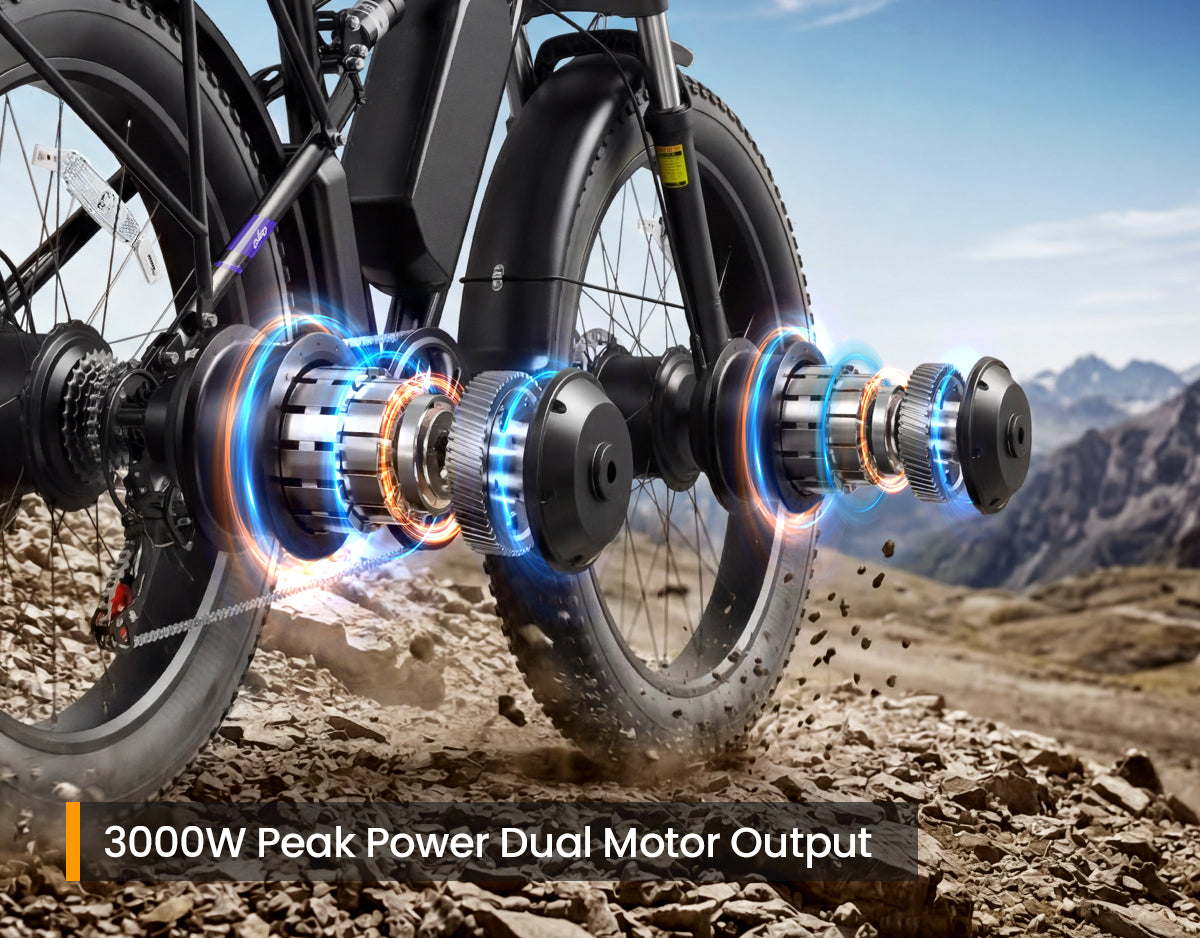
Dual motor e-bikes are the four-wheel drive of the cycling world. If you’ve ever tried to scramble up a steep hill on an e-bike, only to find your back wheel spinning in the mud and wet leaves, you’ll understand the appeal of two motors.
By driving both wheels forward, you don’t just get more speed — your bike has more traction, control, and power. It goes where other bikes can’t.
But is this premium upgrade really necessary? How does a dual motor electric bike perform on dirt, snow, and sand? And what are the benefits for everyday life? Find out below.
What Is a Dual Motor E-Bike?
A dual motor e-bike is like a regular e-bike, except it has two hub motors — one on the front wheel and one on the rear. Together, they create an all-wheel drive (AWD) system.
Most e-bikes have a single motor that concentrates torque on one wheel. That’s usually the back wheel. The problem is that it drives you forward, but it can struggle to grind up steep slopes. All-wheel drive systems, on the other hand, perform better on loose or unpredictable surfaces, where two wheels are better than one.
How Does a Dual Motor E-Bike Work?
Dual motor e-bikes use a front and rear hub motor to drive the bike forward. These two motors are either controlled by a single advanced unit or a specialized dual motor controller setup. This synchronizes power delivery, so both wheels work in tandem.
Here’s how it works:
· Front motor: Pulls you forward, which helps keep the bike stable and predictable on loose terrain like sand, gravel, or snow.
· Rear motor: Delivers most of the drive. This is where the bulk of your power comes from, giving you strong acceleration and a planted feel.
· Controller: Acts as the system’s brain, managing how power is split between both wheels. On more advanced setups, you can switch between front, rear, or full dual-motor (AWD) modes depending on the terrain.
Most e-bikes rely on pedal assist. That means as you pedal, the motor kicks in, providing the power. In a dual-motor setup, you won’t just feel the push from behind. The entire bike moves forward together, giving you faster acceleration.
Plus, with two points of traction, you can tackle difficult slopes or uneven trails without worrying you’re going to end up spinning out.
What Are the Benefits of a Dual Motor E-Bike?
Significantly More Power
Power isn’t everything — but it’s definitely a plus.
The all-wheel drive system provides significantly higher torque output, capable of tackling steeper slopes. If a regular e-bike struggles with 15° inclines, a dual motor e-bike will scamper up the hill like a mountain goat.
You’ll also notice you’re faster off the mark. With both wheels delivering power, on regular roads and trails, you’ll reach much higher speeds more quickly. That’s a nice plus if you’re commuting.
Improved Traction (All-Wheel Drive Feel)
Even if you’re just riding around the city, wet roads, gravel, or snow are a regular problem. Most of the time, the issue is that you’re relying on the rear wheel to push you forward. If it loses traction, the e-bike stops moving.
That’s not an issue with all-wheel drive.
The front wheel pulls you forward just as the back wheel pushes. So, on uneven or loose ground, one of the wheels almost always finds grip.
Better Hill Climbing
You can have a great grip on a hill and still struggle to reach the top. The problem is that all the strain is placed on a single motor. Because dual motor systems double the power, you can experience more consistent performance on steeper gradients.
As a general rule, dual motor e-bikes can handle much steeper gradients than single motor setups — often around 25–30% depending on the model.
Redundancy and Reliability
When you’ve got two motors, a single motor can fail without too much issue. While you won’t have the same capabilities as a true AWD e-bike, it’ll still get you from A to B.
That’s pretty handy if you rely on your e-bike to get to work. You won’t find yourself stranded miles from home on your evening commute.
Off-Road Performance Boost

Dual motor electric bikes are, first and foremost, designed for trails, sand, and mud. Take the Racer Max, for example. It reaches 3,000W and 200Nm of torque, far more than you’d ever need on the road. Combined with fat tires and a dual suspension system, it can handle the tough terrain no other bike can.
In fact, it can handle extremely steep off-road climbs that would challenge most e-bikes.
What Are the Downsides of Dual Motor E-Bikes?
Reduced Battery Life
More motors consume more power. What would be the point otherwise? Sure, it might drive you up the hill, but doing so drains the battery. Unless you opt for more batteries, you’ll find these e-bikes generally have a shorter range.
The Racer Max has a range of up to 60-70 miles, below the 90-mile peaks you’ll see for other e-bikes in the Qlife collection.
Heavier Build
A subtle but important factor is weight.
The extra components might feel like they are on their own. But they soon add up. You can expect a dual motor electric bike to be around 5-10 kg heavier than comparable single motor models. That’s probably more than you expected.
The second motor alone can add 2-4 kg. Throw in the larger battery, reinforced frame, and heavier tires, and the weight increase compounds quickly.
It’s normally not an issue if you’re primarily riding on trails. But if you’re commuting and have to carry it at any point, 25-35 kg is not easy to lift.
Higher Cost
Dual motor e-bikes are almost always more expensive. Expect premium pricing compared to single motor models.
- Single motor e-bikes. ~$600 – $2,500 (most people sit around $1,000–$2,000)
- Dual motor e-bikes. ~$1,500 – $4,000+ (with high-end pushing higher)
On average, dual motor e-bikes are typically ~30-50% more expensive than single motor equivalents. Remember, you’re not just paying for another motor — you’re paying for a bigger battery, stronger frame, and more complex electronics. It’s a category upgrade, not an add-on.
More Maintenance Complexity
Two motors mean double the chance for something to go wrong. There’s more wiring, more complexity, and more potential issues.
While you’re not guaranteed to need more frequent maintenance, it’s advised. It’s sensible to book a 6-monthly or annual checkup, depending on your usage.
Legal and Speed Considerations
Most e-bikes exceed the speed limits for e-bikes. Usually, that’s around 20-28 mph. The Racer Max tops out at 37 mph, far above what you can legally reach on roads and bike trails. That means you’re restricted to off-road use only, unless you purposefully cap your pedal assist limit.
Depending on your state, you might also face other legal hurdles. In the worst cases, you’ll need a license and registration to ride the bike in public.
Dual Motor vs Single Motor E-Bike: Which Is Better?
If you’re trying to decide between a dual motor and single motor e-bike, this is where things get clearer. On paper, dual motor sounds like the obvious upgrade — more power, better traction, all-wheel drive. But that doesn’t automatically make it the better choice for most riders.
In reality, the differences come down to how you ride.
Commuting through a city, cruising on roads, and keeping things simple? A single motor usually makes more sense. Tackling steep hills, rough terrain, or wanting maximum performance? That’s where the dual motor starts to justify itself.
Here’s how they compare side by side.
|
Feature |
Dual Motor E-Bike |
Single Motor E-Bike |
|
Power |
High torque, faster acceleration, AWD feel |
Moderate power, smoother delivery |
|
Range |
Shorter range (higher battery drain) |
Longer range (more efficient) |
|
Weight |
Heavier due to extra motor + components |
Lighter and easier to handle |
|
Cost |
More expensive (premium category) |
More affordable, wider price range |
|
Best Use |
Off-road, hills, rough terrain |
Commuting, city riding, everyday use |
Who Should Buy a Dual Motor E-Bike?
Dual motor e-bikes are for people who need more speed, more power, more acceleration. They’re not designed for your quiet morning commute; they’re for that desperate scramble up a tricky slope. Unless you live in an especially hilly area, the average rider isn’t going to benefit.
Consider a dual motor electric bike if:
- You’re an off-road rider. The extra power and all-wheel drive are a massive boost on uneven or loose terrain. You can ride confidently no matter the conditions, knowing you’ve got everything you need to tackle even the toughest slope.
- Heavier riders need extra torque. A dual motor setup spreads the workload across both wheels, giving you more consistent pull without straining a single motor. That translates to smoother acceleration, better support on hills, and less drop-off in performance under load.
- People in very hilly areas. Some areas are just hillier than others. Most people don’t want to struggle to get up a hill on their morning commute or a casual bike ride. The dual motors ensure that it just can’t happen.
- Adventure or trail users. Are you the kind of rider who likes to follow the trail wherever it takes you? If so, it’s worth considering a dual motor e-bike for the speed and control it offers.
Who Should Avoid a Dual Motor E-Bike?
Don’t be tempted by the big numbers in the specs. If you’re not using the full features on a regular basis, it’s like buying a 4x4 to drive to the shops. It’s overkill.
A dual motor electric bike isn’t for you if:
- You’re a city commuter. Dual motor e-bikes just aren’t necessary for the kind of stop-start cycling most commuters experience. The heavier weight, extra cost, and thicker tires can even act as an impediment.
- Budget-conscious buyers. Unless you can justify the expenditure, buying for an extra motor (and everything that comes with it) simply isn’t worth it for most buyers — especially those who are new to the e-bike market.
- Riders prioritizing range. Whether you’re commuting or enjoy long bike rides, the reduced range will severely hamper your trips. Even the listed range can fall dramatically if you’re relying on both motors for lots of hills.
- Beginners. Most drivers don’t immediately buy a 4x4 or a supercar. The same is true here. If you’re new to cycling or e-bikes, it’s best to start with something a little tamer.
How Fast Is a Dual Motor E-Bike?
Read the specs for most dual motor e-bikes, and you’ll see aggressive top speeds — sometimes 30, 40, or even 50+ mph. And technically, some models can reach those speeds.
The problem? It’s just not legal. In real-world riding, you’ll usually see:
- 20–28 mph on street-legal setups
- 30+ mph only on high-power or unlocked bikes
But that doesn’t mean they’re not worth it. While marketing focuses on peak speed, riders focus on how long it actually takes to get to their destination. And with better acceleration, faster speed up hill, and a smoother riding experience, dual motors shine.
How Far Can a Dual Motor E-Bike Go (Range Explained)
Dual motor e-bikes trade efficiency for performance. Running two motors obviously consumes more power. Most models make up for this with bigger batteries, so the hit isn’t as big as you’d expect.
Still, they won’t last as long as a single motor setup.
- Single motor: ~40–80 miles (common real-world range)
- Dual motor: ~25–60 miles (depending on how it’s used)
Riding style is another factor. If you’re constantly tackling hills or loose ground, have a higher rider weight, or set your assist level to maximum, it’ll drain your battery faster.
Regardless, dual motor e-bikes will still go plenty far. Unless you’re planning very long rides, it’ll handle most routes. You’ll just have to recharge it more frequently than its single motor counterpart.
Key Features to Look for in a Dual Motor E-Bike
Dual Motor Control (Switchable Modes)
You don’t want both motors running all the time. Look for a bike that lets you switch between front, rear, and dual modes. It gives you control over power and helps preserve battery when you don’t need full output.
Battery capacity (This is a Big One)
Two motors drain power quickly. A small battery will feel limiting fast. Aim for a higher capacity setup, so you’re not constantly worrying about range.
Suspension Quality
Dual motor bikes are often used off-road or on rougher terrain. Good suspension isn’t optional — it’s what keeps the ride comfortable and controlled.
Braking System (Hydraulic Disc is Worth It)
You’re dealing with more speed and more weight. Cheap brakes won’t cut it. Hydraulic disc brakes give you the stopping power and control you actually need.
Frame Durability
More power puts more stress on the frame. A solid, well-built frame isn’t just about longevity — it affects stability and confidence when riding.
Tires (Fat vs Standard)
Fat tires give you better grip and cushioning, especially off-road. Standard tires are faster and more efficient on roads. It depends on where you’ll actually be riding — don’t just follow the trend.
Are Dual Motor E-Bikes Worth It?
Overall, they can be.
Dual motor e-bikes are definitely worth trying out if you’re focused on performance. The real question is how you use your e-bike — Are you constantly riding uphill? Do you enjoy adventure riding? Do you have to deal with tough conditions like snow, mud, or loose ground?
If the answer to any of these questions is yes, then a dual motor e-bike is a good option. But if you’re just a regular commuter or weekend trail rider, it’s probably a little much.
FAQs
Are dual motor e-bikes legal in the US?
Yes — dual motor e-bikes are legal in the US. However, there are state-specific rules around motor power and speed limits. Most states consider them Class 3 e-bikes, with a top speed of 28 mph.
Do dual motor e-bikes have better traction?
Yes, because both wheels have a motor, they push and pull the bike forward. If one wheel slips, the other wheel can still drive the bike.
How much faster is a dual motor e-bike?
They’re not always faster. However, many riders notice more powerful acceleration as both wheels drive the bike forward.
Can you use one motor at a time?
Depends on the model. Some give the option to switch off a specific motor (usually the front).
Do dual motor e-bikes drain the battery faster?
Yes — if both motors are active, you’ll notice the battery drains faster. Most models compensate for this by having a slightly bigger battery capacity.
Are dual motor e-bikes good for hills?
Yes. In fact, that’s what they’re primarily designed for. The front motor pulls the bike as the back motor pushes the bike upwards. It means they can handle very steep slopes more effectively than single motor e-bikes.
Share:
Best Full Suspension E-Bikes
Fat Tire E-Bikes: Pros and Cons