
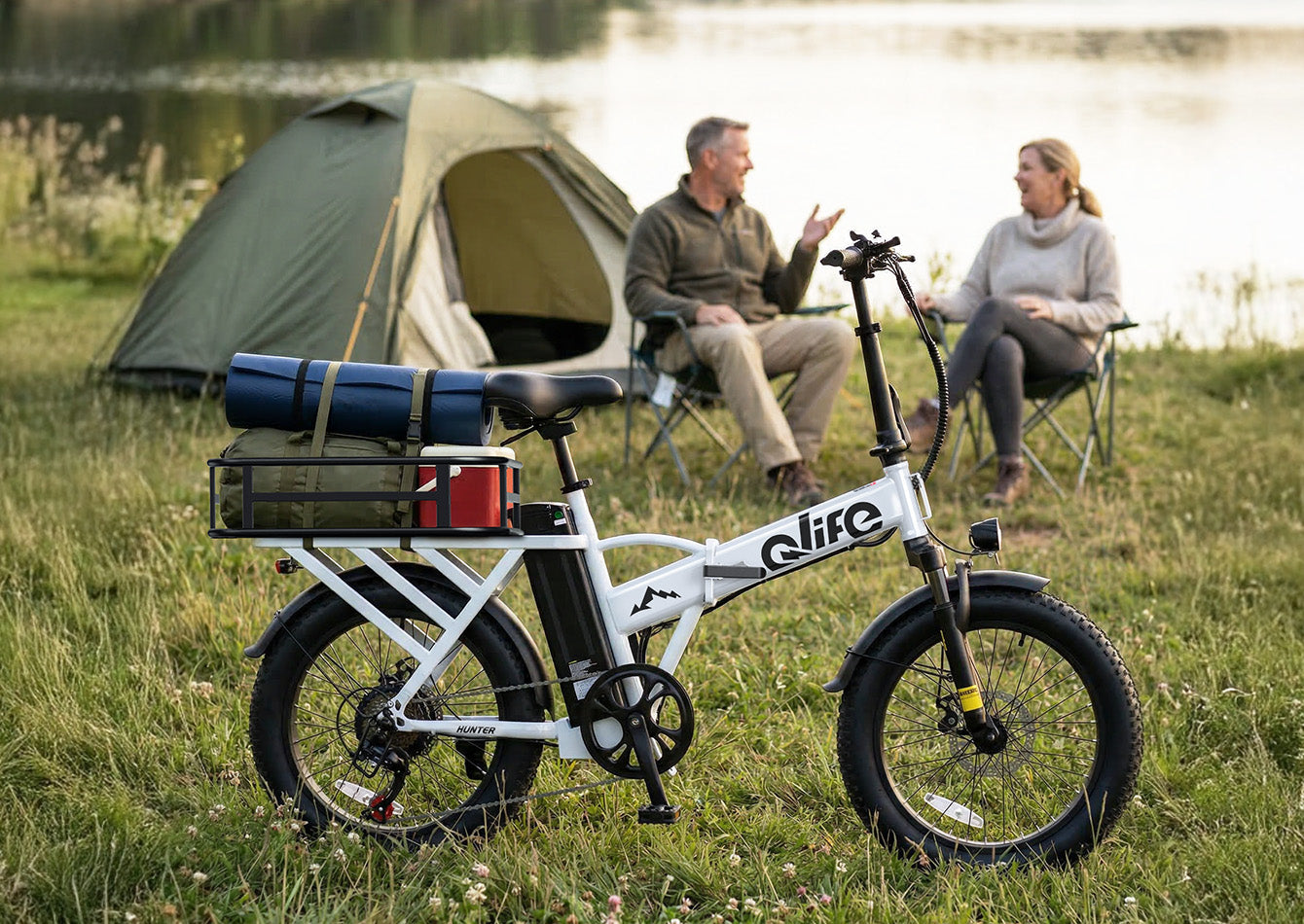
Electric bikes aren’t magic. It’s essentially a regular bike with an added motor. You might wonder why electric bikes weren’t a bigger thing years ago — suddenly, you see them everywhere. A lot of that comes down to how they actually work.
In the past decade, battery capacity has jumped by around 50%. That means batteries can fuel more powerful motors for longer, making e-bikes both more useful and functional. You no longer need a giant battery pack just to manage your morning commute.
But what’s actually going on within the bike? How does an e-bike work? And how do the different mechanisms inform what you should look for when you buy? Find out below.

What Is an Electric Bike?
An electric bike, or e-bike, is any bike that uses a combination of pedal and battery power to move. If there’s no battery, it’s just a regular bike; if there’s no pedaling, it functions more like a throttle-powered bike.
Electric bikes sit somewhere in the middle.
The idea is simple: as you move the pedals, the motor will kick in, supplying additional power. Depending on your assist level, the harder you pedal, the more assistance you’ll receive.
The 3 Core Components of an E-Bike
Electric bikes, for the most part, look a lot like a regular bike. There’s the same-shaped frame, two wheels, handlebars, and a seat. Indeed, there are only three components that differentiate them.
1. The Motor
The motor is the muscle of an e-bike. It’s what makes the wheels move forward. Most e-bikes have a hub motor that’s located at either the front or rear wheel (usually the rear). Dual motor e-bikes have two motors at both the front and back.
Then there’s mid-drive motors. As the name suggests, they’re located in the frame of the bike and supply power to either wheel. They’re generally more expensive but feel more like an analog bike.
Motor power is measured by wattage. Most electric bike motors range from 250 to 900 watts — though some are notably more powerful. The Qlife range, for example, has motors that routinely hit 1,500-2,000 W (with some going as high as 3,500W).
2. The Battery
The battery stores the power that makes the motor go. It’s the “e” in e-bike — equivalent to your legs in an analog bike or gas in a car.
Most e-bikes use rechargeable lithium-ion batteries, characterized by their long lifespan, lightweight, and high energy density. That makes them perfect for bikes, where weight and range really matter.
Battery quality is determined by its power density. That’s the amount of power generated by the battery, measured in watt-hours. You’ll often see e-bikes list only the Volts and Amp-hours, e.g., 52V 20Ah. You can just multiply these numbers together to get the Watt-hours.
3. The Controller
The controller is the brain of the bike. It connects the battery, motor, and wheels, determining how fast the bike should go.
You can adjust the controller via the control panel or app. That could be adjusting the assist setting, lowering the speed limit, or maximizing range (eco-setting). Different models have different settings.
Three bits of information flow into the controller: speed, cadence, and torque. It takes these three bits of info, compares them to the settings, and supplies the right amount of power to the wheels. For example, if you’re going up a hill, you’ll apply more force to the pedal, which means the motor needs to provide more power.
How Pedal Assist Actually Works
Pedal assist, in simple terms, means the bike detects your pedaling, supplying additional power. The motor amplifies your effort. Depending on your assist level, that could be a helping hand or doing the bulk of the work.
Newcomers to electric bikes often describe them as a tailwind. They’re still moving the pedals; they’re just going faster than they normally would on an analog bike.
Where it comes in especially handy is during hill climbs.
Typically, people find that their pace grinds to a halt as they begin an ascent. But with the pedal assist, you can maintain a reasonable pace, climbing the hill with less effort overall. You’ll still need to pedal harder; you just won’t be exhausted when you reach the top.
What is a Throttle? (And How Is It Different?)
The throttle is familiar to anyone who’s ridden a motorbike. Located on the handlebars, it’s twisted to supply power to the pedals without pedaling. The other type is a thumb throttle, where you push down on a small lever to increase the speed.
E-bikes with a throttle are always categorized as Class II e-bikes. They’re not always legal in all regions. In the US, you may face restrictions regarding certain bike trails. However, they are allowed on the roads in most states.
How Power Is Delivered While Riding
The easiest way to understand an e-bike is to think of it as a normal bike with a support system that reacts as you ride.
1. You start pedaling. As soon as you push the pedals, the bike begins reading your movement.
2. The sensors detect what you’re doing. The sensor picks up that the pedals are turning. On more advanced bikes, it may also detect how hard you’re pedaling.
3. The controller decides how much help to give. Based on your assist level, speed, and sensor input, the controller tells the motor how much power to deliver.
4. The motor adds extra power. The motor then helps turn the wheel or crank, making it easier to accelerate, climb hills, or maintain speed.
5. The system keeps adjusting as you ride. If you pedal harder, slow down, change assist level, or hit a hill, the system responds in real time.
What Affects How an E-Bike Feels to Ride?
If you’re used to riding a regular bike, an e-bike can take a bit of getting used to. While most people get the hang of it within half an hour, you may still notice some differences.
One of the big factors is where the motor is located. As mentioned, mid-drive motors — while more expensive — feel a lot more like a regular bike. Hub motors are generally less powerful as well, although that’s not necessarily the case with dual motor bikes.
The assist level is the other big change. It’s best to start on the lowest assist level if you're trying an e-bike for the first time. You won’t suddenly find yourself whizzing along with only a gentle turn of the pedals. You can then increase the assist level to your preferred level.
How Fast Can an Electric Bike Go?
Electric bikes can reach up to 40 mph or more, depending on the model. Some go much faster. However, they’re generally not as popular due to the legal limits.
In the United States, e-bike speeds fall into two categories:
· ~20 mph (Class 1/2)
· ~28 mph (Class 3)
Class 1 and 3 e-bikes are pedal-assist, with the latter category designed for fast commuting. Class 2 e-bikes come with a throttle.
It should be noted that for most e-bikes, there’s a difference between the motor assist cut-off and what it’s actually capable of. But considering that few riders would ever need to go over 28 mph, it’s generally not an issue.
How Far Can an Electric Bike Go? (Range Explained)
Range can vary widely from model to model. The typical range of an e-bike is anywhere between 25 and 80 miles. However, the stated range is usually measured under optimum conditions.
In the real world, the e-bike range is likely reduced by the assist level, terrain, and rider weight. In short, the more the motor has to work, the lower your range will be.
Some manufacturers offer a second set of batteries. That can significantly expand the range beyond that stated. But you’ll pay a fair bit extra, and it’ll add weight to the bike.
How Do You Charge an Electric Bike?
The same way you would charge anything else. Simply plug the e-bike into a standard outlet. On average, it takes around 3-6 hours to fully charge, depending on the battery size.
Most e-bikes either have a removable battery (so you can charge it indoors) or a fixed one that you charge while it’s on the bike. You don’t need any special setup, and it’s generally safe to leave charging overnight. Over time, you’ll get a feel for how often it needs topping up based on how far and how hard you ride.
Do You Still Have to Pedal an Electric Bike?
Yes (in most cases).
If you were hoping to sit and glide along, we’re sorry to disappoint. The majority of e-bikes, being pedal-assist, rely on you to put in some of the effort. It’s not a motorbike. Your legs turn the pedals, which activate the motor.
That being said, Class 2 e-bikes have a throttle. So, while you can use the pedal assist, if you really want to be lazy, the throttle lets you power along solely under the motor’s power. It’s a handy feature if there’s a particularly tricky hill, or you’re tired from a day of work.
Bring It All Together
Once you understand how an electric bike works, the whole thing becomes a lot less mysterious. It’s just a system — battery, motor, controller — working together to make riding easier, faster, and more practical. The real difference isn’t in the mechanics, it’s in how it changes your day-to-day riding.
Hills feel flatter, longer distances feel shorter, and you’re far more likely to actually use the bike consistently.
If you’re thinking about getting one, it’s worth choosing a model that matches how you ride — not just what looks good on paper. That’s where something like Qlife stands out.
Our range is built around real-world use, with higher-powered motors, solid battery capacity, and setups that actually make sense for commuting, off-road riding, or a mix of both.
If you want to see what that looks like in practice, it’s worth exploring the Qlife lineup and finding a model that fits your riding style.
FAQs
How do electric bikes work in simple terms?
An e-bike has three functional parts: the motor, the battery, and the controller. The battery supplies power to the motor, which moves the wheels. The amount of power supplied between the battery, motor, and wheels is determined by the controller. You can alter the controller settings either through a screen or an app, depending on the model.
Do you have to pedal an electric bike?
In most cases, yes. The majority of e-bikes are “pedal assist.” That means you pedal the bike and the motor provides assistance, amplifying your effort. Generally, the faster you pedal, the more assistance you’ll receive.
How fast can an electric bike go?
Most e-bikes reach speeds between 20 and 28 mph. Some e-bikes can go a lot quicker. However, in the US, e-bikes are legally allowed to go up to 28 mph; any quicker and you may need a license, registration, and insurance.
How long does an e-bike battery last?
That depends on the model. Most e-bikes have a range between 20 and 80 miles. However, the exact time your battery will last depends on your assist level, battery capacity, the terrain, and rider weight. The more your motor has to work, the shorter the battery capacity will last.
Can you ride an e-bike without the battery?
Yes — e-bikes can still be ridden like a normal bike. The only difference is the extra weight due to the batteries, motor, and electronics.
How long does it take to charge an e-bike?
It takes around 3-6 hours to charge an e-bike to full capacity.
Are electric bikes legal?
Yes — electric bikes are legal in the US, but they’re regulated by a three-class system that determines how they can be used.
· Class 1: Pedal assist only, up to 20 mph
· Class 2: Throttle + pedal assist, up to 20 mph
· Class 3: Pedal assist only, up to 28 mph
In most states, you can ride Class 1 and 2 e-bikes on bike lanes and paths, while Class 3 is usually restricted to roads or designated lanes. You typically don’t need a license, registration, or insurance — but rules can vary slightly by state, so it’s worth checking local regulations.
Share:
Fat Tire E-Bikes: Pros and Cons
How Fast Do Electric Bikes Go?