
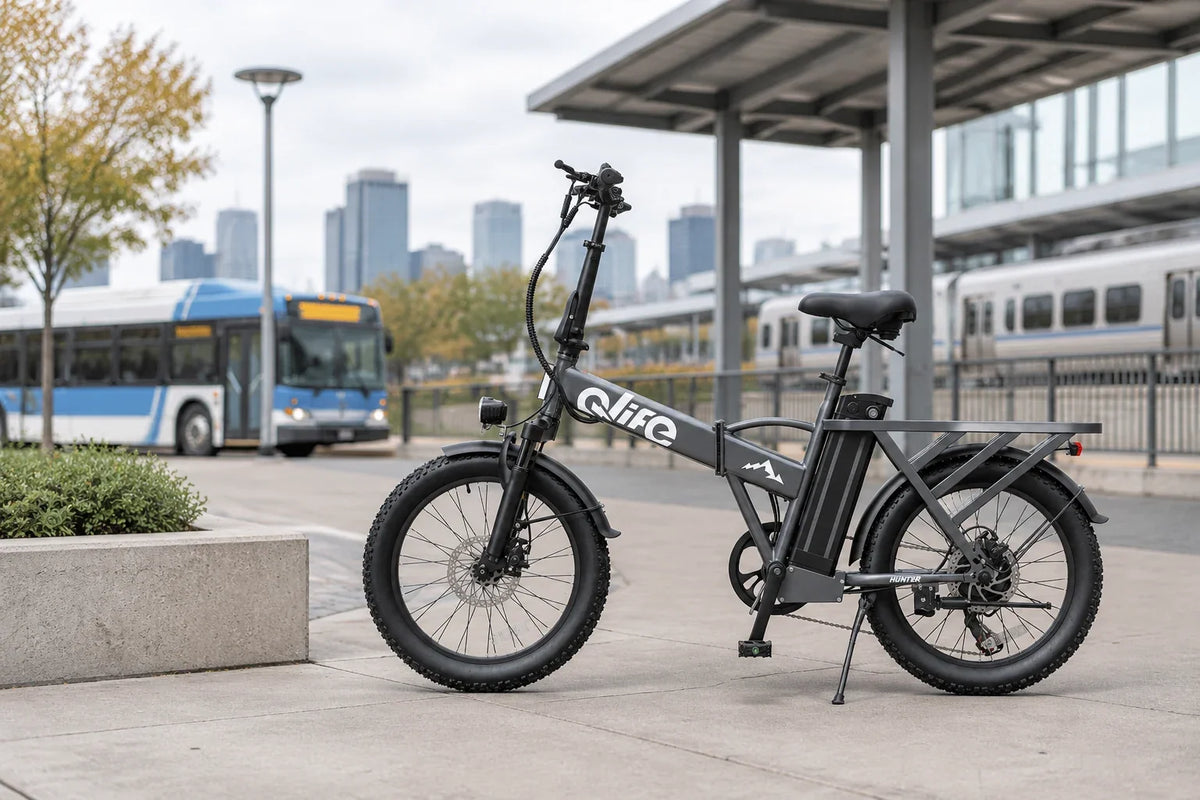
Can you take an e-bike on public transit? Sometimes, depending on the transit operator, the vehicle mode, your bike's exact measurements, and whether bike space is open when you board. No nationwide rule covers every U.S. bus or train. A front bus rack, a folded bike carried inside, and commuter-rail bike storage follow separate rules.
I've watched riders learn that the hard way at the curb. One local bus system's front rack has a 55-pound weight cap and a 2-inch tire-width limit. A 60-pound e-bike with 3-inch tires exceeds both before you even reach the platform.
This guide is a route-policy playbook, not another pitch for folding bikes. Below, we'll walk through how local buses and commuter trains set their rules, compare two verified U.S. agency policies checked on 2026-11-01, and test our own Qlife folding models against those exact numbers.

Why One Transit System's E-Bike Rule Does Not Apply to Another
U.S. public transit isn't a single system. Municipal buses, regional authorities, and commuter rail each set their own rules. A bike accepted on a train can be turned away at a local-bus transfer.
When an agency page says "bikes allowed," check whether that allowance covers e-bikes. Operators can set separate limits for weight, tires, battery construction, power, charging, and stowage. The WeGo and Metrolink examples below show how different those conditions can be.
This guide covers U.S. local buses, regional services, and commuter rail, not intercity rail. The operator rules below come from official pages checked on 2026-11-01. Recheck the rules and service alerts for your route before riding.
First Identify the Vehicle and Every Operator on Your Trip
A mixed-mode commute is only as permissive as its strictest segment. Before you grab a tape measure, list every vehicle and operator on your route. If you ride a local bus to a commuter rail station and transfer to a downtown shuttle, you're dealing with up to three separate equipment rules.
Check your return trip separately. Peak-hour crowding, track work, or a bus bridge can change available bike space or your storage method.

Use this worksheet to check each leg before you leave:
| Segment | Route / date | Bike method | Size / weight limit | Battery rule | Reservation / fee | Space availability | Possible disruptions or alerts |
|---|---|---|---|---|---|---|---|
| Local bus | Route # & date | Front rack | Rack weight & tire cap | E-bike rack rule | Base or extra fare | First-come (often 2 slots) | Detours or bus swaps |
| Folded onboard | Route # & date | Folded in cabin | Folded box or safe-stow rule | Cabin e-bike rule | Bag/cover rule | Clear of aisles; driver call | Peak-hour crowding |
| Commuter rail | Line & train # | Lower-level bay | Max footprint & tire width | Sealed pack; power off; no charging | Permit or pass check | First-come; check any accessibility priority | Car closures or alerts |
| Transfers | Next agency | Rack-to-rail | Stricter limit of both legs | Next agency's battery rule | Separate fare check | Extra transfer time | Missed-connection rules |
| Return trip | Evening run # | Same or bus bridge | Night equipment limits | Power off; no charging | Peak/off-peak rules | Rush-hour racks fill fast | Afternoon line alerts |
Compare Two Current Operator Policies
To see how differently two real U.S. systems handle electric bikes, compare WeGo Public Transit (Nashville and Middle Tennessee) and Metrolink (Southern California commuter rail). We checked the operators' live policy pages directly on 2026-11-01.
| System and mode | Policy: weight / size | Policy: tire width | Policy: battery / power | Capacity, storage & trip-day checks | Official sources (checked 2026-11-01) |
|---|---|---|---|---|---|
| WeGo local bus (front rack) | 55 lb max for e-bikes on the rack. | Tires 2 in wide or less. | WeGo's e-bike policy requires the bike powered off; charging is prohibited. Batteries must be UL-certified and listed, undamaged, and not emit environmental contaminants. | Rack holds 2 bikes, first-come, first-served. Operators may deny e-bikes on crowded vehicles; keep doors, seats, aisles, and emergency equipment clear. | WeGo FAQ and E-bike Policy |
| WeGo local bus (folded onboard) | No numeric weight or folded-size limit stated. | No numeric tire limit stated. | Same WeGo power, charging, and battery conditions apply. | Foldable e-bikes are allowed if safely stowed. Operators may deny e-bikes on crowded vehicles; keep doors, seats, aisles, and emergency equipment clear. | WeGo FAQ and E-bike Policy |
| WeGo Star commuter rail | No numeric weight limit stated. | No numeric tire-size limit stated. | Same WeGo power, charging, and battery conditions apply. | Riders must provide their own securements. No numeric limit does not guarantee fit or boarding: keep doors, seats, aisles, and emergency equipment clear; operators may deny e-bikes on crowded vehicles. | WeGo FAQ and E-bike Policy |
| Metrolink commuter rail | 32 in wide x 58 in long max; e-bikes need pedals and a straddle seat. | 2.6 in max generally. On Arrow trains, lower rails take tires up to 2.0 in; upper hooks take up to 2.6 in. | Manufacturer-installed sealed battery; powered off; no onboard charging. Altered, damaged, swollen, leaking, exposed, or taped battery packs; liquid lead-acid batteries; and e-bikes without manufacturer certification are not allowed. | Bike space is limited and first-come, first-served, not guaranteed. Mobility-device users have priority; riders secure bikes with onboard straps, racks, or hooks. Personal locks may not be used onboard; staff may deny boarding. Check alerts and train equipment. | Metrolink Bike Guidelines and Arrow bike storage |
Policy rules are separated from capacity and trip-day checks above. WeGo's FAQ gives the numeric rack limits and separate folded-bike/WeGo Star rules. Its E-bike Policy, effective March 1, 2024, adds battery, power, charging, clearance, and crowding conditions. Metrolink lists pedals and a straddle seat as eligibility requirements but does not explain the rationale; it expressly excludes e-bikes without either feature.
What WeGo's split rules mean at the stop
WeGo's local-bus front rack holds two bikes first-come, first-served; each e-bike must weigh 55 pounds or less and have tires no wider than 2 inches.

The FAQ allows foldable e-bikes inside local buses if safely stowed, but states no numeric weight or folded-size limit. WeGo's separate policy requires power off, prohibits charging, and requires UL-certified/listed, undamaged batteries that do not emit environmental contaminants. Operators may deny e-bikes on crowded vehicles; keep doors, seats, aisles, and emergency equipment clear.
WeGo Star publishes no numeric weight or tire-size limit, but riders must bring securements, meet the safe-clearance rules, and allow for limited space or denial on crowded vehicles. No numeric cap does not mean unlimited dimensions or guaranteed boarding.
What Metrolink's rules mean on the platform
Metrolink requires pedals and a straddle seat, dimensions no larger than 32 by 58 inches, tires no wider than 2.6 inches, and a manufacturer-installed sealed battery. It also bars modified or altered battery systems; damaged, swollen, leaking, exposed, or taped packs; liquid lead-acid batteries; and e-bikes without manufacturer certification. The page does not explain the pedal/seat rationale, but excludes e-bikes missing either feature. On Arrow, lower rails take tires up to 2.0 inches and top hooks up to 2.6 inches. E-bikes must be powered off and cannot be charged onboard. Bike spaces are limited and first-come, with mobility-device users prioritized. Riders lift, load, and secure bikes using onboard straps, racks, or hooks; personal locks may not be used onboard. Crew may deny boarding, so check the equipment and alerts for your run.
Measure Your Bike Against the Operator's Exact Limits
Spec tables online don't count your accessories, and agencies measure specific points. Spend ten minutes in the garage checking four numbers:

- Actual bike weight as loaded: If a bus rack caps e-bikes at 55 pounds, weigh your bike with the battery installed plus any bolted-on rear rack, basket, or heavy U-lock. Only weigh the bike without the battery if your transit operator explicitly lets you pull the pack and carry it in a bag while loading the bare frame on the front rack.
- Tire width from the sidewall marking: Read the stamped numbers on your tire sidewall, such as 20 x 3.0 or 26 x 2.6. Compare that second number directly to the operator's maximum (2 inches on WeGo front racks; 2.6 inches on Metrolink).
- Assembled or folded dimensions where required: If an operator like Metrolink sets a 32-by-58-inch limit, measure full assembled width from bar-end to bar-end and full length from the front tire tip to the rear fender. Measure folded dimensions only when an operator publishes a folded size box, using the agency's stated method.
- Battery housing and rating: Check battery construction whenever an operator requires it. Don't assume a removable pack automatically satisfies Metrolink's "manufacturer-installed sealed battery" rule. Note the pack's watt-hours (Wh); calculate it as volts x amp-hours if it isn't listed.
If you're still comparing bikes for stairs, trunks, and transit, see how to choose a folding e-bike by its folded size and carry weight.
Do Racks, Folded-Bike Carry, and Train Storage Mean the Same Thing?
No. The loading method and applicable rules differ by mode.
- Front bus rack: Lift the bike onto the bumper rack and secure it as directed. Check weight, tire width, wheel size, rack capacity, and loading instructions.
- Folded onboard: Folding does not reserve a space. WeGo requires safe stowage, clear of doors, seats, aisles, and emergency equipment; operators may deny e-bikes on crowded vehicles.
- Commuter rail: Metrolink uses designated areas; WeGo Star riders bring their own straps. Both require power off and prohibit charging. Metrolink explicitly prioritizes mobility-device users. WeGo's e-bike policy excludes ADA-defined mobility devices but does not state a comparable bike-storage priority order.

Qlife Examples Against the Published Limits
Because we build folding electric bikes, riders often ask if our folding frames automatically clear city bus racks and commuter trains. The straight answer is no. A frame hinge helps with garage and trunk storage, but it doesn't shrink a 3.0-inch tire into a 2-inch rack slot.
Here's how our current Hunter and Hunter Plus models compare against the verified WeGo and Metrolink rules from 2026-11-01:
| Qlife model | Published specs | WeGo bus front rack (55 lb / 2 in max) | WeGo bus folded onboard ("safely stowed") | Metrolink commuter rail (32 x 58 in / 2.6 in tire max) |
|---|---|---|---|---|
| Our Hunter (Qlife Hunter specifications) | 60.49 lb; 20 x 3.0 in tires; 648 Wh battery; foldable (36.6 x 28 in folded length x height; folded width not listed). | Exceeds both limits: weight and tire width. | Conditional: verify battery eligibility, power off, and safely stow; WeGo may deny e-bikes on crowded vehicles. | Exceeds tire limit (3.0 in vs. 2.6 in max); folded width not listed, so the full size limit cannot be confirmed. |
| Our Hunter Plus (Hunter Plus specifications) | 79.3 lb; 20 x 4.0 in fat tires; 960 Wh battery; foldable frame. | Exceeds both limits: weight and tire width. | Conditional: verify battery eligibility, power off, and safely stow the 79.3 lb bike; WeGo may deny e-bikes on crowded vehicles. | Exceeds tire limit (4.0 in vs. 2.6 in max); the product listing does not establish whether its battery meets Metrolink's sealed-battery condition. |
Specifications come from Qlife's manufacturer product pages checked 2026-11-01. Hunter's listing gives folded length and height but no folded width. The product listings do not establish whether these exact batteries meet WeGo's UL-certified/listed condition or Metrolink's sealed-battery and manufacturer-certification conditions; confirm with the operator before travel.

Our Hunter and Hunter Plus are built around wide tires, long-range batteries, and folding storage. Both exceed WeGo's published front-rack limits and Metrolink's 2.6-inch tire-width cap. WeGo's folded-bus rule is conditional, and its operators may deny e-bikes on crowded vehicles. WeGo Star publishes no numeric weight or tire-size cap, but still requires rider-supplied securements and adequate clearance.
Before You Leave Home
Even when your bike fits the published numbers, run this travel-day checklist before you head to the stop:
- Check the agency's bike page and live service alerts that morning. Service changes and the equipment assigned to a run can affect available bike space.
- Verify your outbound leg, return leg, and every transfer. Make sure evening equipment swaps or connecting bus rules won't leave you stranded after dark.
- Check station elevators, stairs, and storage positions. Know beforehand whether you have to carry the bike up an overpass staircase or lift it onto a high rail vestibule.
- Pack the required securements. WeGo Star riders supply their own; Metrolink riders must use the onboard straps, racks, or hooks and may not lock a bike onboard.
- Follow the battery and power rules. WeGo and Metrolink require e-bikes powered off and prohibit charging in the locations their policies cover.
- Have a fallback if storage is full. WeGo bus racks are first-come, first-served; WeGo operators may deny e-bikes on crowded vehicles. Metrolink bike spaces are limited and first-come, first-served, with mobility-device users given priority. Know the next departure or another route before leaving home.
FAQ
Can I put an e-bike on any city bus rack?
No. Every bus operator sets its own rack weight and tire-width limits. On WeGo local buses, the e-bike must weigh 55 pounds or less and have tires no wider than 2 inches. The rack holds two bikes first-come, first-served. WeGo's separate e-bike policy also requires the bike to be powered off, prohibits charging, and sets battery and safe-clearance conditions.
Are folding e-bikes allowed on buses?
Sometimes. WeGo's FAQ allows folded e-bikes onboard local buses if safely stowed but gives no numeric weight or folded-size limit. Its separate policy still requires the e-bike to be powered off, prohibits charging, requires a compliant undamaged battery, and allows operators to deny e-bikes on crowded vehicles. Keep the bike clear of doors, seats, aisles, and emergency equipment.
Do commuter trains allow fat-tire e-bikes?
It depends on the rail system's tire-width limit. Metrolink's general maximum is 2.6 inches, which rules out 3.0-inch and 4.0-inch tires. On Arrow trains, lower rails fit tires up to 2.0 inches and top hooks up to 2.6 inches. WeGo Star publishes no numeric weight or tire-size limit, but riders must bring their own securements and still meet battery, clearance, and crowded-vehicle rules.
Can I charge my e-bike on the train?
Not on WeGo or Metrolink. WeGo prohibits charging in or on buses, trains, platforms, stations, and transit facilities; Metrolink prohibits charging onboard its trains. Both require e-bikes to remain powered off while being transported. Check other operators' rules separately.
What happens if the bike rack or rail storage area is full?
You may need to wait for the next service or use another route. WeGo's bus racks hold two bikes first-come, first-served, and its operators may deny e-bikes on crowded vehicles. Metrolink's bike spaces are limited and first-come, first-served; passengers using mobility devices have priority, and staff may direct a bike to move or deny boarding when space is full.
Final Thoughts
Taking an e-bike on public transit means matching its weight, tires, battery, and dimensions to every operator on your route. WeGo's front rack caps e-bikes at 55 pounds and 2-inch tires; Metrolink's general tire cap is 2.6 inches, with a 2.0-inch limit on Arrow lower rails. Our Hunter and Hunter Plus exceed those listed weight or tire limits. Folding does not override them or guarantee acceptance under WeGo's safely-stowed rule.
Measure your tires and loaded weight in the garage, check live policy pages and service alerts for both outbound and return legs, pack tie-down straps, and build a one-vehicle buffer into peak-hour commutes.
Share:
Can You Fly With an E-Bike? Airline Battery Rules