
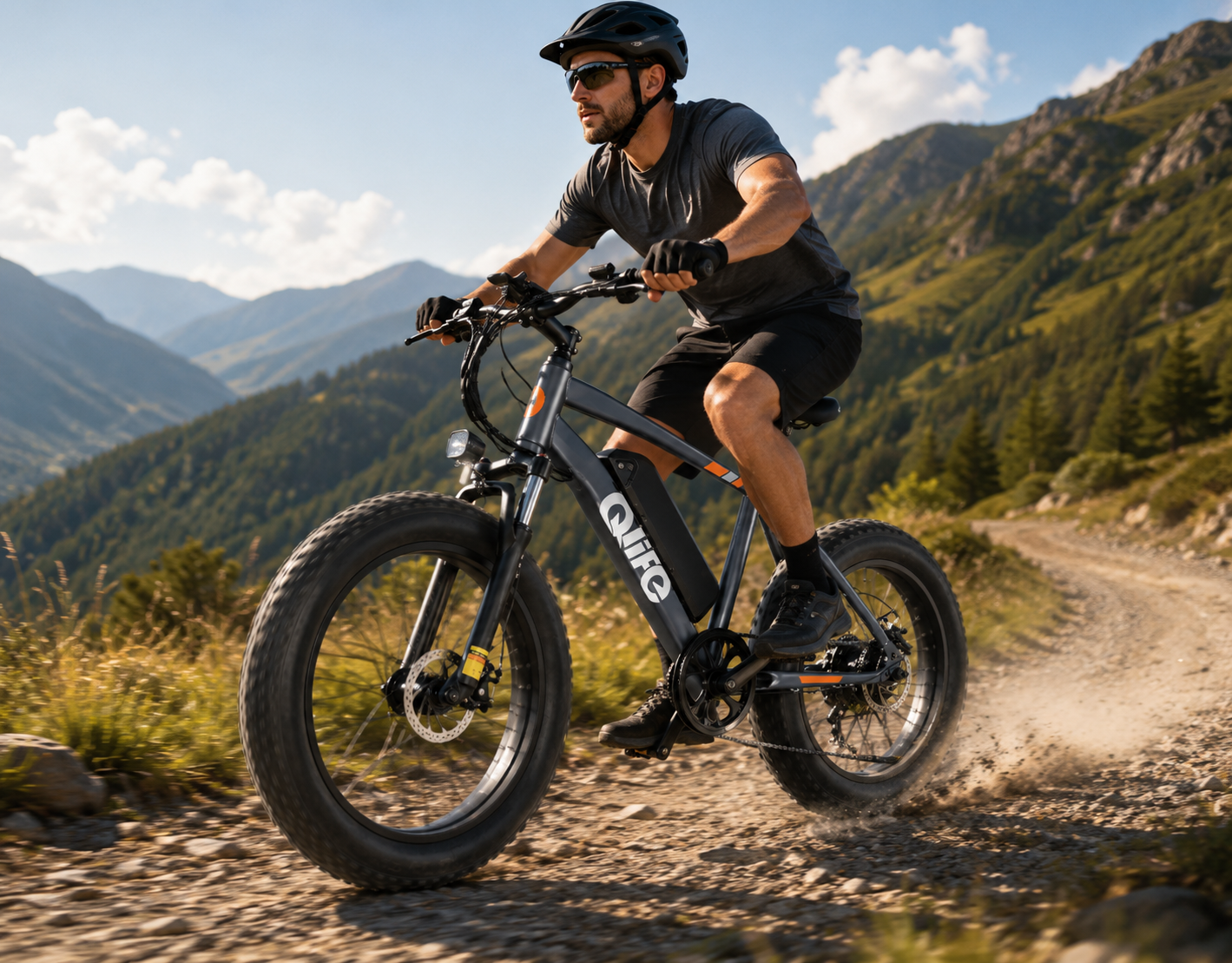
Fat tires just look cool. They give an e-bike more presence, more traction and that unmistakable motorbike aesthetic. They look ready for almost anything. But not every fat-tire e-bike under $1,200 is equally suited to traffic, loose gravel, sand and winter conditions.

Fat tires are generally around 3–4 inches wide. The broader tread creates a larger contact patch, improving traction and stability on loose or uneven ground. This can make them a great choice if you need an electric bike for gravel and beach paths or a fat-tire e-bike for snow. The downside is extra weight and drag. Greater rolling resistance can drain the battery faster than a narrower, more efficient tire.
With a budget of $1,200 or less, you have plenty of options. But which features genuinely matter? How does a 20×4 vs 26×4 fat-tire e-bike compare? And which are the best fat-tire electric bikes under $1,200 for the way you ride?
Let’s find out.
Match the Bike to the Terrain Before Comparing Power
Fat tires are just one feature of an e-bike. While they’re better suited to uneven ground and challenging terrain, that can mean anything from rough pavement, cobblestone streets, or sandy beaches. Each of these terrains comes with other difficulties.
That’s why it’s best to think about the kinds of terrain you’re riding on. You can then prioritize certain features, matching the bike to the routes you’ll actually ride on rather than picking the biggest numbers in the specs.
What Makes a Fat-Tire E-Bike Different?
Fat-tire e-bikes generally use tires around four inches wide, considerably wider than conventional commuter or mountain-bike tires. It’s what gives them their solid, stable appearance.
There are some obvious benefits:
- Fat tires provide more traction. Their wider contact patch helps the bike grip loose surfaces such as gravel, sand, snow and wet ground.
- Fat tires improve stability. The extra width can make the bike feel more planted, particularly at lower speeds or over uneven terrain.
- Fat tires add natural cushioning. Their larger air volume helps absorb small bumps and vibrations before they reach the frame and rider.
That said, riders should not confuse cushioning with suspension. Fat tires soften smaller surface imperfections, while a suspension fork or rear shock allows the frame and wheels to move over larger impacts.
The other big difference is wheel size. Qlife offers e-bikes with two main wheel sizes:
- 20×4 inches: Compact and maneuverable
- 26×4 inches: A larger overall wheel with a more traditional mountain-bike feel
Bigger wheels can roll more smoothly over uneven ground, but they are also harder to store and maneuver. Fat tires are generally optimized for surfaces such as sand, snow, and loose gravel rather than being a universal improvement for every road.
Why Fat Tires Are Worth It — and Why They Sometimes Aren’t
Fat tires are definitely the best option for some riders. They offer greater stability on broken or loose surfaces, more cushioning over cracks and rough pavement, and better flotation on suitable snow or sand. Some riders may simply prefer the appearance.
There are, of course, some obvious trade-offs:
- Heavier wheels and frames
- More rolling resistance
- Greater battery consumption in demanding conditions
- Bulkier storage
- More effort when riding without assistance
You will also need to spend more on tire and tube replacements. But if you regularly face rough or loose surfaces, the reduced range and increased weight may be easy to overlook. On the other hand, if you often carry the bike upstairs or need to maximize range, fat tires can become more of a hassle than a help.
For City Riding, Manageable Beats Massive
Fat tires can work well in cities with potholes, broken pavements, cobblestones, or poorly maintained shoulders. However, the largest and most powerful model is rarely the easiest urban bike to live with.
Yet fat tires are becoming more popular with city riders. Because range isn’t as much of an issue, many riders don’t mind the extra battery power. Plus, the fat tires offer much greater stability and comfort. And, of course, they’re a major style statement. They can turn any bike into something seriously imposing.
But for city riders, there are much more important things to prioritize: reliable brakes, low-speed handling, a practical turning signal, and integrated lights and reflectors.
Still, if you’re committed to a fat tire e-bike, you can get a great option for under $1,200. The Racer Fat Tire, for example, uses 20x4-inch wheels, saving weight. The model comes in at just 59.5 lbs. With a payload capacity of 350lbs and a range of up to 55 miles, it’s a great option for city streets or weekend trails.

Gravel Rewards Control More Than Top Speed
Loose gravel is one of the hardest surfaces to ride on. You need consistent traction and predictable steering rather than aggressive acceleration.
Fat tires can help a lot. Wheel size also matters. Larger 26×4-inch wheels may roll across ruts and irregular ground more smoothly, while 20×4-inch wheels can feel easier to maneuver through tighter sections.
Other helpful features include a stable frame geometry, front or full suspension, and strong low-speed torque.
The Racer Plus Fat Tire 2.0 is an upgrade suited for longer gravel and mixed-terrain rides. It uses larger 26x4-inch tires, full suspension, and a 48V 20Ah battery. It has an impressive 85Nm of torque, with a throttle, so you don’t have to rely solely on pedal power.
Beach Riding Depends on the Kind of Sand
Beach riding isn’t all the same. The sand makes a huge difference. Some beaches are more like a gravel path, while others are fine and dense like snow.
Think of three very different surfaces:
- Paved beachfront paths: Similar to ordinary city riding.
- Hard-packed sand: Potentially manageable with suitable tires and controlled speed.
- Deep, loose sand: Much more demanding on the motor, battery, and rider.
The wider tires are beneficial on all surfaces. They help spread the load across a larger area and reduce sinking. However, soft sand consumes battery power quickly. So, if rides on the beach are a regular part of your cycling, you might want to opt for a bigger battery.
Always follow the manufacturer’s advice for cleaning and maintenance after exposure to sand and salt. Sand can gradually erode components, while salt is highly corrosive.
Fat Tires Help in Snow, Not on Every Winter Surface
Fat tires work in snow similarly to how they do on sand. The wider surface area and greater flotation stop the bike from sinking in. The wider contact patch can also improve traction on packed or light snow.
But that doesn’t make the e-bike immune to sliding.
Just as for sand, you need to distinguish between the kind of snow or ice:
- Firm or groomed snow: Often the most manageable condition
- Loose snow: May require lower pressure and considerably more energy
- Slush: Can reduce traction and contaminate components
- Ice: Fat tires without suitable winter tread or studs may still slide easily
Even with fat tires, riders should still use controlled acceleration and slower speeds and allow for longer braking distances.
Also, you’ll need to consider that cold conditions may temporarily reduce available battery performance. If riding in winter is a routine part of your year, opting for more battery capacity is a sensible investment.
20×4 vs 26×4: Two Different Kinds of Fat-Tire Bike
A four-inch tire does not tell you everything. Put that tire on a 20-inch wheel, and the bike feels compact, punchy, and easier to place. Put it on a 26-inch wheel, and the character changes completely. The bike becomes taller, more planted and better able to roll across rough ground without being knocked off line.
Neither setup is automatically better. A 20×4-inch wheel often suits city riding, tighter storage and moped-style frames, while a 26×4-inch wheel feels more at home on gravel, longer routes and broken terrain. One turns more eagerly. The other carries momentum.
|
Feature |
20×4 inches |
26×4 inches |
|
Handling |
More compact and maneuverable |
More planted and deliberate |
|
Obstacles |
Reacts more to larger bumps |
Rolls across irregular ground more easily |
|
Storage |
Usually easier to fit into small spaces |
Requires more room |
|
Rider fit |
Often used on lower frames |
Often uses taller, traditional geometry |
|
Typical use |
City, moped-style and compact mixed terrain |
Gravel, longer rides and rougher routes |
|
Main drawback |
Less rollover confidence |
Greater size and wheel weight |
Fat Tires Need the Right Motor, Battery and Brakes Behind Them
Fat tires increase the contact between the bike and the ground. That means greater friction or rolling resistance. The extra rubber also adds to the e-bike’s weight.
Many manufacturers equip fat tire e-bikes with stronger motors and bigger batteries to compensate. It can help drive the bike forward on tougher terrain and means the rolling resistance doesn’t drain the battery before you’ve had time to get home.
Strong low-speed assistance is also particularly useful for starting on loose ground and climbing under load. Meanwhile, heavier and faster bikes place greater demand on braking components. Upgrading to hydraulics can provide smoother modulation and require less hand pressure, although brake type must still be judged alongside rotor size, bike weight and maintenance.
The Best Qlife Fat-Tire Models by Use Case
Fat tire e-bikes come in all shapes and sizes. Qlife uses them primarily on the Racer collection — e-bikes designed for tougher trails, potholes, and more intensive riding. Here’s everything you need to know:
|
Main use |
Features to prioritize |
Qlife starting point |
Main compromise |
|
City streets and rough pavement |
Compact handling, dependable brakes, integrated lights, and a manageable overall size |
More stable over potholes than a commuter, but less efficient and harder to carry |
|
|
Gravel and dirt roads |
26×4-inch tires, front or full suspension, stable geometry, and enough battery reserve for added drag |
Comfortable and planted on loose ground, but larger and heavier in tight spaces |
|
|
Beach paths and firm sand |
Wide tires, adjustable assistance, controlled acceleration, and conservative range planning |
Works best on packed surfaces, as deep or soft sand can drain the battery quickly |
|
|
Light or packed snow |
Suitable tread, low-speed control, strong visibility, and room to lower tire pressure appropriately |
Fat tires improve flotation and grip, but they cannot overcome ice or poor braking technique. |
|
|
Hills and loose terrain |
Strong torque, substantial battery capacity, hydraulic brakes, and confident suspension |
Offers serious climbing support, but is extremely heavy, power-hungry, and more legally complex |
|
|
Moped-style city comfort |
A padded seat, suspension, integrated lighting, and an upright riding position |
Comfortable for relaxed urban riding, but awkward to lift, transport, or store |
Run These Checks Before Choosing a Model
Most people glance at dozens of models before settling on a handful they actually like. You just can’t compare too many models without it getting confusing.

But how do you narrow it down? It’s best to have a clear set of checks in mind. You’ll want to ask these questions:
- Where will you ride most often? Match the tires, wheel size and suspension to pavement, gravel, sand, snow or mixed terrain.
- Can the bike handle the full load? Compare the rider, cargo and accessories with the stated payload limit.
- Will the battery cover the complete route? Include hills, loose ground and a conservative real-world range buffer.
- Can you stop, store and transport it safely? Check the brakes, total weight, dimensions and suitability for stairs, racks or car transport.
- Will it remain practical to own? Confirm local access rules, tire availability, warranty coverage and replacement parts.
Remember, once you’ve decided on your specific set of criteria, select fat-tire e-bikes suited to the same terrain. Comparing a compact city bike directly with a 90-pound dual-motor model rarely produces a useful decision. They’re not designed for the same thing.
Choose the Tires for Your Real Route
Fat tires are not automatically better. They are better when the route gives them something to do.
On broken pavement, loose gravel, packed snow or firm sand, their extra width can add grip, cushioning and confidence. On smooth city streets, the same tires may simply add weight and drain the battery faster. The right choice comes down to where you ride, how much bike you can comfortably handle and whether the added stability is worth the trade-off in efficiency.
Qlife’s fat-tire range includes compact 20×4-inch models, larger 26×4-inch bikes and powerful options for more demanding terrain. Explore the collection and choose the bike built for the surfaces waiting beyond your front door.
FAQs About Fat-Tire Electric Bikes
Are Fat-Tire E-Bikes Good for City Riding?
They’re not specifically designed for city riding. They can make it easier to ride on damaged roads, although their weight, width, and rolling resistance can be unnecessary on smooth routes. Still, many riders opt for fatter tires purely for the aesthetic or the added comfort when cruising.
Are Fat Tires Good for Gravel?
Fat tires help spread the e-bike's weight, increasing traction and cushioning on loose ground. They’re generally better suited to travelling on gravel than conventional tires. But you should also look at tread, suspension, and pressure before committing to a particular model.
Can Fat-Tire E-Bikes Ride on Sand?
That depends on the type of sand. Fat tires can provide greater flotation on sand, spreading the bike’s weight and helping it to drive forward. But it’s also likely to spike energy consumption, reducing overall range.
Are Fat-Tire E-Bikes Good in Snow?
Fat-tire e-bikes can perform well in light or packed snow because their wider tread provides greater flotation, traction, and low-speed stability. They are less reliable on deep snow or ice, however, where suitable tread, careful braking and controlled speeds remain essential.
Do Fat Tires Reduce E-Bike Range?
Generally yes. The added weight and rolling resistance increase energy consumption, especially on soft surfaces. However, a particular fat tire model might have a bigger battery to compensate.
Is 20×4 or 26×4 Better?
That depends on the use case. 20×4-inch wheels are great for compact handling, giving you more control as you ride. 26×4-inch wheels, by contrast, let you roll over bumps and cracks in the road. They’re better for longer, mixed-terrain rides.
Do I Need Suspension With Fat Tires?
Fat tires are often compared with suspension directly. While they can cushion smaller impacts, suspension handles larger or repeated bumps. Together, they offer the greatest comfort but also extra weight and complexity.
Are Fat-Tire E-Bikes Worth It Under $1,200?
Yes. If you regularly use rough or loose surfaces, choosing a fat tire e-bike can be a sensible investment. But they’re not necessarily ideal for smooth commuting or frequent lifting due to the reduced range or added weight.
Share:
Full-Suspension Electric Bikes Under $1,200: Worth It or Overkill?
Best Electric Bikes Under $800 for Commuting, Campus, and Errands