
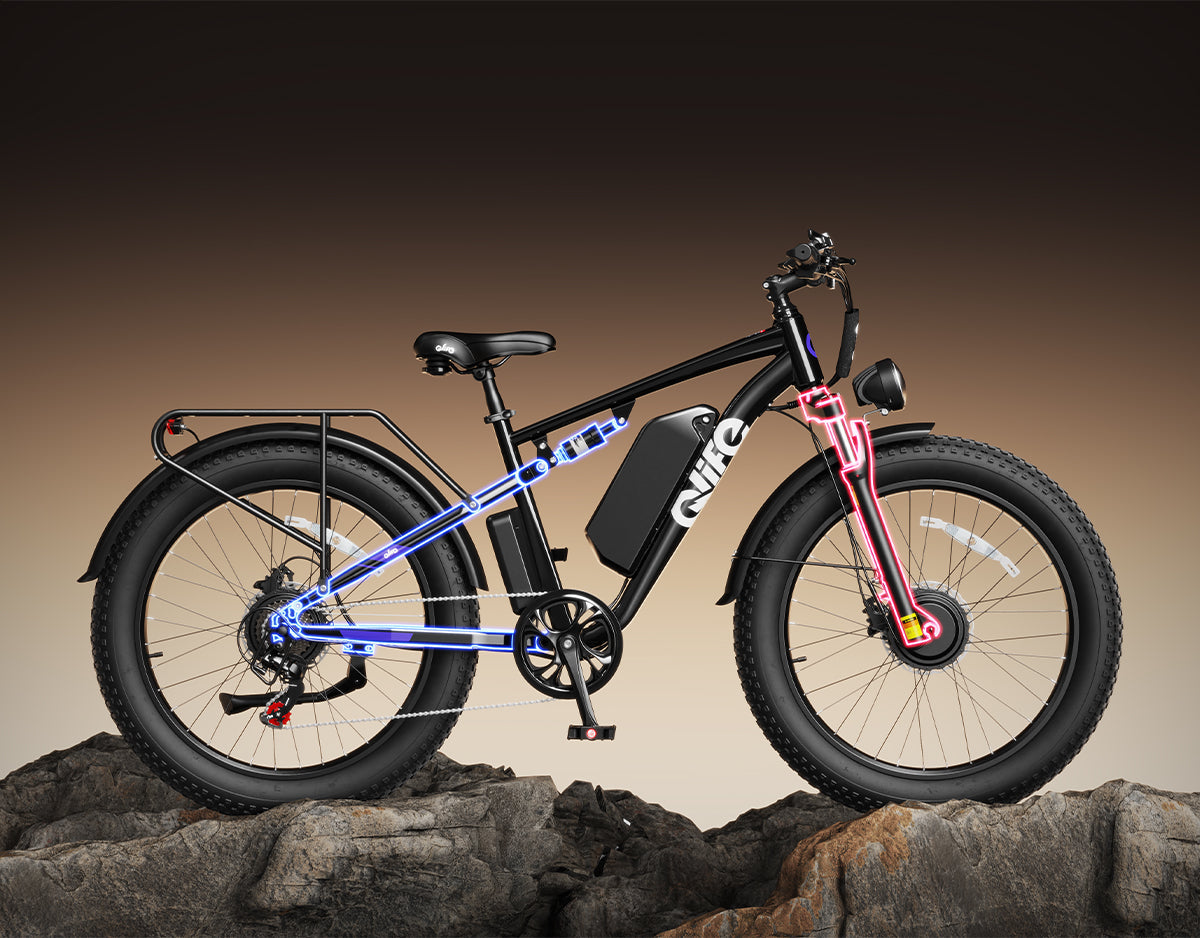
Beginners often have a lot of confusion dealing with different bike terminology. Perhaps the biggest issue is the difference between hardtail and full suspension. Full suspension means the bike has suspension at both the front and rear, whereas a hardtail means it’s only present at the front.
Most bikes are hardtail by design. They’re intended for gentle riding on roads or bike trails. But if you’re heading off-road onto rough terrain, full suspension becomes a big advantage. Without it, riders can find the experience not just uncomfortable, but hard to control.
Below, we explain what full suspension is, how it works, and what you need to look for when you’re buying a full suspension bike.
 What Is a Full Suspension E-Bike? (Simple Definition)
Full suspension e-bikes are usually a form of mountain bike. They’re fitted with two specific features:
1. The front suspension fork absorbs the impact on the front wheel.
2. The rear shock is a pivoting triangle controlled by either an air or coil shock.
There is also some form of linkage system that connects the rear triangle to the main frame. It dictates how the suspension performs in practice.
How Does Full Suspension Actually Work?
Normally, bikes rely on the front suspension fork to handle all the impacts. That’s because, in most cases, as you ride along a road or along a gentle trail, only the front wheel does any significant bouncing. The back wheel simply trails along behind.
In off-road and mountain bikes, things are different.
The front fork still absorbs the bumps at the front. However, the bike is more likely to rebound as it bounces along uneven ground. The rear shock, therefore, absorbs the impact at the back, increasing the comfort and control of the rider.
Suspension aims to keep the tires in contact with the ground. Tires create friction and grip, which the rider uses to control the bike. The more they bounce, the higher the risk of an accident.
Full Suspension vs Hardtail: What’s the Difference?
If you’re comparing mountain bikes, this is the first distinction that matters. The difference is simple on paper. But when you’re out on the trail, it has a big impact on how the bike feels and performs.
· Hardtail: Front suspension only, with a rigid rear end. Simpler, lighter, and more efficient on smoother terrain.
· Full suspension: Suspension at both the front and rear, designed to absorb impact and improve control on rough ground.
From there, it comes down to how those differences play out in real riding conditions:
|
Feature |
Full Suspension Bike |
Hardtail Bike |
|
Comfort |
High — absorbs bumps front and rear |
Moderate — rear is rigid |
|
Control |
Better on rough or technical terrain |
Good on smoother trails |
|
Weight |
Heavier due to added components |
Lighter and easier to handle |
|
Cost |
More expensive overall |
More budget-friendly |
|
Maintenance |
More moving parts to maintain |
Simpler and lower maintenance |
What Are the Benefits of a Full Suspension E-Bike?
1. Better Comfort on Rough Terrain
Full suspension e-bikes excel in mountainous, rocky terrain. Where most bikes would become unstable on uneven ground, these bikes tackle roots, gravel, or craggy hillside paths with relative ease. The suspension absorbs the bumps and bounces, allowing you to focus on controlling your ascent or descent.
2. Improved Control and Traction
The most important thing for a mountain bike is to keep both wheels on the ground. Without contact, you have no control. Full suspension bikes keep both wheels planted on the ground, so you have more stability downhill.
Plus, greater control can increase your confidence in steep descents or technical sections. Your bike can handle smoother and allow for precise cornering so that you can push yourself to the limits.
3. Less Fatigue on Long Rides
Constantly bracing your body during a ride is exhausting. Rather than feeling the force of each impact, the bike’s suspension absorbs the vibration. With less fatigue, you’re better able to ride longer, more aggressively, and without the soreness the next day.
4. More Confidence for Technical Riding
Confidence comes not just from experience but from the feel of the bike. If every slight bump jerks your bike or you can feel it slipping, you’re less likely to push yourself. A full suspension e-bike gives you the chance to see what you’re capable of.
What Are the Downsides?
1. Heavier Than Hardtails
Full suspension e-bikes are a fair bit heavier than a hardtail. The extra components add weight, which can reduce the range of the battery. Many manufacturers compensate by increasing the overall battery capacity. But this will add further weight to the bike.
2. More Expensive
Full suspension bikes sit firmly in the mid-to-high price range. Entry-level models usually start around $1,500–$2,500, while more capable setups are typically $2,500–$4,000. High-end builds with premium suspension and components can easily go beyond $4,000–$6,000+.
3. Requires More Maintenance
Every additional component creates the possibility of something breaking. The rear shock and linkage systems, in particular, can go wrong. You’ll need to schedule regular maintenance to keep the e-bike in good condition.
4. Less Efficient on Smooth Surfaces
If you’re just riding to and from work, the extra weight will slow the bike down and reduce the battery range. You’ll experience much higher energy loss from pedaling. Plus, if you reduce the assist level, it can feel a lot harder to pedal.
When Does Full Suspension Actually Make Sense?
Rough Trails and Technical Terrain
Full suspension is specifically designed for difficult terrain. It reduces the impact of any bumps, rocks, or roots, allowing the e-bike to ride smoothly forward. Most e-bikes simply can’t stand up to this kind of riding.
Downhill or Aggressive Riding
As you descend or ride aggressively, the back wheel has a higher chance of bouncing or rebounding. Without a rear shock, the e-bike can pivot or become uncontrollable. That’s why it’s important to only tackle this kind of trail with a full suspension e-bike.
Long Off-Road Rides Where Comfort Matters
If you’re spending long rides on off-road trails (even without extreme terrain), it pays to have a full suspension bike. You’ll notice less vibration, helping you to feel more relaxed and alert when you’re done.
When You Probably Don’t Need It
Full suspension e-bikes are overkill for a lot of riders. You probably won’t need a full suspension if:
- You’re mostly road riding
- You’re on light trails and gravel
- You’re a budget-focused rider
- You’re a casual or beginner
But if you’re an advanced or experienced rider who loves heading off into the hills, there’s no alternative to full suspension. Hardtail simply won’t cut it.
How Much Do Full Suspension E-Bikes Cost?
Full suspension e-bikes come in a lot of different models. The price doesn’t just depend on the suspension but also on the frame, wheels, and other components. For e-bikes, the motor and battery matter a lot too.
You can expect to pay:
- Entry: ~$1,500–$2,500
- Mid-range: ~$2,500–$4,000
- High-end: $4,000+
Are Full Suspension Bikes Worth It?
Full suspension e-bikes aren’t for everyone. They’re designed for people riding on rough terrain, steep descents, or longer off-road routes. The added comfort, control, and confidence can completely change how (and where) you ride.
On the flip side, they’re heavier and more expensive, meaning if you’re mostly sticking to roads or light trails, you’re overpaying for performance.
If you’re planning to ride off-road, it’s worth taking a look at Qlife’s full suspension range. Our e-bikes are built for real control and stability on rough terrain, not just smooth paths or light trails. If you want something that can handle climbs, descents, and uneven ground without feeling out of its depth, it’s a solid place to start.
FAQs
Is a full suspension better than a hardtail?
That depends on the terrain. For difficult, uneven terrain, full suspension e-bikes offer a smoother, more comfortable, and more controllable ride. However, on flat, even ground, they’re heavier and less efficient.
Are full suspension e-bikes good for beginners?
Sometimes, but not always necessary. If you’re just riding to and from work or enjoy an occasional bit of off-road riding, it might be a little much for a beginner.
Are full suspension e-bikes heavier?
Yes — the additional components can add considerable weight to the frame.
Can you ride a full suspension e-bike on the road?
Yes, there’s no reason you cannot ride a full-suspension e-bike on the road. However, the additional weight will mean it’s less efficient compared to the average road bike.
Do full suspension bikes require more maintenance?
Yes — the specific components of a full suspension system increase the risk of breakage. It’s important to get the rear shock and linkage system checked regularly.
Share:
How Fast Do Electric Bikes Go?
Can Electric Bikes Get Wet?