
It doesn’t take long on an electric bike before you start wondering how fast it can really go. You pedal harder, hoping for the assist to push faster and faster, but eventually you reach a limit. For most e-bikes, that’s somewhere between 20 and 28 mph.
Some high-performance e-bikes can exceed 35–50 mph, but these are usually classed as mopeds or motor vehicles rather than standard e-bikes.
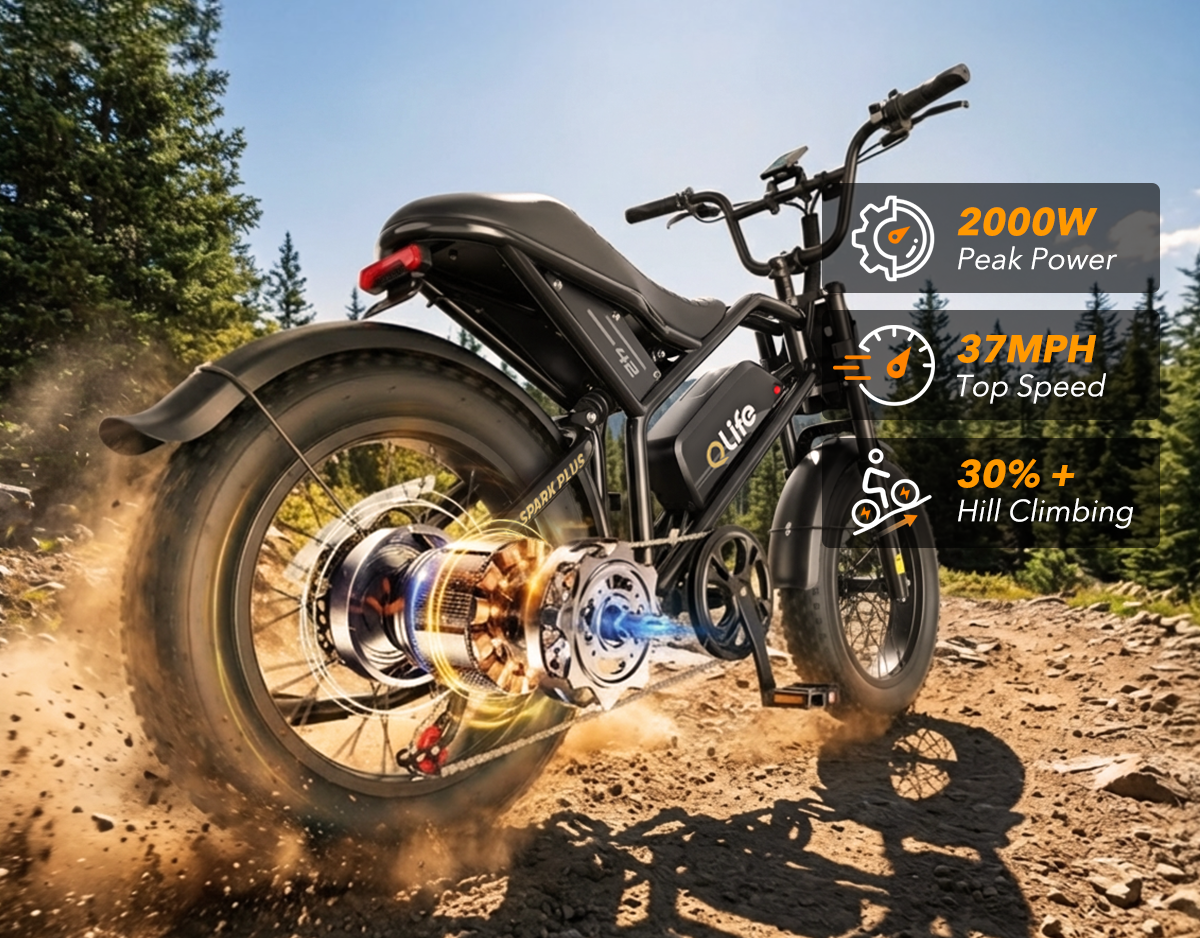
One of the big points of confusion with riders is the difference between spec speeds and real-world cycling. While an e-bike might list 37 mph in the specifications, you’ll find it much harder to reach that speed in practice. Stop-start intersection riding, hills, and legal limits mean that actual riding speeds are generally slower.
But just how fast can an electric bike go? What’s the fastest electric bike speed? And what do you need to know about e-bike speed limits? Find out below.
How Fast Do Electric Bikes Go on Average?
Electric bikes can typically reach speeds of 20 mph (32 km/h) for Class 1 and Class 2 e-bikes, while Class 3 e-bikes can go up to 28 mph (45 km/h). The actual speed may vary based on factors like rider effort, terrain, and bike specifications.
There’s a big difference between the speed a motor is capable of and the point at which the assist cuts off. Throttle e-bikes can reach their maximum speed on motor power alone (assuming there’s no cap). But with pedal assist, the motor cuts out at a certain point.
That being said, e-bikes might still go faster than 28 mph on certain downhill stretches.
E-Bike Classes and Legal Status (US)
Class 1
Class 1 e-bikes are pedal-assist only. That means the motor only kicks in when you pedal, and it stops helping at 20 mph. They’re designed for casual riders who want a little extra power when they ride.
Generally, they’re fitted with 250W motors. That’s enough power for most commuters or bike path cruisers, but not enough for any high speed.
Class 2
Class 2 e-bikes are defined by having a pedal-assist and a throttle. They’re like a hybrid between a bike and a motorcycle. However, like Class 1, they’re capped at a 20-mph top speed. Often, e-bikes can have a throttle but go higher, sitting outside the strict classification system.
Class 3
Class 3 e-bikes are also pedal-assist only. The main difference is that they have a top speed of up to 28 mph. Built for commuters, they’re intended to offer fast travel along roads. They’re typically fitted with more powerful motors.
While this is technically the limit, many e-bikes can go faster. For example, the Spark Plus has a top speed of 37 mph. However, it’s more akin to a moped than a regular e-bike.

Can Electric Bikes Go Faster Than 28 mph?
Yes — unlocked or high-power models exist.
Many Qlife models have a higher top speed than 28 mph. That’s common among dirt bike or moped-style models, where higher speeds are expected. However, even the Racer Max and Racer Plus boast a top speed of ~37-38 mph.
The problem? While they’re a lot of fun, there are legal implications for these e-bikes. In many US states, they may be classed as mopeds or motor vehicles, requiring a license and registration. That’s why most of our commuter e-bikes are capped at 28 mph.
What Actually Affects E-Bike Speed?
Motor Power (Watts)
Unsurprisingly, it’s the motor that determines the ultimate speed of the e-bike. More power = faster acceleration.
But just because the e-bike can accelerate faster, it doesn’t always mean a higher top speed. Other factors can diminish the potential output of a motor, making it harder to reach optimal speeds.
Rider Input
In a pedal-assist e-bike, the rider still matters. If they’re not pedaling harder, the motor won’t kick in. Often, the motor’s assistance is proportional to how hard you’re pedalling. So, if you’re going uphill or cycling faster, the motor increases its assist level.
Terrain
You’re not going to reach top speeds riding up a hill. The fastest speed the bike can reach is on flat ground. If you’re going downhill, you’ll likely surpass the top speed, and the motor will no longer provide any assistance.
Bike Weight
Heavier bikes have slow acceleration. The bike’s weight can increase due to fatter tires, more batteries, a heavier frame, or the rider themselves. If you’re heavier than the assumed weight of the rider, you might find it difficult to reach the top speed listed by the manufacturer.
Tires and Resistance
Rolling resistance refers to the friction of the tire on the road. The greater the surface area or grip, the slower the e-bike will be. That’s a problem for fat tires, where it takes more energy to rotate the wheel. Often, these e-bikes have a slower top speed.
Real-World Speeds vs Manufacturer Claims
On paper, e-bike speeds can look impressive. The thought of whizzing along at 37 mph might even seem a little scary.
However, they’re often based on best-case scenarios.
That usually means a light rider, flat ground, full battery, and maximum assist. They’re the “top” speed for a reason. In everyday riding, you’re dealing with hills, wind, traffic, and stop-start conditions, so the actual top speed tends to be lower.
What matters more is acceleration and handling. Many bikes can hit the top speed briefly. But if you want to get from A to B as quickly as possible, average speed over the journey matters far more than brief peaks.
Is Faster Always Better?
Most people are drawn to bigger numbers in specs. It’s not surprising. We equate a bigger number with better. While there’s some truth to that, speed often comes at the sacrifice of other metrics.
For example, the faster you go, the more quickly you’ll use up the battery’s power. So, you’ll find your range significantly diminished. Faster speeds also reduce rider control. You’re more likely to skid out or have an accident.
The right speed is usually the one that lets you cycle at a good rolling speed with reasonable pedal input. That balances range, legal limits, and time spent cycling. So, you’ll get from A to B in good time without pushing the e-bike to its maximum.
How Speed Affects Battery Range
Speed naturally diminishes battery range. Higher speeds use up more energy, lowering the range. That depends either on how much you use the throttle (if the e-bike has one) or the assist level.
In practical terms, riding at ~15–20 mph might give you 40–60 miles of range on a typical battery. Push that up to ~25–28 mph, and it can drop to 25–40 miles. If you’re riding flat-out on throttle or max assist, you might see as little as 15–30 miles.
The faster you go, the sharper the drop-off. That’s why most riders don’t sit at max speed — it drains the battery much quicker for relatively small time savings.
FAQs
What is the fastest electric bike speed?
Legally, the limit for e-bikes in the US is 28 mph. However, many e-bikes can go faster if they’re higher-end models or are unlocked. You’ll either need to ride these models on private ground or have a license to use them on the road.
Are electric bikes limited to 20 mph?
No. Class 1 and 2 e-bikes are limited to 20 mph. However, if an e-bike is Class 3 (pedal-assist only), it can reach a top speed of 28 mph.
Can you go faster than 28 mph on an e-bike?
Yes, many e-bikes can go faster than 28 mph. You might even reach a higher speed riding an e-bike downhill. That said, most US states follow the Class system, which restricts e-bike speeds to 28 mph. If your e-bike is set to go faster, you may need a license and registration.
Do more watts mean more speed?
Not necessarily. More watts usually mean more power and faster acceleration. Top speed is often limited by the bike’s controlled and legal caps, so even a higher-watt motor won’t keep pushing beyond that.
Does speed affect battery life?
Yes — going faster will drain the battery quicker. If you require a long range for a journey, it’s sensible to conserve battery power to not risk running out before you reach your destination.
Are fast e-bikes legal?
Yes — but only up to a point. In the US, e-bikes are legal if they start within the standard class limits: 20 mph for Class 1 and 2, and 28 mph for Class 3. Once an e-bike goes beyond that, it’s no longer classified as a bicycle. It may be treated as a moped or motor vehicle, which can require registration, a license, and insurance, depending on the state.
Share:
How Do Electric Bikes Work?
What is a Full Suspension E-Bike?