
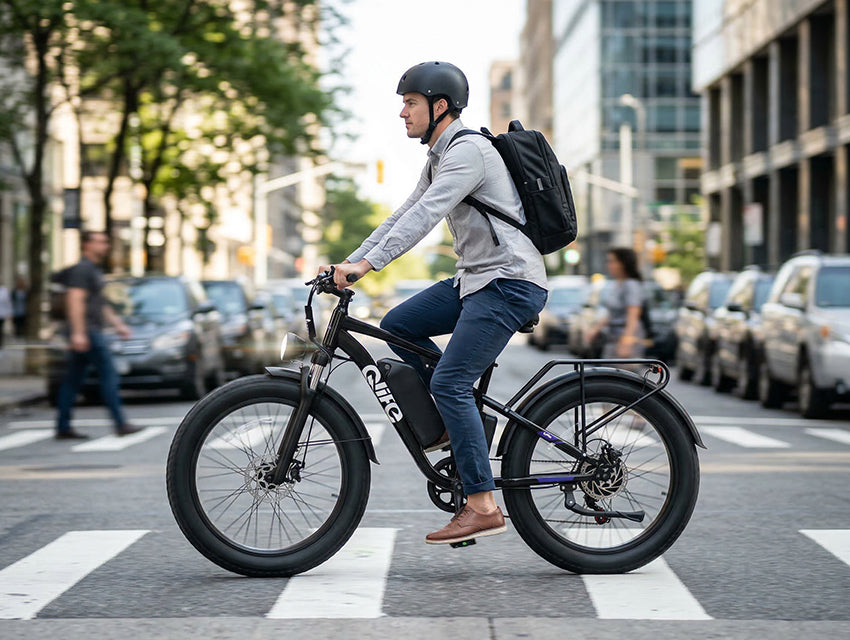
If you're planning on buying an electric bike in the US, there are a few things you need to know to stay on the right side of the law. Electric bikes in the US are regulated under a three-tier classification system, and the speed limit you're subject to depends on which class your bike falls into. You have to get this right because it determines where you can legally ride, and some states have their own rules on top of the federal ones.
This guide covers how the US e-bike classification system works, what the speed limits mean in practice, and which Qlife models fit into each category.
 The Three-Class System
The federal e-bike classification system divides electric bikes into three classes based on how the motor assists and how fast the bike can go.
Class 1 e-bikes have a motor that only assists when you're pedaling, and the assist cuts out at 20 mph. You get no throttle mode, so the motor stops helping the moment you stop pedaling. These are the most widely permitted e-bikes, as they're treated similarly to regular bicycles in most states. You can ride them on bike paths, trails, and road bike lanes in the vast majority of places. So if you're unsure what you can ride in your area, a Class 1 electric bike is the safest way to go.
Class 2 e-bikes also have a 20 mph assist limit, but the difference is that they have a throttle mode that lets you ride without pedaling. The maximum assisted speed is the same 20 mph as Class 1.
Class 3 e-bikes are where it gets interesting for riders who want to ride faster. The motor on a Class 3 bike assists up to 28 mph, a significant step up from the 20 mph limit in the other two classes.
Some Class 3 bikes also have a throttle that operates up to 20 mph, with the pedal-assist extending to 28 mph. These bikes are permitted on roads and in bike lanes in most states, but they're typically not allowed on multi-use paths or trails where Class 1 bikes are permitted. Many states also require riders to be at least 16 years old to ride a Class 3 e-bike.
What Happens Above 28 mph?
Whatever your electric bike's limit is, it will stop assisting at that speed. Electric bike motors simply cut out, so any extra speed comes from your legs or from rolling downhill.
You may come across bikes that are capable of going faster. But any e-bike with a motor that assists above 28 mph falls outside the federal three-class system and is no longer classified as a bicycle under federal law. These bikes are typically treated as mopeds or motor vehicles, which means they may require registration, a license, and insurance, depending on the state. Several Qlife models exceed 28 mph, so it's worth understanding this distinction before buying.
How States Handle E-Bike Laws
Most states use the three-tier system. As of 2025, 37 have officially adopted it, meaning Class 1 and 2 bikes are treated like regular bicycles, but Class 3 bikes face a few additional restrictions. States that haven't adopted it tend to have their own definitions, so speeds and rules can vary.
California is a good example of how states add their own layer on top of the federal rules. Class 3 riders need to wear a helmet, and you can't ride e-bikes on most multi-use paths. New York takes a different approach with its own rules around bike lane access. If you're moving to a new state or planning a trip, it's best to check the local laws before you go, to make sure you're allowed to ride your e-bike there.
Which Qlife E-Bikes Fall Into Each Class?
Qlife's electric bike range covers all three classes and beyond.

The Triker 2.0 tops out at 18 mph, keeping it well within Class 1/2 territory. It's permitted almost everywhere bicycles are allowed, making it a good choice for riders who want maximum access with no regulatory complications.
 The Racer Fat Tire 2.0 at 35+ mph and the Racer Plus Fat Tire 2.0 at 37+ mph both exceed the Class 3 limit of 28 mph. In most states, bikes that can go over 28 mph are treated as mopeds and may require registration or a license. With this in mind, it's best to check your local regulations before riding either of these on public roads.
 The Racer Max Dual Motor tops out at 38+ mph with its 3000W dual-motor system. This sits firmly outside standard bicycle classification in most US states and is best suited to private land, hunting, backcountry use, or states with more permissive rules.
Does Speed Class Affect Where You Can Ride?
Yes, and it's one of the most practical things to think about before buying.
If you want to ride on dedicated bike paths, multi-use trails, and in urban bike lanes without restrictions, a Class 1 or Class 2 bike is the safest choice. The Triker 2.0 fits comfortably here.
If you want Class 3 speed for road riding and commuting, most states allow this with some trail restrictions. Many Qlife models that top out at 28 mph in their legal assist mode fall into this category.
If you want higher performance for off-road use, private land, or riding in less restricted areas, the Racer Fat Tire 2.0, Racer Plus, and Racer Max give you significantly more capability than any class-compliant bike.
Final Thoughts
In the US, 20 mph is the limit for Class 1 and 2 e-bikes, and 28 mph is the maximum speed you can go and still be classified as a bicycle under Class 3. If you go above that, you're in motor vehicle territory in most states, which can mean you need a registration, a license, and insurance.
The best electric bike for you depends on where you live and where you plan to ride. If you want to keep things simple, Class 1 or 2 is the way to go. If you want more speed and are happy to check your state's rules, Class 3 offers significantly better performance.
Browse the full Qlife electric bike range to find a model that fits your needs and your local rules.
FAQ
What is the maximum speed of a Class 3 e-bike in the US?
Class 3 e-bikes have a maximum motor-assisted speed of 28 mph. Above that speed, the motor cuts out, and you're pedaling on your own.
Can I ride a 35 mph e-bike on public roads in the US?
It depends on your state. E-bikes above 28 mph fall outside the federal bicycle classification and are often treated as mopeds or motor vehicles. Some states are more permissive than others, so check your local rules before riding a higher-speed model on public roads.
Do I need a license to ride an e-bike in the US?
For Class 1, 2, and 3 e-bikes, most states don't require a license, registration, or insurance. Higher-speed models above 28 mph can be a different story depending on the state, as they may be classed as motor vehicles.
What class is the Qlife Racer Max?
The Racer Max Dual Motor tops out at 38+ mph, which puts it outside the Class 1-3 bicycle classification in most US states. It's best suited to private land, off-road use, or states with more permissive rules around high-powered e-bikes.
Are Class 3 e-bikes allowed on bike paths?
It varies by state and by the specific path. In many states, Class 3 e-bikes can't use multi-use paths that are open to Class 1 bikes. They're generally fine on road bike lanes and public roads.
Share:
Best Fat Tire Ebikes 2026: Top Picks for Every Terrain
What Should I Look for When Buying a Fat Tire E-Bike?