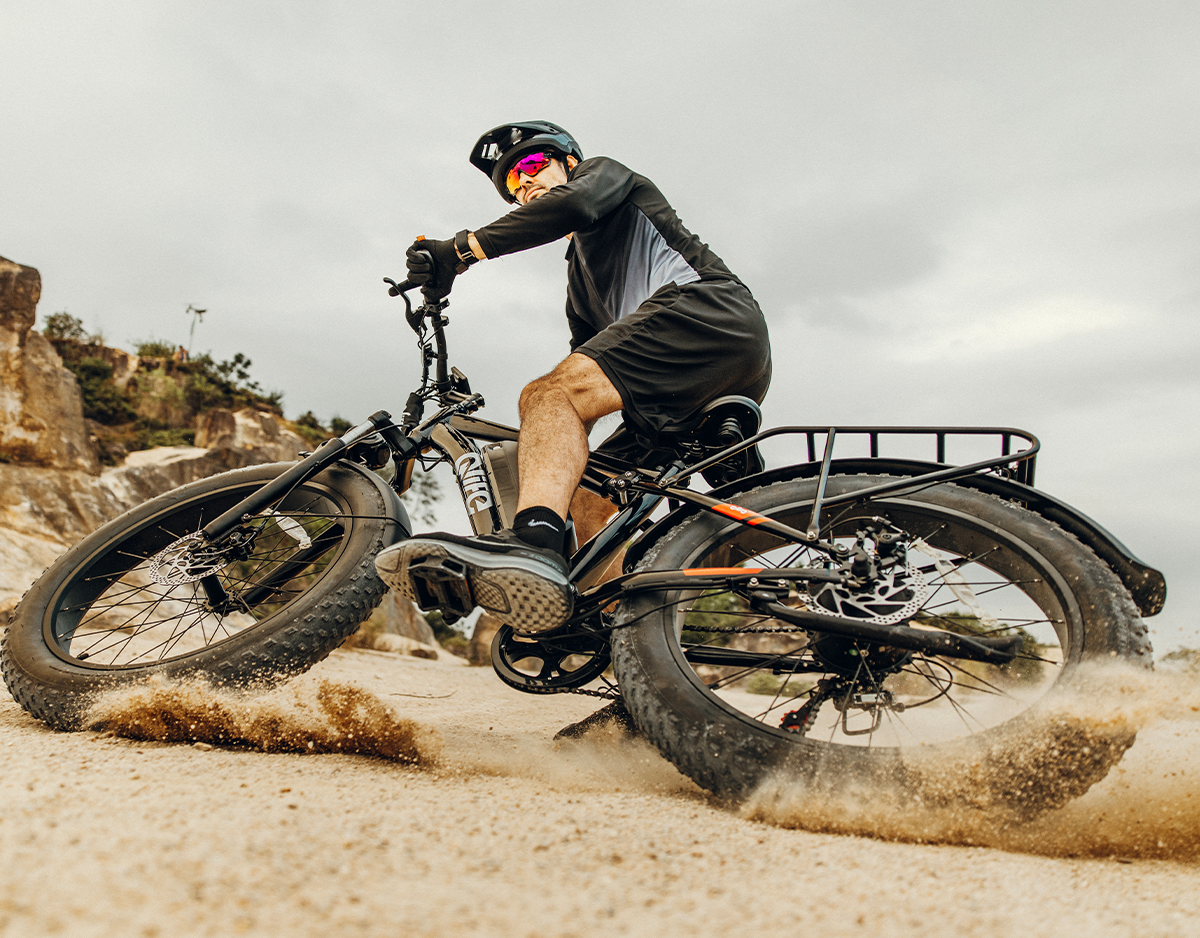
Electric mountain bikes have significantly changed trail riding. A climb that used to take 40 minutes of hard effort can be done in 20. Terrain that was off-limits because of the distance from the trailhead is now within reach. Riders who thought their days on technical trails were behind them are back out there. That's quite significant for people who want an active lifestyle and get outdoors.
But if you're new to e-MTBs, the spec sheets can be overwhelming. Motor power, battery voltage, amp-hours, torque figures, and pedal assist classes are a lot to decode before you've even thought about geometry or tire width. This guide simplifies it all and explains what matters when you're choosing an electric mountain bike for trail riding.
What Is an e-MTB?
An electric mountain bike is exactly how it sounds: it's a mountain bike with a motor and battery integrated into the frame. Unlike a motorbike or moped, it doesn't have a throttle; the motor only engages when you pedal.
That's the part most beginners don't quite expect. The motor doesn't take over. You're still working, the bike just makes the work feel different. On descents and technical sections, a well-set-up e-MTB handles a lot like a regular mountain bike. The difference shows up when you start climbing, or when you're two hours in to a ride and would otherwise be running on fumes.
Most e-MTBs sold in the US are Class 1, which means the motor assists you up to 20 mph, and there's no throttle. It's important to understand the class system because it determines where you're allowed to ride, as some places restrict what you can ride. Class 1 bikes are allowed on most trails that allow regular bicycles, though local rules vary and are worth checking before you head out. We will go into the details of electric bike classes later in this blog.
How e-MTB Motors Work
Hub Motors vs Mid-Drive Motors
Where the motor is mounted on the bike is important, as it affects power delivery and how the whole bike feels.
A hub motor is mounted inside either the front or rear wheel hub. Most affordable e-MTBs use this design because it's cheaper to produce and simpler to service. On flat or rolling terrain, it does the job well. Where things get more complicated is on technical trails. A rear hub motor biases the bike's weight towards the back, which affects how it handles on steep descents and tight turns. It's not a dealbreaker, but it's a real difference from a mid-drive.
A mid-drive motor is mounted at the bottom bracket, right in the middle of the bike, between the cranks. This means the weight stays low and centered, which is better for handling on technical terrain. Mid-drive motors also work through the bike's gears, so the motor can spin efficiently regardless of the gradient. That makes them more capable on varied terrain and better at sustained climbing.
However, you need to be prepared to pay more for mid-drive e-bikes as they cost more to make. For most beginner and intermediate riders on a reasonable budget, a hub motor is a perfectly good starting point, as long as you stay on mellow terrain. If you're serious about technical trail riding and handling, a mid-drive is worth the extra cost.
It's also worth noting that hub motor technology has improved considerably in recent years. Higher-quality hub motor e-MTBs have narrowed the handling gap with mid-drives, particularly at the lower end of the trail difficulty spectrum. For beginners who ride natural trails and gravel routes, a well-designed hub motor bike will rarely feel limiting.
Peak vs Nominal Wattage
When you look at an electric bike's spec sheet, you'll sometimes see two wattage numbers. Nominal wattage is the maximum power the motor can continuously deliver. Peak wattage is the maximum it can briefly deliver when you need it most, like during short bursts or on steep climbs.
A motor rated at 750W nominal might peak at 1200W or more. That's not marketing spin. It means you've got a bit more grunt for demanding moments without the motor working at its limit all the time. It's good to know these two numbers, as nominal gives you an idea of sustained performance, and peak tells you what it can do when the trail gets hard.
Torque: The Number That Tells You About Hillclimbing Ability
If you want to know how well an e-MTB climbs hills, you need to look at the torque figure, not the power. Torque is measured in Newton-meters (Nm) and indicates how much rotational force the motor produces. More torque means better performance on steep gradients. It also means the bike performs well even when you're carrying a bit of extra weight.
For trail riding, 60Nm is a reasonable minimum. Many good trail e-MTBs offer 70-85Nm of torque, allowing you to climb long, steep sections without the motor (or you) struggling or the bike slowing to a crawl.
Understanding the Battery
Voltage and Amp Hours
Battery capacity is measured in watt-hours (Wh). To get that figure, multiply the voltage by the amp-hours. A 48V 13Ah battery gives you 624Wh. A 52V 20Ah gives you 1,040Wh. More watt-hours mean the battery has more stored energy and, generally, provides more range.
Voltage also affects how the power feels. A 52V system pushes more current to the motor than a 48V system with the same amp-hour rating. So, when you're riding a trail that requires peak output regularly, you get a more responsive and less strained feeling from the motor.
Real-World Range
How far you can ride isn't as straightforward as you may think. Manufacturer range figures are almost always best-case numbers. Light rider, flat terrain, low assist. That's not how most trail riding works.
So, if you were to ride a hilly trail with lots of climbing, a bike quoted at 65 miles might realistically give you 30-40 miles. The assistance level you use makes a big difference to range, too. For example, riding on the highest assistance level the whole time drains the battery quickly. Ride on a mid-level setting, contribute your own effort, and you'll get considerably more out of each charge.
A good rule of thumb is to plan your rides around 50-60% of the quoted range if you're on hilly terrain with moderate assist. That gives you a buffer without worrying about having enough battery power to get home. If you work out that you have plenty of battery power left, you can choose higher levels to finish your ride.
It's also worth factoring in rider weight and the amount of gear you're carrying. A heavier rider with a loaded pack demands more from the motor, which will drain the battery faster than a lighter rider on the same route. If you're a heavier person or plan to carry a lot of stuff, lower your battery capacity expectations a bit more.
Suspension: How Much Do You Need?
Hardtail vs Full Suspension
A hardtail has a suspension fork up front, but no rear suspension. It's lighter, simpler, and cheaper than a full suspension bike. On smoother trails, gravel, and cross-country terrain, hardtails are efficient and capable. They're also easier to maintain and great for learning essential mountain bike skills.
Full suspension adds a rear shock absorber. On rocky, rooted, or technical terrain, this makes a significant difference. The rear wheel stays in contact with the ground more consistently, which improves traction and control. The rider also takes less of a beating on rough trails, which adds up over a long day out.
For beginners on moderate trails, a hardtail is a sensible starting point. If your local trails are technical or you plan to push into rougher terrain, full suspension will serve you better.
One thing that often gets overlooked is that full-suspension e-MTBs are better at retaining traction on climbs, too, not just descents. The rear wheel stays planted on uneven ground instead of bouncing off it, which means the motor's power translates more effectively to forward motion. On steep, loose climbs, that can make the difference between getting up and not.
Travel Figures
Suspension travel is measured in millimeters and tells you how far the suspension can compress to absorb an impact. More travel means more capability on rough terrain and more weight.
Light trail and cross-country riding suits 100-120mm. All-mountain riding on rougher terrain calls for 130-150mm. Enduro-style descents need 160mm or more. Most beginner e-MTBs sit in the 80-120mm range, which covers the kind of trails most new riders will spend their time on. But you can get e-MTBs with 180mm of travel and more, but these are for serious riding on extreme terrain.
Tires and Wheel Size
Fat Tires vs Standard MTB Tires
Fat tires (3.0 to 5.0 inches wide) have a bigger contact patch with the ground. That means you get more grip on loose, sandy, muddy, or snowy surfaces. They also act as a suspension system, absorbing much of the vibration and shock before they reach your hands and arms. This makes a real difference on rough terrain without rear suspension.
The downside of fat tires is their higher rolling resistance, which slightly reduces your range. Fat tires are harder work on smooth, hard surfaces than a narrower mountain bike tire. For mixed terrain and trail riding, that trade-off is worth it. For riders who spend most of their time on smooth or flat terrain, a 2.1- to 2.4-inch tire is more efficient.
Wheel Size
E-MTBs typically use 20-inch, 26-inch, 27.5-inch, or 29-inch wheels, depending on the style of bike. Smaller wheels make the bike more maneuverable and make tight turns easier. Bigger wheels roll over obstacles such as rocks and roots more easily and hold speed better on bumpy trails.
20-inch wheels are common on compact and folding fat tire e-MTBs. They're nimble and easy to handle, and the wide, fat tire compensates for the smaller diameter by improving grip and absorbing trail vibration. 26-inch wheels are also common on full-size fat tire e-MTBs and offer a good balance of maneuverability and trail capability.
27.5-inch wheels hit a good middle point for traditional trail riding; they roll efficiently while still giving you good handling characteristics. 29-inch wheels are the choice for cross-country, enduro, and downhill riders who benefit more from rolling speed and obstacle clearance than nimble handling.
Brakes: Why Hydraulic Matters
When you're riding a heavy e-MTB on the trails, you need to think about its brakes. The difference between mechanical and hydraulic disc brakes is worth understanding.
Mechanical disc brakes use a cable to actuate the caliper. They're lighter and cheaper to service, but they need more hand force to stop effectively and don't offer the same feel or precision. In the wet or after heavy use, they can also fade.
Hydraulic disc brakes use fluid, just like a car. The advantage of hydraulic brakes is that you can stop harder with less effort on the brake levers. They also feel more consistent in wet or hot conditions, and give you better control when you need to scrub at a gradual speed instead of grabbing a handful. This really makes a difference on a bike that can easily exceed 20+ mph on a descent. Most mid-range and above e-MTBs come with hydraulic brakes as standard, and for good reason.
If you're looking at a bike with mechanical disc brakes and everything else about it suits you, it's worth knowing that hydraulic brakes can be retrofitted later. It's not a cheap upgrade, but it's an option if the rest of the spec is right and the budget is tight.
Pedal Assist Classes
In the US, e-bikes are divided into three classes based on how the motor behaves. Most trail-legal e-MTBs are Class 1, but it's worth knowing what each class means before you buy.
• Class 1: Pedal assist only, no throttle, motor cuts off at 20 mph. This is the standard for most trail-legal e-MTBs in the US and the class most land managers accept alongside regular mountain bikes.
• Class 2: Adds a throttle but still caps at 20 mph. Less common on dedicated trail bikes and not permitted on many trail systems.
• Class 3: Pedal assist up to 28 mph, no throttle. Higher speeds mean fewer places you can legally ride on shared trail networks.
If you're unsure about what to choose, or are a total beginner, Class 1 is the safe choice.
Regulations are still evolving in many areas, and what's permitted can vary significantly between trail systems. Some land managers treat Class 1 e-MTBs the same as regular mountain bikes. Others prohibit them entirely on certain trails. Checking before you buy saves you from finding out when you get to the trail.
It's also worth knowing that some higher-powered bikes marketed as e-MTBs exceed Class 1 and Class 3 limits. If a bike tops out at 37 mph or has a throttle that works without pedaling, it's likely not trail-legal under standard mountain bike access rules. That doesn't make it a bad bike. It just means you need to be clear on where you can ride it before committing.
What to Look for as a Beginner
There's a lot to consider when buying your first e-MTB, but these are the things that you should look for as a beginner:
• Torque over wattage. At least 60Nm will handle hills on most trails. Entry-level bikes don't always publish torque prominently, so dig into the spec sheet if hills are going to be a regular part of your riding.
• Battery capacity of at least 500Wh. Below that, longer rides become a balancing act, giving you range anxiety. If you're planning to ride for more than 2 hours, go for a bike with at least 600Wh.
• Hydraulic disc brakes over mechanical, if your budget allows. The difference in feel on technical descents is noticeable, and on a heavier e-MTB, it's a safety consideration as much as a comfort one.
• At least 80-100mm of suspension travel up front. This covers most beginner-to-intermediate trail conditions. If you know you'll be pushing into rougher terrain eventually, 120mm gives you room to grow without needing to upgrade. However, if you live in a mountainous area, you'll need much more travel to ride the more technical trails.
• Wider tires in the 2.4-4.0 inch range. More grip and forgiveness on loose or uneven surfaces. For anyone new to trail riding, that extra margin makes the experience less stressful.
• Don't let peak wattage drive the decision. A well-rounded bike with good brakes, appropriate suspension, and a capable battery will serve you better than a high-powered motor on a bike that cuts corners everywhere else.
• Check the overall weight. E-MTBs are heavy, and that's fine on the trail. It becomes an issue when you're loading it into a car, lifting it over obstacles, or carrying it up stairs.
• Don't forget the controls. A clear, easy-to-read display you can operate with gloves on makes a bigger difference than most buyers expect. Some bikes have excellent motors and frustrating controls. If you can, play with the controls before committing; if you can't, read reviews carefully.
Qlife Electric Mountain Bikes
Qlife's electric mountain bike collection covers everything from entry-level fat tire hardtails to high-power dual motor options. Here's what's in the range.
Racer Fat Tire 2.0: from $659
 If you're new to e-MTBs and want to start somewhere sensible, the Racer Fat Tire 2.0 is a good place to start. It has a 1200W peak motor, a 28 mph top speed, and up to 55 miles of range on 20x4.0-inch fat tires. The 20-inch wheels keep it maneuverable in tight situations, and the wide tires handle loose terrain, gravel, and light trails without much drama. At $659, it doesn't ask you to overcommit on budget before you know what kind of riding you want to do.
Best for: Beginner and intermediate riders who want an accessible fat tire e-MTB for mixed terrain and light trail use.
Racer Plus Fat Tire 2.0: from $749
 More wheel, more range, same motor. The Racer Plus Fat Tire 2.0 keeps the 1200W peak motor and 28 mph top speed from the standard Racer, but steps up to 26x4.0-inch fat tires and a bigger battery. The larger wheels roll more efficiently over rough terrain, and the extended range suits longer days better than the base model. If you already know you'll be pushing the bike harder or further, the Plus is the smarter place to start.
Best for: Riders who want more range and larger wheels from the fat tire platform for longer off-road riding.
Racer Ultra 27.5": from $549
 The Racer Ultra 27.5" is the most affordable model in the range and also the one that feels closest to a traditional mountain bike. Full suspension, 27.5x2.1-inch wheels, a 750W peak motor, and a 21-speed drivetrain. The full suspension makes a real difference on technical or rocky terrain compared to a hardtail fat tire bike, and the 27.5-inch wheels roll well across mixed surfaces. The 750W motor is modest compared to the rest of the lineup, but at $549 with full suspension included, it punches above its price for beginner trail riders.
Best for: Beginner riders who want full suspension and a traditional mountain bike feel at the lowest price in the range.
Racer Max Dual Motor: from $1,099
 At the top of the range, the Racer Max is a different kind of bike entirely. Dual motors, 3000W peak output, 52V 20Ah battery, and 37 mph top speed on 26x4.0-inch fat tires. It's not for beginners, and it's not aimed at Class 1 trail access. At 37 mph, it sits well outside the limits for most shared trail systems, so this one is for riders who know where they're going to ride it and want the most power the Qlife range has to offer.
Best for: Experienced riders who want maximum power and don't mind checking trail access regulations for higher-speed e-bikes.
FAQs
Do I need a license to ride an e-MTB on trails?
For Class 1 e-MTBs, no license is required in most US states. Trail access depends on local regulations, so always check the rules for specific trail systems before riding.
Is an e-MTB good for fitness?
Yes. Research consistently shows that e-MTB riders get meaningful cardiovascular exercise. The motor reduces effort, allowing most riders to ride longer and further than they would on a regular mountain bike.
How heavy is an e-MTB?
Most e-MTBs weigh between 50 and 70 lbs, depending on motor size, battery capacity, and frame material.
Can I ride an e-MTB in the rain?
Most e-MTBs are water-resistant and can handle rain and wet trail conditions. Avoid submerging the battery or motor, and check the bike's IP rating if you regularly ride in wet conditions.
How long does an e-MTB battery last?
Most lithium-ion e-bike batteries are rated for 500-1,000 charge cycles before capacity begins to decline. With regular use, that typically means 3-5 years before the battery needs to be replaced.
Final Thoughts
The spec sheet on an e-MTB can be a bit overwhelming if you're new to electric bikes, but once you know what to look for, it gets simpler. Torque over wattage, battery capacity over claimed range, hydraulic brakes over mechanical. Those three things alone will help you make a better decision than most riders make when they buy their first e-MTB.
Qlife's electric mountain bike range covers several price points. If you're starting with a fat tire hardtail or stepping up to full suspension, there's a model in the range that fits where you are and where you want to get to.
Share:
The Ultimate Under-$1,000 e-MTB Guide: Find Your Perfect Off-Road Companion
Beyond the Mountains: Using Your E-MTB for Bikepacking, Hunting, and Exploring