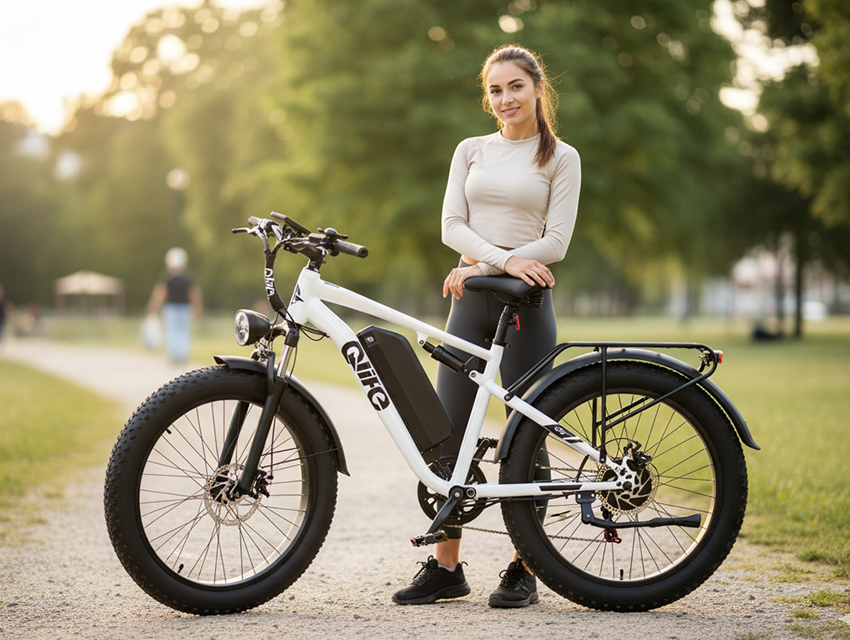
Qlife's electric mountain bike collection covers a wider range of riding styles and price points than most people expect. From entry-level trail bikes to dual-motor beasts, moped-style cruisers, and full suspension e-MTBs, there's more variety here than a typical e-MTB brand.
But what makes the lineup interesting isn't just the number of models. It's how differently these bikes are positioned.
Some are clearly built for riders buying their first electric mountain bike and trying to stay under budget. Others focus on bigger batteries, higher speeds, and more aggressive off-road capability. Some prioritize comfort and relaxed riding posture, while others feel much closer to a traditional mountain bike. There are compact 20-inch fat tire models designed for maneuverability and urban riding, alongside larger 26-inch platforms that feel more stable and efficient on longer mixed-terrain rides.
That variety is useful, but it can also make the collection harder to understand at first glance. Looking at motor wattage alone doesn't really tell you how a bike will feel to ride. Wheel size, suspension setup, frame geometry, riding posture, and battery capacity all change the experience in very different ways.
For example, a smaller fat tire bike may feel more playful and easier to handle in tighter environments, while a larger-wheel model tends to roll more smoothly over rough ground and maintain stability at higher speeds. Likewise, a full suspension setup can dramatically improve comfort and control on uneven terrain, especially for riders spending more time off-road.
The good news is that the Qlife lineup is broad enough that most riders can quickly narrow things down once they understand what category fits their riding style best.
This guide breaks the collection down by bike type, wheel size, and intended riding use so you can compare the models more naturally instead of just scanning spec sheets. Whether you're looking for an affordable first e-MTB, a high-powered fat tire machine for rough terrain, a comfortable commuter with trail capability, or a moped-style cruiser with extra performance, there's likely a model in the range that fits.
Let's start with the most accessible category in the lineup: the 20-inch fat tire e-MTBs.
Fat Tire e-MTBs: 20-Inch Wheels
Racer Fat Tire: from $569
 If you want to get into fat tire e-MTB riding without spending a lot, the Racer Fat Tire is the place to start. It has a 1200W peak motor, a 48V 10.4Ah battery, a top speed of 28 mph, and up to 55 miles of range on 20x4.0-inch fat tires. The front suspension fork takes the edge off rougher surfaces, and Shimano 7-speed gears give you control on varied gradients.
It's also one of the most reviewed models in the Qlife range, which tells you something about how often it gets chosen and how well it holds up. At $569, there's not much else on the market that offers this combination of fat tire capability and motor performance at this price.
Best for: Riders who want an accessible, well-proven fat tire e-MTB at the lowest entry price.
Racer Fat Tire 2.0: from $659
 Same frame, same motor, same tires. The Racer Fat Tire 2.0 features a larger 48V 13Ah battery. The extra capacity is especially useful if you ride longer distances, carry weight, or often use higher assistance levels. You're not getting a fundamentally different bike; you're getting the original Racer with more battery behind it.
For riders who found the original Racer appealing but wanted more range, this is the straightforward upgrade.
Best for: Riders who want the 20-inch fat tire format with more battery capacity for longer or more demanding rides.
What you start noticing after riding 20-inch fat tire bikes for a while is how much wheel size changes the overall feel of the ride.
Smaller wheels tend to feel more compact, playful, and easier to maneuver in tighter environments. But once riders begin covering longer distances or spending more time on gravel roads, dirt paths, and uneven terrain, many naturally start looking toward larger 26-inch platforms for better rollover ability, stability, and range efficiency.
That's where the larger-fat-tire side of the Qlife lineup comes in.
Fat Tire e-MTBs: 26-Inch Wheels
Racer Plus Fat Tire: from $649
 The Racer Plus Fat Tire has 26x4.0-inch fat tires, which change how the bike feels and behaves on rougher ground. The bigger contact patch gives you more traction, it rolls more efficiently, handles obstacles with less drama, and gives the bike a more planted feel at speed. Combined with a 1200W peak motor, 48V 13Ah battery, 28 mph top speed, and up to 65 miles of range, it covers significantly more distance than the 20-inch models on a single charge.
For riders who spend most of their time on gravel, dirt roads, or varied terrain instead of tight urban environments, the 26-inch format is worth the extra $80 over the Racer Fat Tire 2.0.
Best for: Riders who want the efficiency and range of larger fat tires for mixed terrain and longer off-road rides.
Racer Plus Fat Tire 2.0: from $749
 This one is worth reading carefully because it's more of a step up than the name suggests. The Racer Plus Fat Tire 2.0 upgrades to a 1500W peak motor and a 36 mph top speed, putting it in a noticeably different performance bracket than the other 26-inch models. The 48V 15.6Ah battery is also the largest in this corner of the range, offering greater capacity and more consistent output under load.
You get up to 65 miles of range on 26x4.0-inch fat tires, with a motor that can handle steep climbs and heavier riders without struggling. If you want the most capable fat tire e-MTB in the Qlife range short of the Racer Max, and you don't need dual motors to get there, the Racer Plus Fat Tire 2.0 is the pick.
Best for: Riders who want more motor power and a larger battery from the 26-inch fat-tire platform.
Racer Max Dual Motor: from $1,099
 The Racer Max is at the top of the range and a different bike entirely. Its dual motors give you 3000W peak output, a 52V 20Ah battery, and 26x4.0-inch fat tires. This is a serious machine for riders who need serious power.
With a 37 mph assisted top speed, it sits outside Class 1 limits, so if you ride standard mountain bike trails, you'll have to choose a different bike. But for road use, hunting trips, backcountry exploring, or any situation where raw power and range are the priorities, nothing else in the Qlife range comes close.
Best for: Experienced riders who want maximum power and range and don't need Class 1 trail access.
Not every rider wants maximum speed and dual-motor power, though.
For many people, ride comfort, handling, and trail feel matter more than outright acceleration. That's where full suspension e-MTBs become a very different category. Instead of focusing primarily on raw power, these bikes are designed to absorb impacts better, maintain traction on uneven terrain, and feel more controlled on technical trails.
If you're looking for something that rides more like a traditional mountain bike, the next model is the one to pay attention to.
Full Suspension e-MTB
Racer Ultra 27.5": from $549
 Of all the bikes in this collection, the Racer Ultra 27.5" is the one that feels most like a traditional mountain bike. Full suspension front and rear, a 1200W peak motor producing 70Nm of torque, a 48V 10.4Ah battery, and a 28 mph top speed. You also get up to 55 miles of range on a single charge.
$549 for a full suspension e-MTB with this motor spec is a strong offer. The rear suspension makes a real difference on technical or rocky terrain compared to any hardtail, and the 27.5-inch wheels roll efficiently across mixed surfaces in a way the 20-inch fat tire bikes can't quite do on smoother ground.
Best for: Beginner to intermediate riders who want full suspension and a traditional mountain bike feel at the lowest price in the range.
At this point, the lineup starts branching into a different riding philosophy altogether.
Some riders want an e-bike that feels athletic and trail-focused. Others care more about comfort, cruising posture, and visual style. That's exactly why moped-style electric bikes have exploded in popularity over the last few years. They blend fat-tire capability with a more relaxed riding position and a motorcycle-inspired design that appeals to commuters and recreational riders alike.
Qlife's Spark series leans heavily into that category.
Moped-Style e-MTBs
Spark: from $689
 Most e-MTBs look the same. The Spark doesn't. The motorcycle-inspired frame is the obvious difference, but the spec underneath is just as impressive. This bike has a 1500W peak motor, 20x4.0-inch fat tires, and a range of up to 60 miles. It also reaches an assisted top speed of 32+ mph. IP54-rated waterproofing means it withstands light rain, and the dual suspension keeps it comfortable on rough ground.
The riding experience is very different from the Racer series. This is down to the geometry, seat position, and dual suspension, which give it a cruiser-style character that some riders prefer for longer days out. This type of e-bike is popular with commuters who want something a little different and with recreational riders who spend time on mixed terrain without needing a dedicated trail bike.
Best for: Riders who want a moped-style design with dual suspension and strong all-terrain performance.
Spark Plus: from $1,099
 Where the Spark is a capable all-rounder, the Spark Plus is for riders who want more of everything. A 2000W peak motor, 52V 20Ah battery, 37 mph top speed, and hydraulic disc brakes on 20x4.0-inch fat tires. The hydraulic brakes alone are worth mentioning. At 37 mph, the difference between hydraulic and mechanical braking is quite significant in terms of control and stopping power.
Hydraulic brakes require less hand effort and respond more precisely, which matters when you need to shed speed quickly.
Like the Racer Max, the 37 mph top speed puts it outside Class 1 limits. Therefore, you should check local regulations before riding on shared trail systems.
Best for: Riders who want maximum power, hydraulic brakes, and the Spark's moped-style design.
Of course, not everyone shopping for an electric mountain bike is planning to ride aggressive trails or chase high top speeds.
A large part of the market simply wants something practical: an e-bike that can handle commuting during the week, bike paths on weekends, and the occasional dirt shortcut without feeling overbuilt or intimidating. That's where the Cityone series fits into the lineup.
These bikes focus more on accessibility, comfort, and everyday usability while still keeping enough motor power and suspension travel for light off-road riding.
Urban Trail e-MTBs
Cityone Step Over 2.0: from $469
 The most affordable model in the Cityone lineup, the Cityone Step Over 2.0 is ideal for riders who want a practical, easy-to-live-with e-bike for commuting and light trail use without spending much. It has a hub-mounted 1200W peak motor, and its 48V 10.4Ah battery gives you up to 55 miles of range. The 80mm front suspension fork does a great job of smoothing rough roads and light off-road terrain, making it more comfortable, and the 21-speed Shimano gearing makes riding up hills much easier. It is also IP54-rated, so you can commute in light rain.
Best for: First-time riders and daily commuters who want a practical, affordable e-bike for commuting and light trail riding.
Cityone Step Over Ultra: from $549
 If the Step Over 2.0 appeals but you want more capability on rougher terrain, the Cityone Step Over Ultra is worth checking out. It has the same 1200W peak motor, 28 mph top speed, and 55 miles of range, but adds full suspension front and rear. The specs are very similar, but the rear shock absorber makes a noticeable difference on rougher surfaces and longer rides.
Best for: Riders who split their time between city commuting and light trails. The full suspension makes the Cityone Ultra more comfortable and capable without having to buy a dedicated electric mountain bike.
By this point, one thing becomes pretty clear: Qlife isn't building just one type of electric mountain bike.
Some models are built around affordability. Others prioritize range, suspension comfort, top speed, or aggressive off-road capability. Some are closer to traditional mountain bikes, while others lean into moped-inspired cruising.
That variety is useful, but it can also make the lineup harder to navigate if you're buying your first e-MTB. So instead of comparing every spec line-by-line, it helps to narrow things down based on how and where you actually plan to ride.
How to Choose
The right model depends on what you plan to do with it. Here's a quick breakdown by riding style:
• Trail riding and off-road on a budget: The Racer Ultra 27.5" gives you full suspension at $549 and is hard to beat at that price.
• Fat-tire versatility on varied terrain: The Racer series ranges from $569 to $1,099, depending on wheel size, motor power, and battery capacity. The 20-inch models suit tighter, urban-oriented riding. The 26-inch models are suited to mixed terrain and longer distances.
• Moped-style design with real performance: The Spark and Spark Plus are the picks, with the Spark Plus adding hydraulic brakes and more power at $1,099.
• Urban commuting with light trail capability: The Cityone range covers everything from the $469 Step Over 2.0 to the full suspension Step Over Ultra at $549.
If you're buying your first e-MTB, the Cityone Step Over 2.0, the Racer Fat Tire, and the Racer Ultra 27.5" are the three models worth starting with, depending on your riding style. If you already know you want more power, range, or a specific riding style, the rest of the range has something for you.
FAQs
Are Qlife e-MTBs good for trail riding?
Most models are Class 1 and suitable for trails that permit regular mountain bikes. The Racer Max and Spark Plus exceed Class 1 limits at 37 mph, so check local regulations before riding on shared trail systems.
Do all Qlife e-MTBs come with a warranty?
Yes. All models come with a 365-day warranty covering manufacturing defects, with US-based customer support available within 24 hours on weekdays.
How long does it take for a Qlife e-MTB battery to charge?
Most models charge fully in 4 to 5 hours. Batteries are removable on most models for convenient indoor charging.
Can I ride a Qlife e-MTB in the rain?
Most models have IP54-rated waterproofing, which handles light rain and road spray. Avoid deep water and heavy storms.
Final Thoughts
Qlife's electric mountain bike collection covers more ground than most brands at these price points. From the $469 Cityone Step Over 2.0 to the $1,099 Racer Max Dual Motor, there's a model for every type of rider and every kind of terrain. Browse the full collection to compare specs and find the one that suits your riding style.
Share:
Can Electric Bikes Get Wet?
Decoding the e-MTB: A Beginner’s Guide to Motors, Range, and Trail Performance