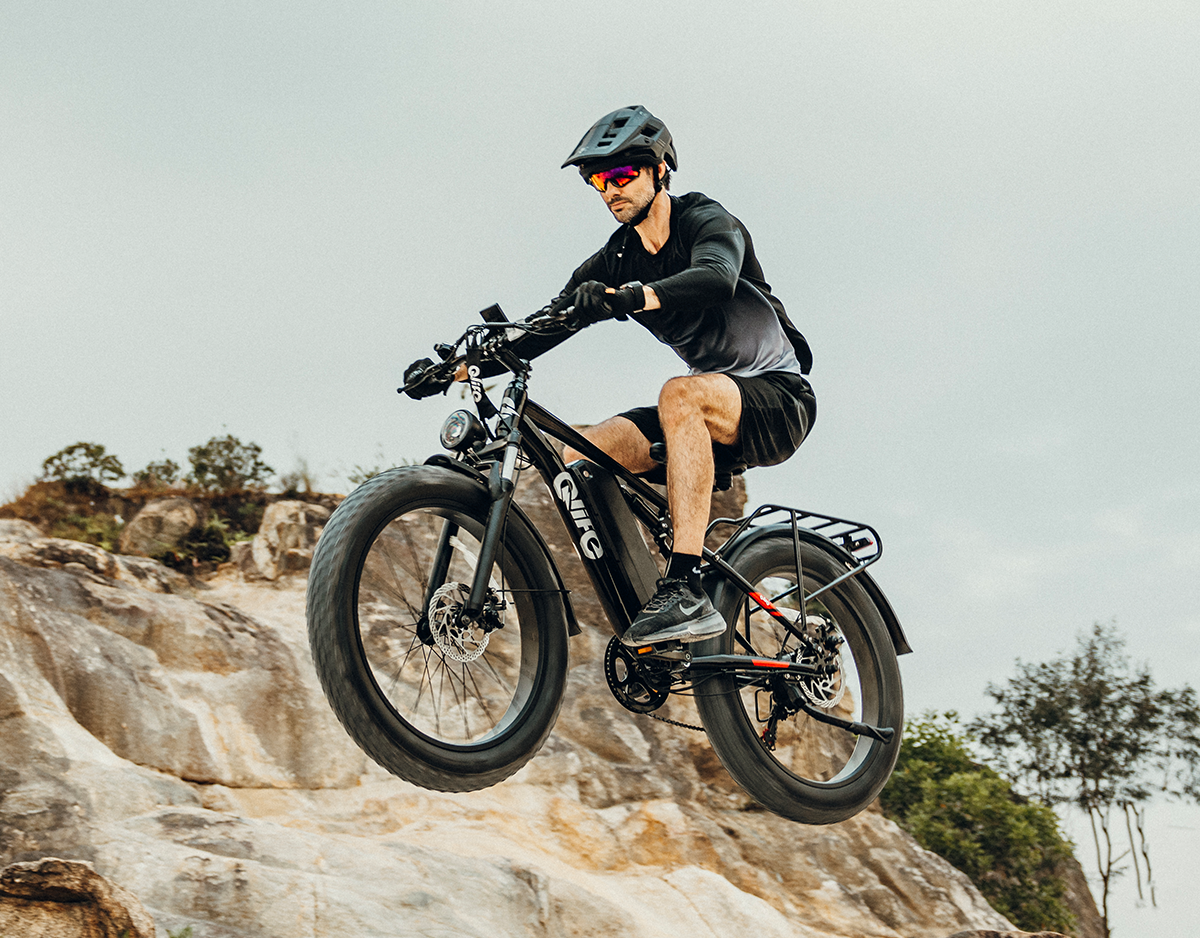
If you're new to mountain biking and wondering about e-MTBs, the honest answer is: yes, for most people. But that answer comes with some context that's worth understanding before you buy.
An electric mountain bike isn't a shortcut to riding technical trails. It doesn't make descents safer or replace the skills you'll need to enjoy the sport properly. What it does is change the how much effort you need to put in, and for a lot of beginners, that's what makes riding enjoyable from the start, instead of something you have to suffer through before it gets fun.
Here's what you need to know.
 What an e-MTB Does for a Beginner
The biggest barrier for new mountain bikers isn't the descents. It's the climbs. Most beginners are fit enough to enjoy a trail, but not fit enough yet to get up a long, steep climb without stopping three times and arriving at the top too tired to appreciate what comes next.
An e-MTB removes that specific frustration. The motor assists your pedaling on the way up, so you arrive at the top with something left in the tank. You can focus on the trail instead of just surviving it. For a lot of riders, that's the moment mountain biking goes from a chilling experience to an enjoyable one.
It also extends how long you can ride. A beginner on a regular mountain bike might manage 90 minutes before fatigue becomes a factor. The same rider on an e-MTB can often double that, meaning more time on the trail and faster skill progression.
What an e-MTB Doesn't Do
This is the part that some beginners miss. The motor helps with effort, not with skill.
Cornering, braking, picking a line, reading the trail ahead, and balancing through technical sections. None of that gets easier because you have a motor. If anything, e-MTBs are heavier than regular mountain bikes, which makes handling slightly less forgiving, not more.
That means you still need to learn the fundamentals. A beginner who buys an e-MTB and immediately tries to ride trails that are beyond their skill level is going to have a bad time, motor or not. The assistance doesn't catch mistakes. You still go over the bars if you brake in the wrong place.
The good news is that most beginners aren't trying to ride expert trails. They're riding mellow paths, gravel tracks, and easier trails where the e-MTB's benefits are straightforward and the extra weight is easy to manage.
Is the Weight a Problem?
E-MTBs are heavier than regular mountain bikes, often significantly so. Most weigh between 50 and 70 lbs. That's a real consideration, but it's less of a problem than it sounds for most beginners.
On the trail, the weight is manageable because the motor compensates for it on climbs. Where it becomes noticeable is off the bike: loading it into a vehicle, carrying it up stairs, lifting it over gates. If those situations are a regular part of your riding life, it's worth factoring the weight in before buying.
For most beginners riding local trails, it's not a dealbreaker. You get used to it quickly, and the motor more than compensates for the extra mass when you're on the trail.
Skills Development: Does an e-MTB Hold You Back?
This comes up a lot, and the concern is understandable. If the motor is doing some of the work, are you developing fitness and skills?
On fitness, the research is detailed: e-MTB riders still get significant cardiovascular exercise. The motor reduces effort enough to make riding enjoyable, not so much as to make it passive. Most riders end up covering more distance and spending more time on the bike, which means the overall fitness benefit often exceeds what they'd get on a regular mountain bike with shorter, harder rides.
A study conducted by Brigham Young University in Utah monitored a group of experienced mountain bikers. They rode a 7-mile loop on traditional mountain bikes, then repeated it on electric mountain bikes. When they rode the electric mountain bikes, they hit 94% of the average heart rate recorded on their regular mountain bikes. The main difference was that they completed the loop much faster. The study confirms that you can still get a great cardiovascular workout even with assistance from an electric motor.
On skills, an e-MTB neither helps nor hinders. You develop trail reading, cornering, and braking skills at the same rate on an e-MTB as on a regular bike, as long as you're riding appropriate trails for your level. Some coaches argue that the e-MTB's extra weight builds strength faster, and the ability to do more laps of a trail in a session means you can practice a difficult section repeatedly without being too tired to learn from it.
What Kind of Trails Are Best for Beginner e-MTB Riders?
Start with trails rated green or blue on the trail difficulty scale. These are designed for riders who are still building skills and don't require technical knowledge to ride safely.
Gravel paths and cross-country trails are ideal starting points. The terrain is forgiving, the gradients are manageable, and there's enough variety to keep things interesting. As your confidence and skills develop, you can start exploring more challenging trails.
One advantage of starting on an e-MTB is that you can explore a wider geographic area from day one. Trails that would be too far or too hilly to reach on a regular bike become accessible, which makes the early stages of the sport more interesting and less repetitive.
Avoid black- and double-black-rated trails until your skills are ready. The motor won't help you on a technical descent, and the extra weight can make mistakes harder to recover from.
How Much Should a Beginner Spend?
You don't need to spend a lot to get a capable beginner e-MTB. The market has changed significantly in the last few years, and there are well-specced options available for under $800.
What matters at the beginner level is reliability, an appropriate motor, enough battery range for the rides you plan to do, and a frame that suits your body and riding style. You don't need a high-end suspension system, a premium mid-drive motor, or the lightest possible frame. Those things matter more as your riding develops and you start pushing the bike harder.
A sensible starting budget for a beginner e-MTB is somewhere between $500 and $800. In that range, you get enough performance to enjoy trail riding without paying for features you won't use.
Qlife e-MTBs Worth Considering for Beginners
Qlife's electric mountain bike range covers several price points, and two models stand out for beginner riders specifically.
Racer Ultra 27.5": from $549
 The Racer Ultra 27.5" is the most beginner-friendly model in the Qlife eMTB range, and also the most affordable. Full suspension, 27.5x2.1-inch wheels, a 750W peak motor, and a 21-speed drivetrain. At $549, it's hard to find full suspension and trail-ready geometry at this price point elsewhere.
The 27.5-inch wheels and traditional mountain bike geometry make it feel familiar to anyone who has ridden a regular bike. The full suspension keeps things comfortable on rougher ground, and the 21-speed gearing gives you fine control over effort on varied gradients. The 750W motor is more modest than the higher-powered models in the range, but for beginner trail riders on green and blue routes, that's more than enough.
Racer Fat Tire 2.0: from $659
 If your local trails include gravel, sandy paths, or unpaved tracks, the Racer Fat Tire 2.0 is worth a look. The 20x4.0-inch fat tires handle loose and uneven surfaces with more confidence than a standard mountain bike tire, which makes it a forgiving choice for beginners who aren't always riding on well-maintained trails.
The 1200W peak motor and 28 mph top speed give it more performance headroom than the Racer Ultra, and the fat tires absorb trail vibration, compensating for the lack of rear suspension. At $659, it's a step up in motor and tire capability while staying well within a beginner-friendly budget.
FAQs
Do beginners need a special type of e-MTB?
No. Any well-specced e-MTB with appropriate suspension and a reliable motor will work for beginners. The main thing is choosing trails that match your skill level, not the bike's capability.
Is an e-MTB harder to learn on than a regular mountain bike?
Not significantly. The extra weight takes a ride or two to adjust to, but the motor's assistance on climbs more than compensates. Most beginners find the experience more enjoyable from the start on an e-MTB.
How long will the battery last on a beginner trail ride?
Most e-MTBs will comfortably cover a 1.5 to 2.5-hour trail ride on a single charge at moderate assist. On easier trails at lower assist levels, you'll get more. Battery range is rarely a limiting factor for beginner riders.
Do I need special safety gear for an e-MTB?
The same gear you'd use for regular mountain biking applies: helmet, gloves, and knee pads at a minimum. Some riders add elbow pads and a full-face helmet as they progress to more technical trails.
Can I learn to ride trails on an e-MTB without any prior mountain biking experience?
Yes. Many people start mountain biking on an e-MTB. It's worth taking a beginner skills session with a coach to learn the fundamentals, but the bike itself doesn't require prior experience to enjoy
Final Thoughts
An electric mountain bike is a good choice for most beginners. The motor lowers the barrier to enjoying trail riding from day one, extends how long and how far you can ride, and doesn't get in the way of developing real skills.
The key is starting on appropriate trails, being realistic about what the motor does and doesn't do, and not overspending on features you won't need until your riding develops.
Qlife's electric mountain bike range covers the beginner price point well. The Racer Ultra 27.5" and Racer Fat Tire 2.0 are both strong starting points, depending on the terrain you plan to ride.
Share:
Beyond the Mountains: Using Your E-MTB for Bikepacking, Hunting, and Exploring
Aventon vs. Himiway vs. Qlife: Are Premium e-MTBs Worth the Extra Cash?