
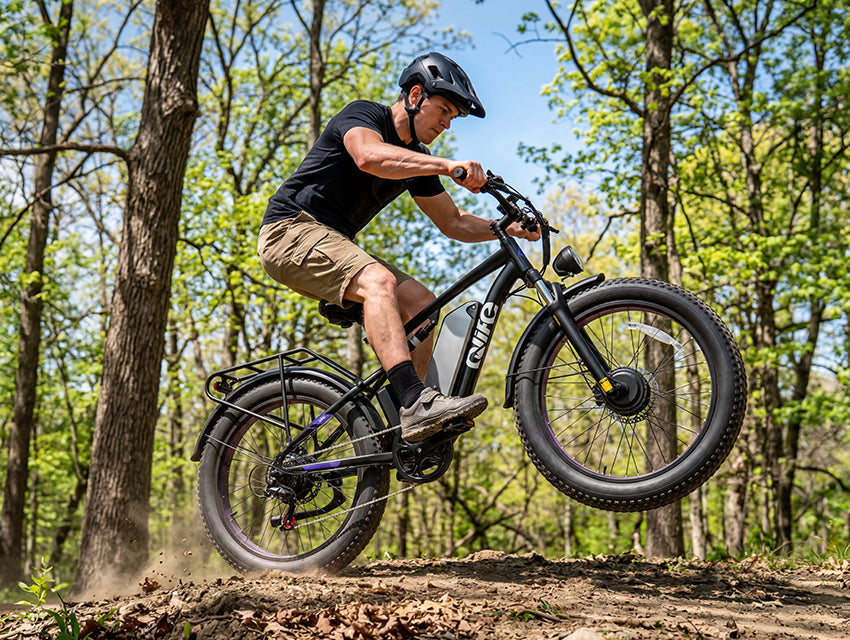
Dual motors promise more power, more traction, and more torque. They’re designed to drive electric bikes forward on difficult terrain like hills, loose ground, snow, or sand, and they can handle heavier cargo. But does everyone actually need two motors?
More motors don’t always mean better. While a dual motor e-bike can be a serious upgrade, for the average rider, it adds weight, complexity, and battery demand. It simply isn’t worth it if you’re just cycling on flat ground to and from work.
So, when is a dual motor e-bike worth it? Who should buy one? And how do they compare to a single motor e-bike? Find out below.
What’s the Difference Between Dual Motor and Single Motor E-Bikes?
Most e-bikes have a single motor that supplies power to either the rear or front wheels — or a mid-drive motor near the crank. A single motor, while enough for many riders, can struggle on loose ground, as only one wheel is driving the bike forward. It can also overheat or become slow going uphill or under heavier loads.
Dual motor e-bikes, by contrast, have two motors, usually one in the front wheel and one in the rear wheel. That means both wheels drive the bike forward. Think of it as the cycling equivalent of four-wheel drive; it’s why riders often prefer it for off-road riding.
Power and Torque: Where Dual Motor Wins
The biggest advantage of dual motors is more power.
 A dual motor e-bike with two 750W motors can pull from both wheels, which helps when starting from a stop, climbing hills, carrying extra weight, or riding across unstable surfaces. Some have even more power. The Racer Max Dual Motor, for example, reaches 3,000W peak power (1,800W front + 1,200W rear), producing 200Nm of torque.
The first thing most riders notice is the faster acceleration from low speeds. But it’s the performance on steep inclines or loose ground that’s the most useful. Where many other e-bikes would struggle, dual motor e-bikes continue to climb.
But it’s not as simple as it sounds. Two 750W motors aren’t necessarily a 1,500W monster. Controller limits, battery output, terrain, and rider weight all affect the real-world result.
Battery Life and Range: Does Dual Motor Drain Faster?
In short, yes.
There’s no such thing as a free lunch. The more power the motors deliver, the more energy is drained from the battery. That affects how far the bike can be ridden. If you’re using both motors constantly on hills or trails, you’ll pay a range penalty.
That said, many manufacturers add extra battery power to compensate. The bike itself will be heavier, but the range may be comparable to other models. Plus, some e-bikes let you turn off one of the motors. So, if you’re just cruising along on flat ground, you can preserve battery life.
As a rough guide, a normal single-motor e-bike might use around 15–25Wh per mile in mixed riding. A powerful dual-motor e-bike can use closer to 25–40Wh per mile, especially if both motors are working hard. So, a 720Wh battery might deliver around 30–45 miles on a single-motor setup, but closer to 20–35 miles on a dual-motor setup, depending on terrain, rider weight, speed, and assist level.
These figures aren’t exact, but they show the basic trade-off: dual motors give you more pull, but they ask more from the battery.
Weight and Handling: The Practical Trade-Off
The other trade-off is weight.
Motors are one of the heavier components. But it’s not the only weight factor. Dual motor e-bikes often come with a larger battery, fat tires, stronger frame components, and more robust brakes. Together, it can add a sizeable amount to the bike’s overall weight.
That’s actually a benefit for some riders. Beginners might find the bike more planted at speed. However, it will feel less nimble in tight urban riding and can be very inconvenient if you’ve got to carry it or store it.
Commuting, Hills, Off-Road: Which Motor Setup Fits Your Ride?
Urban Commuting
Urban commuting isn’t the best case for dual motors. Most commutes are on flat roads or bike lanes where lighter, nimbler, and more efficient e-bikes are preferable. Dual motors are rarely needed for the kind of start-stop riding, unless riders face steep hills or carry cargo.
Hills and Mountain Roads
Dual motors excel uphill and on mountain roads. The front wheel helps pull the bike along, while the back wheel pushes the bike forward. Together, they provide enough torque to consistently and confidently climb all but the steepest inclines.
The best part? There’s less strain on a single motor. So, you can be sure you’ll reach the top without a noticeable drop in speed or power.
Off-Road Trails
Dual motors are, once again, a big advantage. The front and rear wheel drive help prevent wheel spin, giving you greater traction even when one wheel briefly loses grip.
Combined with fat tires and a dual suspension system, you’ve got an incredible setup for off-road riding.
Sand, Snow, Mud, and Loose Ground
Single motor e-bikes are liable to spin out on loose ground. They just can’t get the traction. That’s not the case with dual motor e-bikes, which continue to push or pull forward despite the difficult terrain.
It’s not magic, however. Tire pressure, rider skill, and battery power still make a difference.
Cargo and Heavier Loads
Two motors aren’t just more helpful in challenging environments. If you regularly load up the bike or are a heavier person, dual motors can help you accelerate faster. Single motors are good for normal payloads. But they simply don’t have the overall capacity a dual motor setup does.
Single Motor vs Dual Motor vs Mid-Drive: How to Choose
|
Motor Setup |
Best For |
Main Strengths |
Main Trade-Offs |
Typical Rider |
|
Single Hub Motor |
Commuting, paved roads, light trails, general everyday riding |
Lighter, simpler, usually more affordable, better battery efficiency, easier to maintain |
Less torque on steep hills, weaker traction on loose surfaces, can struggle with heavier loads |
Riders who mostly use their e-bike for city roads, bike lanes, errands, and moderate hills |
|
Dual Hub Motor |
Steep hills, off-road trails, snow, sand, gravel, heavier loads |
Stronger acceleration, better climbing power, improved traction, more capable on difficult terrain |
Heavier, more complex, usually drains the battery faster, often more expensive |
Riders who need extra torque and grip rather than just a basic commuter bike |
|
Mid-Drive Motor |
Hill climbing, long-distance rides, cargo riding, more natural pedaling |
Uses the bike’s gears, efficient on climbs, balanced weight distribution, natural ride feel |
Usually more expensive, can wear the chain and drivetrain faster, may need more regular mechanical maintenance |
Riders who want efficient climbing, strong pedal assistance, and a more traditional cycling feel |
Single Hub Motor
Single hub motors are the default setup. For most riders, it’s enough power and acceleration. They’re recommended for:
- Flat or moderate terrain
- Lower budget
- Simpler maintenance
- Lighter bike handling
The biggest weakness is the climbing power. It wouldn’t be advisable to tackle long, steep hills or really tough terrain reliant on a single motor.
Dual Hub Motor
Dual hub motors are best for:
- Steep hills
- Off-road trails
- Snow, sand, mud, and gravel
- Heavier riders
- Riders who want maximum traction and torque
Of course, that extra power means the bike is heavier and more battery-hungry. Plus, two motors add to the complexity and maintenance costs of the bike.
Mid-Drive Motor
Mid-drive motors are something of the Goldilocks zone. They’re popular for:
- Efficient hill climbing
- Long-distance riding
- Riders who want a natural pedaling feel
- Technical climbs
- Cargo riders who want to use the bike’s gears
However, they’re quite a bit more complicated, increasing cost and wear on the chain and drivetrain. That can lead to even more expensive repairs and parts down the road.
Who Should Choose a Dual Motor E-Bike?
Dual motor e-bikes are worth it when your main problem is traction, climbing power, or difficult terrain. It’s worth considering if you:
- Ride steep hills regularly
- Live somewhere with snow, sand, mud, or loose gravel
- Use your e-bike for off-road trails
- Are a heavier rider and want stronger acceleration
- Carry cargo or equipment
- Want extra traction rather than just extra speed
- Prefer a powerful, planted ride
- Are willing to pay more for performance
Just remember the bike is going to be heavier and harder to store. If you’re living in a city apartment or primarily ride on flat, paved roads, it’s best to go for something simpler.
Who Should Stick with a Single Motor E-Bike?
Single motor e-bikes aren’t the “worse” choice. Simpler can be better. In fact, when you’re carrying your e-bike up stairs or zipping around urban streets, you’ll be grateful for a lighter, more efficient e-bike.
A single motor e-bike is usually better if you commute in the city, ride mostly on paved roads, have a tighter budget, and just don’t need the extra power. A dual motor may feel impressive, but it can be overkill if you rarely use the extra capability.
Is Dual Motor Actually Faster?
Not exactly.
Dual motor bikes often get mistaken for being faster. While they offer faster acceleration and higher speeds over difficult terrain or uphill, the actual top speed can be the same as that of most other e-bikes. In fact, legal limits can cap off top speed at around 28mph.
That said, in a race over difficult terrain, dual motor e-bikes will cross the finish line first most times. They keep moving under difficult conditions and are quicker off the mark.
Final Verdict: Is Dual Motor Worth It?
A dual motor e-bike is worth it if you actually need the extra power. If you’re riding steep hills, loose trails, sand, snow, gravel, or carrying heavier loads, the difference can be huge. You get a stronger pull from a stop, better grip, and more confidence when the ground gets difficult.
That’s where dual motors make sense — not because they sound impressive, but because they solve a real riding problem.
Explore Qlife dual motor e-bikes and find a model built for tougher rides, stronger climbs, and more confident all-terrain performance.
FAQs
Is a dual motor e-bike better than a single motor e-bike?
Not always. Dual motor e-bikes perform better uphill, on loose ground, or with heavier cargo. However, for most standard bike riding, a single motor is more than enough.
Does a dual motor e-bike drain the battery faster?
Yes, especially if you’re using the motor heavily: riding uphill, off-road, or at high power settings.
Are dual motor e-bikes heavier?
Generally, yes. Dual motor e-bikes need an extra motor, stronger components, larger batteries, and often bigger tires and brakes.
Do I need a dual motor e-bike for commuting?
Generally, no. For most urban commutes (or even suburban commutes), a single motor e-bike is sufficient to get you from A to B. However, if you regularly ride up steep hills or in difficult weather conditions (e.g., snow or mud), dual motors may be beneficial.
Are dual motor e-bikes good for hills?
Yes. Hills are one of the main reasons to choose a dual motor e-bike. Power going to both wheels helps the bike climb more confidently, especially when the rider is heavier or the hill is long and steep.
Are dual motor e-bikes good for off-road riding?
Yes. Because both wheels provide traction, dual motor e-bikes perform better on loose gravel, dirt, snow, and mud.
Is a mid-drive better than a dual motor e-bike?
It depends on the ride. A mid-drive can be better for efficient hill climbing because it uses the bike’s gears. A dual hub motor setup can be better for traction and raw pulling power on loose ground. For a natural pedaling feel, mid-drive often wins. For all-wheel traction, the dual motor wins.
Share:
Best Dual Motor E-Bikes: Power, Traction, and All-Terrain Performance
Has an Electric Bike Changed Your Life?