
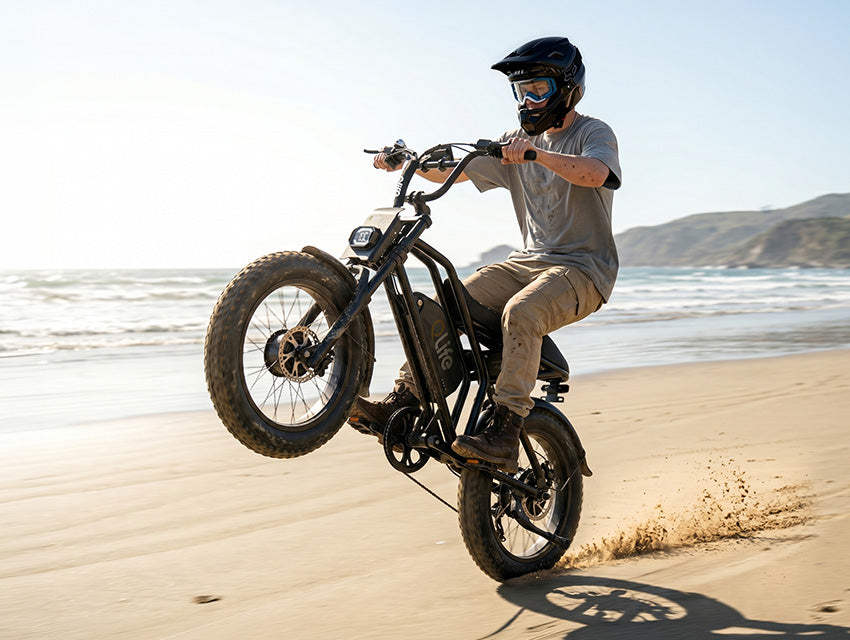
If you're seeking serious power, there's only one option: dual-motor e-bikes. Like the power, acceleration, and torque of a 4x4, dual-motor e-bikes fit a motor into each wheel. That means you get pulling and pushing power, providing greater control and speed over challenging terrain.
In fact, that's precisely why they're so popular. As mountain bikers and off-road riders increasingly turn to electric bikes, these two motors allow them to push their skill to the limits. Plus, they can withstand all kinds of weather conditions, from muddy hills to sand and snow.
Below, we explore what makes a dual-motor e-bike so special, including listing the best dual-motor e-bikes currently on the market.
What is a Dual Motor E-Bike?
A dual-motor e-bike has two motors. Instead of using a single front hub, rear hub, or mid-drive motor, a dual motor e-bike places one motor in the front wheel and one in the rear wheel. It's similar to the all-wheel drive or 4x4 concept, delivering more traction, more torque, and better performance on challenging terrain.
Most commuter e-bikes rely on a single motor. However, for some off-road, hunting, cargo, and all-terrain e-bikes, a dual motor system can make sense.
Whether you're climbing steep hills, riding through sand, tackling snowy trails, or carrying heavy loads, the extra motor helps maintain momentum and control in conditions where a single motor may struggle.
How a Dual Motor System Works
Both motors work together. When the rider begins to pedal, the motor propels the bike forward, distributing power between the two wheels.
The obvious benefit is traction.
On loose terrain — like gravel, mud, or snow — it is easier for one of the wheels to lose its grip. But if both wheels are powered, the second motor can help maintain forward movement. That means greater speeds, more power, and more control.
Dual Motor vs Mid-Drive Systems
Mid-drive systems also provide more power. A mid-drive motor sits near the bike's crankset and sends power through the drivetrain. Many riders prefer them as they offer a smooth, natural riding experience — especially on steep climbs.
Dual motor systems focus on outright power and traction. Because both wheels are powered directly, riders get stronger acceleration and greater grip on difficult terrain. The trade-off? Increased weight, higher battery consumption, and a higher purchase price.
Typical Power Levels
Most dual motor e-bikes combine two motors rated between 750W and 1,000W each. For example, a common setup is a 750W in the front and 750W in the rear for a total combined output of 1,500W. More powerful models may use dual 1,000W motors to hit 2,000W or more.
One thing to watch for is the difference between peak and average power.
Depending on the controller and battery system, some dual motor e-bikes can briefly deliver over 2,500W of peak output. That's pretty handy when you're accelerating or climbing steep inclines.
The real benefit, however, is torque.
Think of it in terms of pulling power. Two motors together can pull and push the bike up steep gradients, rough terrain, and handle heavy loads with less effort than a single rear-hub motor.
Best Dual Motor E-Bikes
Best Overall Dual Motor E-Bike
Qlife Racer Max Dual Motor
 The Racer Max comes with pretty impressive specs relative to its price. From a top speed of 38mph to a range of 60-70 miles, it's an excellent all-around off-road bike.
Powered by a 3,000W dual-motor system (1,800 front + 1,200 rear), it has incredible traction on steep slopes, sandy beaches, or snowy conditions. In fact, it's capable of effortlessly conquering hills up to a 30-degree incline.
Alongside the fat tires and dual suspension system, it gives you much greater control, comfort, and speed, whatever the terrain. All for a fairly reasonable price.
Pros
· Powerful 3000W peak dual-motor setup.
· 26 x 4.0-inch fat tires for sand, snow, and trails.
· Full suspension and hydraulic disc brakes.
Cons
· Heavy at around 90 lb.
· Long 9–11 hour charging time.
Best for Sand and Snow
Puckipuppy GoldenR
Puckipuppy has a habit of naming their bikes after dogs. The GoldenR won't give you hugs and licks. But it does have the boundless energy typical of its namesake.
The e-bike comes with dual hub motors (960W rear + 640W front). That's not as much power as some models on the list, but the extra power at the rear gives it great pushing power on sand and snow. Combined with the fat 4" tires, it'll give you more grip and speed on uneven ground than many other models.
Where it really excels is in its full suspension system and max range of 80 miles. That means you can spend long days in the saddle without worrying about comfort or charge.
Pros
· Dual motors improve grip on rough terrain.
· Full suspension and hydraulic disc brakes.
· Strong 400 lb payload capacity.
Cons
· Lower peak power than some rivals.
· Heavy at just under 90 lb.
Best for Off-Road Trails
Qlife Spark Max Dual Motor
 The Spark Max Dual Motor falls squarely into the moped-style e-bike category. With a low-slung seat and motorcycle aesthetic, it's one of the coolest models in the list. But it's not style over substance. The 3,000W peak motor gives you more power than almost any other bike for the price.
While it lacks the payload capacity of some e-bikes, it more than makes up for it with a top speed of 38mph and a range of up to 90 miles. Designed specifically for off-road trails and rugged terrain, it delivers extreme pulling power and unstoppable climbing performance.
And, of course, it has a dual-shoulder fork and rear soft-tail suspension, capable of dealing with everything from urban potholes to gravel, rocks, and anything nature can throw at you.
Pros
· 3000W peak power and 200Nm torque.
· Up to 90 miles of claimed range.
· Comfortable moped-style frame with full suspension.
Cons
· Heavy at around 93 lb.
· Less traditional bike feel.
Best Premium Dual Motor E-Bike
HappyRun G70 Pro
Another moped-style e-bike. The HappyRun G70 Pro has a long slung design, forward-facing headlight, and most importantly, a peak motor output of 5,000W — 2,500W front and rear. Together, these motors deliver exceptional torque and climbing ability, able to master any terrain.
It's not the only thing that's dual. The dual battery system provides ultra-long range (up to 85 miles), so you can spend long days exploring off-road routes. Plus, the bike has a small rear seat, perfect for carrying kids or cargo.
Pros
· Huge 5000W total peak output.
· Dual batteries with up to 85 miles of range.
· Practical cargo-style design with strong built-in features.
Cons
· Very heavy at around 101 lb.
· More moped/cargo-style than trail-focused.
Why Riders Choose Dual Motor Electric Bikes
Exceptional Torque and Acceleration
Who doesn't want to be quicker off the mark? As soon as you start to pedal, you're not just relying on a single motor to drive you forward. Both motors kick in, giving you near-instant acceleration. That’s especially useful if you’re carrying cargo or pulling away from a stop.
Superior Traction
Everyone knows that 4-wheel drive works because every wheel contributes to the car's movement. If the front wheel spins out, the back wheel is there to push the car forward. The same logic applies to dual motor e-bikes. While the front wheel helps pull the bike forward, the rear wheel is always pushing.
So, when you're riding on uneven terrain or tackling loose ground, there's always one that provides extra power and grip. It's hard to overstate how important this is.
Better Hill-Climbing Ability
Just as superior traction helps on loose ground, it provides the same driving force on steep gradients or technical climbs. You're getting pulled and pushed upwards at the same time. If one wheel loses contact briefly, it's never just you providing the power.
It helps a lot if you've got cargo on board. Relying on a single motor can overwhelm the system. But with two motors providing the added wattage, it can handle heavier loads.
Increased Rider Confidence
If you've never ridden a dual motor electric bike, it's difficult to explain the added confidence you get. More predictable performance, greater control, and reduced wheel spin mean you tackle routes that you otherwise wouldn't.
Even experienced riders find themselves being more confident, more bold, more vibrant in their riding style. You can tackle bigger hills, steeper descents, or rough terrain that might typically give you a second thought.
Dual Motor vs Single Motor: What's the Real Difference?
|
Feature |
Dual Motor E-Bike |
Single Motor E-Bike |
|
Power & Torque |
Higher power and stronger acceleration |
Lower power but sufficient for everyday riding |
|
Hill Climbing |
Excels on steep hills and challenging terrain |
Better suited to moderate inclines |
|
Traction |
Power to both wheels improves grip on sand, snow, and mud |
Less traction on loose or slippery surfaces |
|
Range |
Typically shorter due to higher power consumption |
Generally longer range from the same battery |
|
Weight & Cost |
Heavier and more expensive |
Lighter and more affordable |
|
Best For |
Off-road riding, hills, heavy loads, and all-terrain use |
Commuting, leisure rides, and urban travel |
Where Dual Motor E-Bikes Perform Best: Hills, Sand, Snow, and Trails
Steep Hills and Mountain Roads
Dual motor e-bikes excel on steep roads. Most riders think of the average hills. However, if you're tackling long, winding mountain ascents, that benefit becomes a lifesaver. There's no need to stop, no overwhelming struggle, or worry about lacking power. The more you pedal, the more power you'll receive at both wheels.
The best part? It reduces strain on any particular motor so that neither one will stall out.
Sand Riding
Sand is one of the hardest surfaces to ride. Even with a single motor, it can be exhausting, as the wheels struggle to find their grip.
Dual motor e-bikes maintain momentum better thanks to their improved flotation and traction. Alongside fat tires, it's the best way to cycle steadily over long beaches.
Snow and Ice
Dual motor e-bikes are often pitched solely as an off-road choice. But many people tackle difficult conditions on their daily ride. If you routinely face snow or ice, having motors reduces the risk you'll slide out, increasing safety and stability in winter conditions.
It's a smart choice if your commute becomes challenging during the colder months.
Mud and Wet Terrain
Most bikes end up slipping and sliding on muddy terrain. Everyone dreads wheel spin. That's not an issue if both wheels can drive you forward. Even if one wheel gets stuck in the mud, the other is there like insurance to push you back out again.
Off-Road Trails
Off-road trails are where dual motor e-bikes become properly useful. Gravel paths, forest tracks, loose stones, roots, and uneven ground can all interrupt your momentum on a standard single-motor bike. With power going to both wheels, the bike has a better chance of staying composed when the surface changes underneath you.
That doesn't mean every dual motor e-bike is a full mountain bike.
You still need to look for full suspension systems, tires, brakes, and frame quality. But it can give you the added kick to feel more confident across mixed terrain.
Heavy Riders and Cargo Loads
Not all riders fall within the weight limits set by e-bike manufacturers. More weight means the motor has to work harder. That can be a problem whether you're a bigger person or you're carrying extra cargo.
A single motor can still do the job. But it will feel slower, hotter, and less responsive under load.
With two motors sharing the work, the bike can accelerate more smoothly, maintaining speed whatever the terrain. It's a great choice if you're carrying hunting gear, camping equipment, and using the bike for deliveries.
Key Features to Look for: Motor Power, Battery, Tires, Suspension, and Brakes
Motor Power and Torque
Motor power is the number most brands push. Some dual motor models use two 750W motors, while more powerful versions use dual 1,000W motors or higher to reach peak outputs of 2,000W to 5,000W.
Torque matters just as much as wattage.
Measured in Newton-meters (Nm), torque tells you how much pulling force the bike can deliver. A dual motor e-bike with 100Nm to 200Nm of torque will usually feel much stronger on hills, sand, snow, and rough trails than a lower-powered single-motor model.
Battery Capacity
No extra power comes without a cost. If the battery capacity doesn't reflect the added power, the range will take a big hit.
Battery capacity is usually measured in watt-hours (Wh). It's how much energy the battery can store. For example, a 48V 20Ah battery provides around 960Wh, while a 52V 20Ah battery provides around 1,040Wh.
For dual motor e-bikes, look for at least 900Wh to 1,000Wh. This translates to a greater range. However, if an e-bike advertises around 40 to 90 miles of range, real-world off-road riding will often be lower, especially if you plan to ride hills, sand, snow, or trails regularly.
It's worth getting the largest battery you can reasonably afford.
Fat Tires
Fat tires are defined as any tire thicker than 4". These wider tires increase grip with the ground. It's a great way to translate all that extra power into forward momentum. Plus, they're recommended for sand, snow, and rough terrain, reducing the risk of your e-bike sliding or skidding.
Suspension Systems
Most e-bikes come with a front suspension fork. That's enough for riding along city streets. However, if you're purchasing a dual motor electric bike, you're probably going off-road. The rear shock minimizes the time the back wheel spends off the ground.
Remember, a motor can only drive the bike forward if it's touching a surface. Dual suspension and dual motor systems, therefore, work together to increase traction and get the most out of a bike.
Hydraulic Disc Brakes
Dual motors generally mean you're riding faster on difficult terrain. It pays to have good brakes to prevent accidents. Hydraulic disc brakes are considered the best option.
Rotor size also matters. Many e-bikes use 180mm rotors, which are fine for general riding, but heavier dual motor bikes often benefit from larger 203mm rotors. A bigger rotor gives the brakes more leverage, helping the bike slow down more confidently on steep descents or when carrying extra weight.
Display and Riding Modes
This is a feature most riders don't consider. However, it's quite handy to switch between dual motor, single motor, and other modes. Not only does it preserve battery life, but it can also improve performance in different settings.
Who Should Buy a Dual Motor E-Bike?
Dual motor e-bikes aren't for everyone. If you're relying on your bike for gentle city commuting or even just casual trail riding, you probably won't get much benefit. However, many riders don't consider dual motor despite it making a big difference.
Riders who will benefit most include:
· Off-road enthusiasts
· Mountain riders
· Snow and beach riders
· Heavy riders
· Cargo riders
To put it simply, the more load you carry or the more difficult the terrain you ride, the more a dual motor e-bike makes sense.
Final Thoughts
Dual motor e-bikes are built for riders who want more from the bike. More pull on steep hills. More grip on loose ground. More confidence when the surface turns awkward.
That does not mean everyone needs one.
If you only ride short city routes, a single-motor e-bike may be enough. But if you want a bike that can handle trails, sand, snow, gravel, and heavier loads without feeling underpowered, a dual motor setup makes a lot of sense.
Explore Qlife's dual motor e-bikes to find a powerful all-terrain model built for the way you ride.
FAQs
Are dual motor e-bikes worth it?
Absolutely. If you're riding on difficult terrain (like sand, snow, hills, mud) or carry heavy cargo, dual motor e-bikes provide some much-needed extra power and traction.
Is a dual motor e-bike faster than a single motor bike?
They can be. It's not necessarily that the top speed is higher. The big difference comes in acceleration and traction. So, in a race between a single motor and a dual motor e-bike, the latter is more likely to win.
How much range can a dual motor e-bike achieve?
That depends on the battery capacity. Most dual motor e-bikes advertise a range somewhere between 40 and 90 miles. However, in real-world conditions, that could be substantially less, especially if you're riding over hills or on sand, snow, or mud.
Can you turn one motor off to save battery?
Some e-bikes allow you to adjust the configuration of the motors. If you're riding on flat terrain, it can make sense to turn one of the motors off. However, this isn't possible with all models.
Are dual motor e-bikes good for steep hills?
Yes, that's where they excel. Because you've got two motors providing power to both wheels, neither is likely to slow down or overheat, providing consistent, steady power.
Do dual motor e-bikes work well in snow?
Yes. Snowy conditions increase the risk of slipping as one of the bike's wheels might struggle to find traction. Dual motors ensure that both wheels will continue to drive the bike forward even as the ground becomes more slippery.
Are dual motor e-bikes legal?
Yes. Dual motor e-bikes can be legal in the US, but the bike still needs to meet local e-bike rules for motor power, speed, pedals, and road use. Dual motors themselves are not usually the issue; the issue is whether the bike exceeds the limits for an e-bike where you ride.
Are dual motor e-bikes harder to maintain?
Yes, slightly. A dual motor e-bike has two motors, more wiring, and extra electrical components, so there is more to check over time. However, routine maintenance is still similar: keep the tires, brakes, battery, and drivetrain in good condition.
How powerful should a dual motor e-bike be?
There's no set amount of power needed. Generally, you'll want either dual 750W motors or, if you're tackling tougher terrain, dual 1,000W motors.
Share:
Are Dual Motor e-Bikes Good for Hills and Off-Road Riding?
Dual Motor vs Single Motor E-Bike: Is Dual Motor Worth It?