
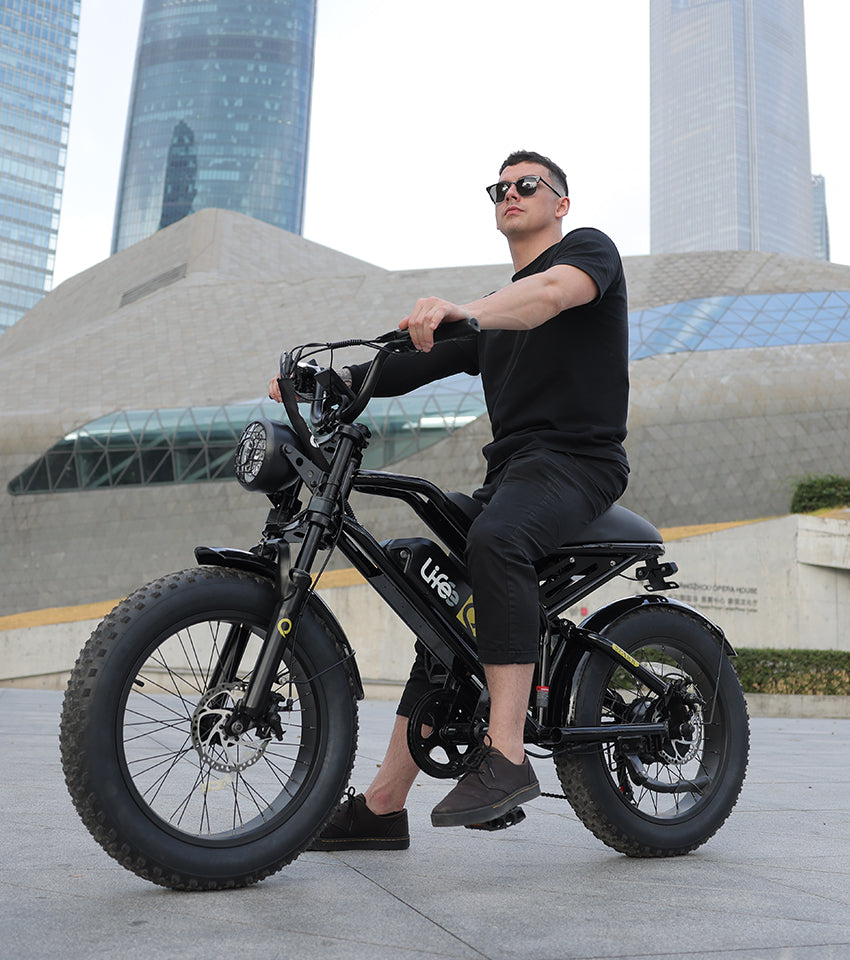
Most e-bikes are capped at 20 or 28 mph and are legally treated as bicycles. Mopeds, by contrast, are classified as motor vehicles. Those speeds can feel fast on the road, but it’s still below the performance level of a true moped. Moped-style e-bikes typically feature more powerful motors, higher potential speeds, and often include a throttle.
That distinction matters. Even if an e-bike looks like a moped, it isn’t always classified the same under the law. Where you can ride, whether you need a license, and if age restrictions apply, all depend on how the bike is defined legally.
Below, we break down the key differences between moped-style e-bikes and standard e-bikes, what’s legal, and how to tell where a model sits before you buy.
What Is a Moped Style E-Bike?
There’s no legal definition of a moped-style e-bike. Usually, it’s done on appearance and power. You might notice these three features:
1. Throttle — the big difference between an e-bike and a moped is the throttle. Most e-bikes are pedal-assist, providing power the harder you pedal. Moped-style e-bikes let you turn the throttle, driving along under the sole power of the motor.
2. Large frame and seat — moped-style e-bikes are shaped more like a moped. A larger, sturdier frame and a more comfortable seat are designed for long periods of sitting.
3. Higher power motors — a more powerful motor is characteristic of a moped-style e-bike alongside a higher capacity battery (but that’s not always the case).
Are Moped-Style E-Bikes Legal?
Moped-style e-bikes aren’t inherently illegal, but some configurations may not be road-legal without proper registration or licensing.
They fall into a different regulatory category that requires specific consideration. The big factor isn’t the design — it’s the speed, motor power, and throttle rules.
If a moped-style e-bike still behaves like an e-bike, then there are minimal restrictions. You can use them on most roads, park paths, and off-road routes. There might be some restrictions on certain bike paths if they exceed 20 mph or have a throttle.
However, if the bike goes over 28 mph (above a class 3), has an extremely powerful motor, and has a throttle, then you might need a license and registration to drive it on public roads. You’ll be restricted from most park paths and bike routes, as it’s treated legally like a moped or motorized vehicle.
The problem? States are not consistent in their treatment of e-bikes and mopeds. The rules can vary significantly with different jurisdictions setting the bar higher or lower.
E-Bike vs Moped: What’s the Legal Difference?
Still confused? It’s understandable. The main point is that “moped-style” is a design, not a legal category. Some models fall within the standard e-bike limits and are fully legal to ride like a bike. Others cross into moped territory due to higher speeds or power. That’s when licenses, registration, and stricter rules apply.
Here’s a quick breakdown:
|
Feature |
E-Bike |
Moped-Style E-Bike |
Moped |
|
Power source |
Electric motor with pedal assist (sometimes throttle) |
Electric motor, often with throttle and optional pedaling |
Motor only (no pedaling required) |
|
Speed limits |
Restricted (typically 20–28 mph) |
Varies — may exceed e-bike limits |
Higher speeds allowed |
|
Licence required |
Usually no |
Sometimes (depends on specs) |
Yes |
|
Registration |
No |
Sometimes (depends on classification) |
Yes |
US Laws on Moped-Style E-Bikes
Three-Class System
Most states in the US use the three-class system. It splits e-bikes into the following categories:
- Class 1 e-bikes are pedal-assist only. They have a maximum assistance speed of 20 mph. They’re widely allowed on roads, bike paths, and many trails. It’s rare to have to apply for a license for a class 1 e-bike.
- Class 2 e-bikes have both pedal-assist and a throttle. They have a maximum assistance speed of 20 mph. Most moped-style e-bikes fall into this category. Usually, there are some restrictions on riding on certain bike lanes.
- Class 3 e-bikes are a faster version of class 1. They’re still pedal-assist only, but the maximum assistance speed is 28 mph. They’re designed for faster commuting. Due to their speed, these e-bikes face more access restrictions, particularly on shared paths and trails.
The Fourth Class
Officially, there are only three e-bike classes in the US. However, many models fall outside these three classes. The Spark 20x4.0” Moped-Style E-Bike, for example, has a 1,500W motor, a 28+ mph top speed, a throttle, and pedal-assist. The throttle makes it a class 2 e-bike, but the top speed is more like a class 3.
 These models don’t fit neatly into the standard class system. However, some people consider them a separate class 4. Class 4 e-bikes face higher restrictions, being treated primarily like a moped. You’ll need to be over 16 years old and have a license and registration to ride one.
It’s best to check your local state laws to find out the exact rules in your jurisdiction.
When a Moped Style E-Bike Becomes Illegal (or a Moped)
The real question is, where’s the line? When does a regular e-bike transition into being a moped-style e-bike — or even a moped? The legal line depends on speed, motor power, and configuration.
Consider these factors:
- Exceeds 28 mph (beyond Class 3 limits)
- Motor power over 750W (in the US)
- No pedals, or pedals that aren’t realistically usable
- Operates on throttle only without the need to pedal
It’s not the end of the world if it falls into this category. The bike will be classified as a motor vehicle or moped, requiring a license, insurance, and registration.
Why Moped-Style E-Bikes Sit in a Legal Gray Area
The issue isn’t that the law is unclear. Rather, modern e-bikes have moved faster than the categories designed to regulate them. The three-class system works well for standard pedal-assist bikes. But it doesn’t describe everything we’re technically capable of manufacturing.
That’s where moped style e-bikes sit.
You might have a bike with a throttle (Class 2), speeds closer to Class 3, and a motor that exceeds typical limits — all in one model.
Regulators aren’t yet sure how to regulate this within a specific category. So, the e-bike gets classed along with other e-bikes and is shifted into the “motorized vehicle” category. In some cases, a model may even be sold as road-legal but can be adjusted in the settings to exceed those limits, changing how it’s classified.
Can You Ride a Moped-Style E-Bike on Bike Paths?
Many e-bikes are allowed on bike paths. Class 1 e-bikes and class 2 e-bikes are generally fine. There might be some restrictions for class 2 e-bikes on certain paths.
Because of the higher speeds, class 3 e-bikes are usually restricted. You can’t ride them on certain park routes or bike paths. The same is true for mopeds. They’re treated like motor vehicles and follow similar restrictions.
Again, there’s a lot of local variations. You’ll need to review your local state rules to ensure you don’t get into unwanted trouble.
Are Moped-Style E-Bikes Safe and Practical?
Moped-style e-bikes aren’t for everyone. If you’re just after a quicker way to get to work, you’re better with a class 1 or 3 e-bike. As for whether they’re safe, that really depends on how and where you plan to ride.
Pros:
- Comfortable — larger frames and padded seats make longer rides easier
- Powerful — stronger motors handle hills and longer distances with ease
- Easy riding — throttle options reduce effort, especially in stop-start traffic
Cons:
- Heavier — bulkier design can make them harder to maneuver or store
- Legal grey areas — some models sit on the edge of e-bike and moped classifications
- Restricted access — may not be allowed on certain bike paths or trails
Overall, they strike a careful balance between power and convenience. They’re great if you want to zip around from A to B like a moped. But if you’re looking for a bike-first experience, you’re better off with other classes that are simple, lightweight, and legal everywhere.
What to Check Before Buying a Moped-Style E-Bike
If you’re new to e-bikes, it can be hard to understand the specs. Don’t get overwhelmed. You only need to focus on a few things when selecting a moped-style e-bike.
Motor power is the big factor. Measured in Watts (W), you’ll want something over 750W. The Spark comes in at 1,500 W, so you get a fair bit of power from the motor.
Top speed is where the legal issues come in. If it’s 28 mph or under, it’ll be treated as a Class 3 e-bike. Anything over that veers into moped territory.
Throttle vs pedal assist. Most e-bikes come with pedal assist. You need to decide if you also want the throttle for easy riding.
After you’ve gone through these three big factors, it’s sensible to look up your local laws. What will you need to do to ride your intended e-bike where you need to go? Think about what routes you’ll take — on-road, off-road, bike paths? That makes a big difference in what e-bike you should select.
Are Moped-Style E-Bikes Worth It?
Moped-style e-bikes are a great option if you’re riding on private land, heading off-road, or wanting a lot of extra power. If you don’t mind registration and insurance, they’re also a cost-effective way to get around town.
Qlife offers two main moped-style e-bikes:
-
Spark Moped-Style E-Bike — 1,500W peak motor with ~28+ mph top speed and up to ~60 miles of range, making it a strong all-around option for city riding and light off-road use

-
Spark Plus 20×4.0 Moped-Style E-Bike — 2,000W peak motor with speeds up to ~37 mph and up to ~90 miles range, pushing into high-performance territory with longer-distance capability

With 160K+ riders, 1-year warranty, and free shipping, Qlife is a popular option for riders wanting a fast, reliable e-bike that works on-road, off-road, and everything in between.
FAQs About Moped-Style E-Bikes
Are throttle e-bikes legal?
Yes — throttle e-bikes are generally classified as a class 2 e-bike. They’re legal in all US states. However, the rules regarding where you can ride them and if you need a license and registration vary from state to state. Generally, you can ride them on all roads, bike lanes, and park routes if the speed is limited to 20 mph.
Do moped style e-bikes need a license?
They might. If the e-bike has a throttle and the top speed exceeds 28 mph, you’ll often need a license, registration, and insurance to ride it on the road. You’ll also need to be at least 16 years old to ride.
Unfortunately, there are no blanket rules across the US. Each state decides how an e-bike is treated, whether it’s considered a motor vehicle, and where you can ride it.
Can I ride a 1000W e-bike on the road?
It depends on where you are and how the bike is configured. Federal guidance caps e-bikes at 750W for the standard 3-class system. A 1,000 W e-bike usually falls outside this definition. That means it may be treated as a moped or motor vehicle, requiring a license, registration, and insurance.
That said, some states are stricter than others, so local law matters. Indeed, some states do not recognize the 3-class system. You can also restrict e-bikes to limit motor power or top speeds to comply with legal limits.
Are all fat tire e-bikes legal?
No. The size of the tire is usually not a factor in determining if an e-bike is legal or not. Fat tires are often fitted onto moped-style e-bikes to provide greater stability. But it’s not the tires themselves that are the problem. It’s the extra power and speed.
What happens if my e-bike is too powerful?
If your e-bike is too powerful, you’ll either need to limit its power for legal use or treat it as a motorized vehicle. That means you’ll need to apply for a license, registration, and insurance. You’ll be restricted on where you can ride it and if it’s allowed on the roads.
Share:
Are Fat Tire Electric Bikes Better?
E-Bike Classes 1, 2, and 3 Explained