
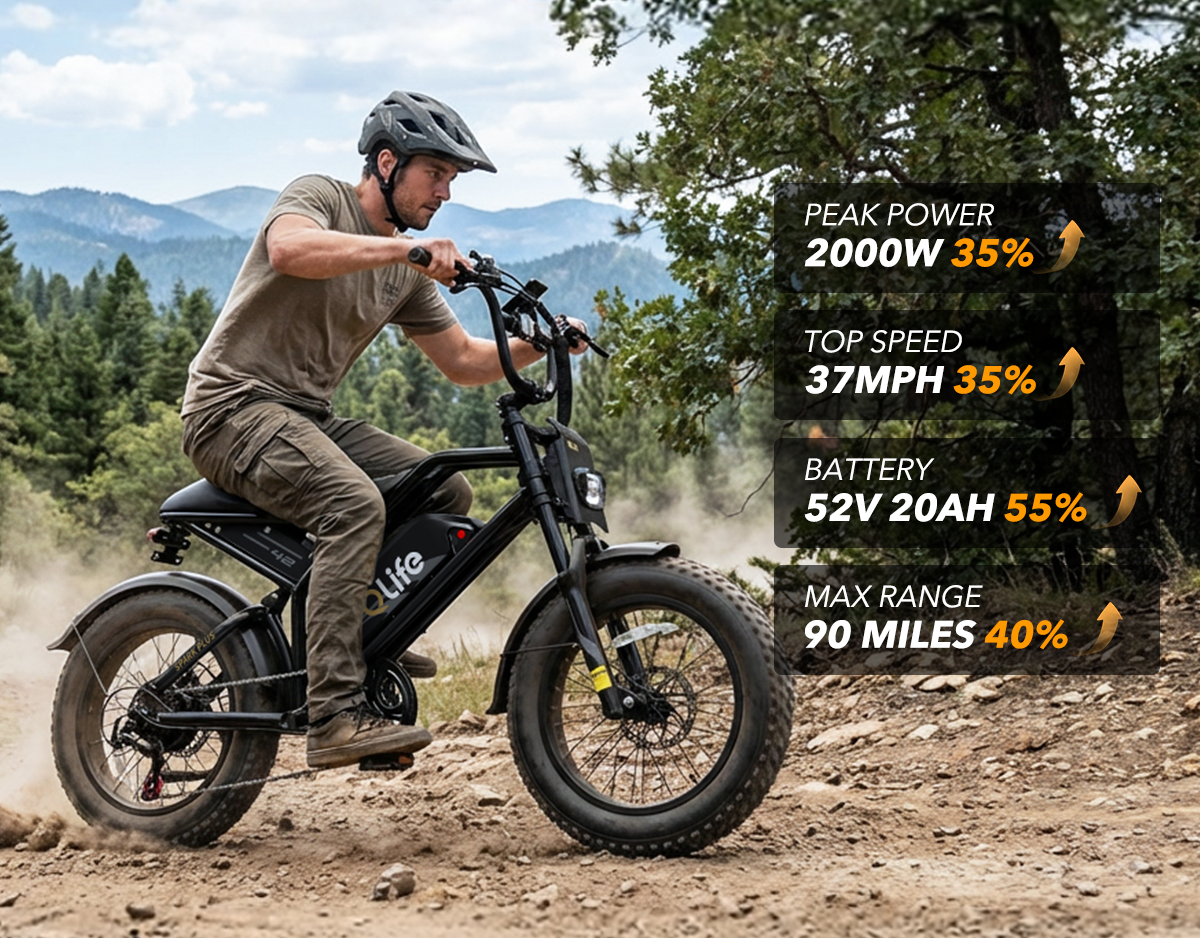
Electric bikes (or e-bikes) are defined by their battery and motor. While e-bikes still mostly rely on pedal power, they’re assisted by a motor, giving you extra help. Most e-bike batteries last 3-5 years or 500-1,000 charge cycles with a range of 20-80 miles, depending on usage.
A battery's lifespan depends on how often it’s used and charged. Each time a battery is charged, it degrades slightly, with that damage accumulating over time. Most e-bike batteries are lithium-ion, making them relatively quick to charge. However, they will inevitably degrade, even without use.
Below, we explain how long an e-bike battery lasts, how many miles it manages on a single charge, and what you can do to extend a battery’s life.
Average E-Bike Battery Lifespan
E-bike batteries don’t last forever. You can expect to get around 500-1,000 charge cycles from a single battery over its lifetime. That usually equates to around 3 to 5 years of normal use.
A charge cycle refers to using a total of 100% of the battery’s capacity (not necessarily in one go). For example, using 50% of your battery one day, recharging it, then using another 50% the next day. That’s one charge cycle.
The more charge cycles occur, the more the battery will struggle. The decline doesn’t happen overnight. You’ll notice a gradual decline in performance, as the battery runs out quicker or doesn’t deliver the same power as it initially did.
How Many Miles Does an E-Bike Battery Last Per Charge?
E-bike batteries normally last around 20-80 miles on a single charge. How far you can go depends on the battery’s capacity, the bike’s load, how fast you travel, and the terrain.
You could expect:
- City commuting (moderate assist): 30–60 miles
- Hilly terrain / high assist: 20–40 miles
- Eco mode / flat terrain: up to 80+ miles
Most e-bike batteries are measured in watt-hours (Wh). Commonly, battery sizes range from 250 Wh to around 750Wh, with many bikes falling somewhere in the middle. Occasionally, you’ll find an e-bike that exceeds 1,000Wh; however, this is rare.
If you can’t find the listed Wh, it’s not hard to calculate. Simply multiply the Volts (V) and Amp-hours (Ah) together to get the Wh. For example, the Spark Plus has a 52V 20 Ah battery — or 1,040 Wh.
 To estimate range, you’ll need to know the Wh per kilometer. Most e-bikes consume around 10-20 Wh per km. That aligns with the Spark Plus, which offers up to 90 miles of range — roughly 7.2 Wh per km.
What Affects E-Bike Battery Life?
Battery Capacity (Watt-hours)
Larger, more powerful batteries can last longer. This isn’t surprising. As explained, battery capacity is measured in Watt-hours. The greater the Watt-hours, the longer the battery lasts, and the further the bike can travel.
Riding Style & Assist Level
The battery drains as and when you use it. That means if you set the assistance level to maximum, it’ll drop faster. Or if you prefer to do more of the pedaling, you can extend the battery life much further than you might imagine.
Class 2 e-bikes come with a throttle option, so the motor does all of the work. If that’s the case, the batteries can drain fast.
Terrain & Weight
Going uphill drains the battery much faster than on the flat or downhill slope. The same is true for weight. More weight puts greater strain on the motor, meaning more power is needed for every mile traveled. It’s best to consider the terrain, cargo, and rider weight when determining how long an e-bike battery lasts.
It’s worth noting that manufacturers estimate ranges based on a lighter rider (often ~75kg) on a flat route in ideal conditions. If you deviate from that, you’re unlikely to achieve the same range.
Weather & Temperature
Weather isn’t the most obvious factor affecting battery life. However, colder temperatures cause lithium-ion batteries to become less efficient. Below 50°F (10°C), a battery’s range may decline by up to 10-20%; if the temperature drops below freezing, the range reduction can reach 30-40%.
Maintenance & Charging Habits
Maintenance plays a big role in battery life — especially as an e-bike gets older. Poor habits can shorten lifespan. This includes letting the battery hit 0%, storing it in cold conditions, leaving the bike exposed to the elements, or frequently topping up unnecessarily.
Tire Pressure & Rolling Resistance
Motors work against resistance. The greater the friction between the tire and the ground, the harder the motor works. That drains more power from the battery.
Fat tires or low tire pressure increase grip (and thus friction), requiring more energy to move the bike forward. It’s smart to keep tires inflated at the recommended pressure. Or if you’re using a fat tire, try to keep the battery charged so you can always make it to your destination.
How Long Does It Take to Charge an E-Bike Battery?
It doesn’t take long to charge a lithium-ion battery. That’s why they’re used.
You can expect around 3-6 hours to reach maximum charge from empty. The exact time depends on the battery size and the charger you’re using. Smaller batteries (around 300-400Wh) charge closer to the 3-hour mark, while larger batteries (500-770Wh+) can take 5-6 hours or more.
Charger type also makes a difference:
- Standard chargers are slower but better for long-term battery health.
- Fast chargers can cut charging time down significantly, but may generate more heat and put slightly more strain on the battery over time.
For most riders, overnight charging with a standard charger is more than enough. It’s also worth knowing that you don’t have to charge from 0% to 100% every time. In fact, partial charging is better for battery longevity — leaving your battery to charge fully increases long-term wear.
It’s also worth noting that most e-bike batteries charge faster in the early stages and slow down as they approach full capacity. This is normal and helps protect the battery from overheating and long-term damage. In practice, this means you can often get a meaningful top-up (for example, 20% to 80%) in a shorter window than a full charge from empty.
How to Extend E-Bike Battery Life (Practical Tips)
Avoid Draining to 0% Regularly
Draining your battery all the way to 0% is the worst thing you can do for battery life. Due to the design of lithium-ion batteries, a full de-charge degrades the battery quicker than if you keep it between 20-80%.
The same is also true for keeping it fully charged (see below). The best practice is to keep the battery somewhere in the middle. That probably means plugging it in whenever you get home.
Lower Your Assist Level
The higher your assistance level, the more work your motor will do. Most e-bikes rely on a combination of pedal power and battery assistance. If you reduce your assistance level, the pedal will do more of the work. Try to find a level that’s comfortable without setting it to maximum.
The other benefit? You’ll get more of a workout. It’s a great way to gradually build up your fitness over the same route.
Store Indoors
Nothing does well when stored in the elements. Keeping an e-bike in a garage or hallway is sensible. It avoids cold spells and wet weather that degrades batteries and causes long-term problems. Most importantly, you want to avoid extremes of temperature.
Change How You Cycle
You want to get home from work as quickly as possible. So, you set the assist level to maximum, and you slam forward as fast as possible.
The problem? It’s an inefficient way to cycle. You can get more of a single charge with good cycle technique. Look ahead, letting the bike coast as much as possible rather than braking hard and accelerating again. With a smooth riding style, you can often extend the range by up to 10-15%.
Charge Immediately After Rides
Don’t wait weeks to charge your battery. That’s how it gets stuck on 0%, damaging its longevity. Most of the time, it’s smart to get into a routine of charging when you get home. Have everything set up, so it only takes a few seconds. It might feel like a hassle in the moment, but it’s a major cost-saving in the long term.
Don’t Leave Fully Charged for Long Periods
Just as being at 0% is damaging, so is 100%. You want to ideally keep it in that 20-80% goldilocks zone. Only charge it 100% if you’re going on a long bike ride. Otherwise, charge just as much as you’ll need for the next journey. Remember, it takes around 3-6 hours to charge fully.
When Should You Replace an E-Bike Battery?
Most e-bikes won’t break within 3-5 years. Sure, there’ll be some wear and tear. But the first thing to go is usually the battery. Thankfully, lots of bike stores are now experienced in repairing e-bikes and can help you out.
We recommend replacing the batteries if you notice a significant drop in range. Other tell-tale signs include charging more frequently or the battery struggling to hold the charge.
Qlife sells spare batteries for all our collections. You can expect to spend somewhere between $200-$350, depending on the model.
Final Thoughts
Batteries are one of the most important elements in an e-bike. Without them, it’s just the same as a regular bike. Most riders get several years of solid use out of a battery before they need a replacement.
But a lot of that depends on how it’s looked after.
Avoid draining your battery fully, store the bike in mild conditions, and lower the assist level where possible. These tips can maximize your battery’s longevity.
Qlife offers some of the most powerful batteries for any e-bike. The Spark Plus comes with a 1,040 Wh battery that powers a 2000 W motor. With a range of up to 90 miles and a top speed of 37 mph, it functions more like a moped than a simple e-bike. It’s just one example of the incredible tech powering our collection.
Explore the full collection to find out more about the batteries behind the e-bikes.
FAQs About E-Bike Battery Life
How long does an e-bike battery last before replacement?
Most e-bike batteries last 3 to 5 years or around 500 to 1,000 charge cycles before needing replacement. Lifespan depends on usage, terrain, and charging habits.
How many miles can an e-bike go on one charge?
That depends on the bike, the load, the terrain, and the battery capacity. On average, most e-bikes typically travel between 20 and 80 miles per charge.
Do e-bike batteries lose capacity over time?
Yes — all batteries will gradually lose capacity with each charge cycle. A charge cycle is whenever the battery expends a full charge, either in a single instance or multiple instances. Most batteries will last for around 500-1,000 charge cycles.
The battery won’t suddenly fail. You’ll notice a gradual decline in functionality over time.
Should I charge my e-bike battery after every ride?
Ideally, yes. Charging your e-bike battery after every ride prevents it from getting fully drained. Leaving your battery at 0% for long periods can damage its ability to function. Keeping it between 20% and 80% can help extend its lifespan.
What is the average charge time for an e-bike battery?
Most e-bike batteries take 3 to 6 hours to fully charge, depending on the battery size and charger type.
Share:
E-Bike Classes 1, 2, and 3 Explained
How to Ride an E-Bike