
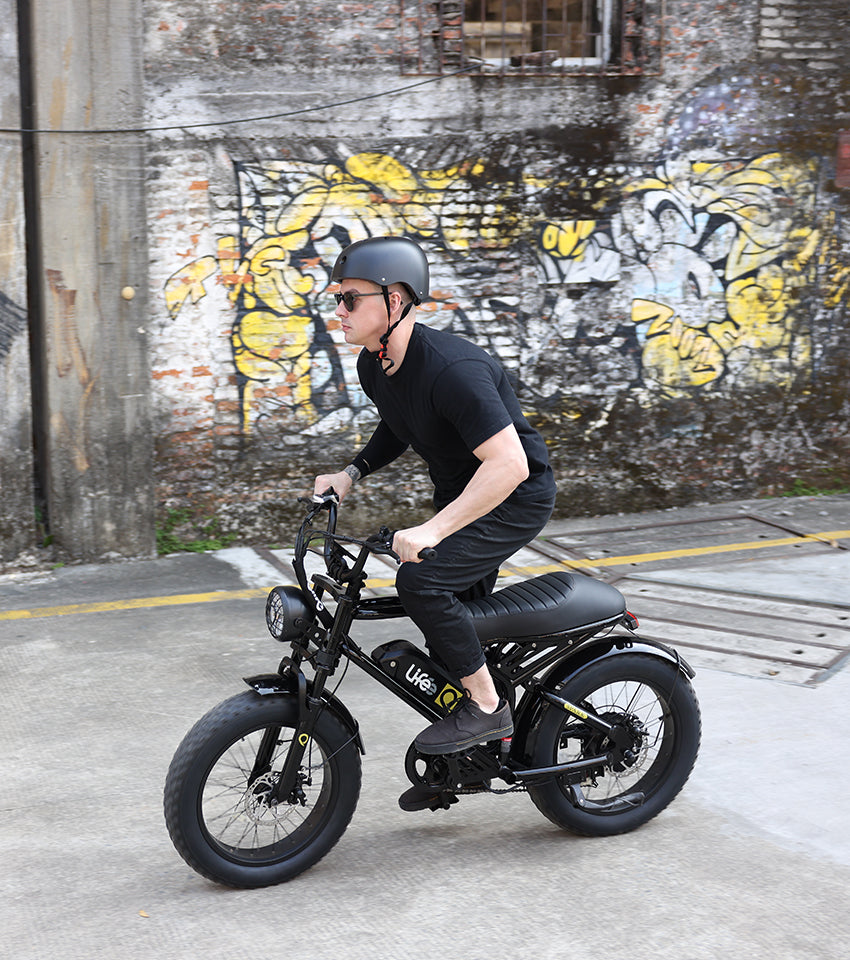
Not all e-bikes are the same. In the US, e-bikes are defined by three classifications: Class 1, 2, and 3. These classes determine how the e-bike is powered, how fast it can go, and who can ride it. While the precise rules can vary from state to state, the classification system is used throughout the nation.
The main difference between classes is pedal assist vs throttle. Pedal assist means the motor provides power when you pedal. Throttle, on the other hand, provides power without pedaling — similar to a moped.
Below, we explain everything you need to know about Class 1, Class 2, and Class 3 e-bikes, from how fast they go to any relevant laws.
What are E-Bike Classes?
E-bikes function like a regular bike. They’re a frame, pedals, and a handlebar. You spin the pedals to move forward, using the handlebars to direct.
So, what’s the difference?
That comes down to the motor and battery, which provide additional power beyond just pedaling. The different e-bike classes determine how the motor and battery work, how much power they can provide, and whether they require pedaling or not.
Because e-bikes go on roads, park routes, and public places, they need to be carefully governed. E-bike classes determine how fast each Class can safely go and who can legally use them. The system is primarily used in the US; however, it’s referenced in other countries as well.
Quick Overview of E-Bike Classes
|
Class |
Motor Type |
Max Assisted Speed |
Key Difference |
|
Class 1 |
Pedal assist only |
20 mph (32 km/h) |
No throttle; widely allowed on paths and trails |
|
Class 2 |
Pedal assist + throttle |
20 mph (32 km/h) |
Can be used without pedaling via throttle |
|
Class 3 |
Pedal assist only |
28 mph (45 km/h) |
Higher speed; often restricted to roads and bike lanes |
Class 1 E-Bike (Pedal Assist Only)
Class 1 e-bikes are pedal-assist only and come without a throttle. Pedal-assist means that the motor is only activated when you pedal. The harder you pedal, the more support you’ll receive.
These e-bikes are limited to 20 mph. That doesn’t mean the bike is incapable of going faster than 20 mph. If you’re going downhill, you’ll commonly exceed this speed. It means the assistance stops when you exceed this speed.
Class 1 e-bikes are often used for hybrid, road, or city bikes. There are minimal rules around where you can ride — so bike paths, roads, and trails are fine. They’re the perfect option for beginners, commuters, and casual riders.
Class 2 E-Bike (Throttle + Pedal Assist)
Class 2 e-bikes aren’t necessarily more powerful or faster than Class 1. The main difference is that Class 2 e-bikes have a throttle, powering the wheels even if you don’t pedal. It’s best to think of them somewhere between a push bike and a moped.
Like Class 1 e-bikes, they have a top speed of 20 mph. Because of the throttle, they’re restricted from use on some trails. Riders favor them for ease and accessibility. They’re great for short rides and low-effort riding. Plus, you can still switch to pedal assist for a more conventional ride.
Class 3 E-Bike (Speed Pedelecs)
Class 3 e-bikes are the fastest option. With a top speed of 28 mph, they’re very similar to Class 1 e-bikes — they’re still pedal-assist.
Designed for commuters, they allow long-distance travel at faster speeds. But with the extra speeds come more rules and regulations. You can’t use Class 3 e-bikes on some bike paths and trails, and they’re not permitted on highways. They’re mostly intended for road use.
You also have to be at least 16 years old to ride a Class 3 e-bike — although rules vary from state to state.
Unrestricted (Class 4) E-Bikes
Officially, there are only three classes of e-bikes. However, some models fall outside the three main classes. These are often referred to informally as ‘Class 4’ e-bikes.
So, what’s the difference?
Well, Class 4 e-bikes usually have a top speed over 28 mph and motors that produce more than 750W. Due to the extra power, they’re heavily restricted from bike paths, trails, and roads if they exceed the normal speed limit.
In the US, they may be classified as mopeds or motor vehicles depending on state laws. Moped-style e-bikes fall into this category. That means Class 4-e-bikes are considered motor vehicles. You’ll need a license, registration, and documentation in order to ride them, and be at least 16 years old.
Class 1 vs Class 2 vs Class 3: What’s the Difference?
|
Feature |
Class 1 |
Class 2 |
Class 3 |
|
Pedal Assist |
Yes |
Yes |
Yes |
|
Throttle |
No |
Yes |
Usually no |
|
Max Assisted Speed |
20 mph (32 km/h) |
20 mph (32 km/h) |
28 mph (45 km/h) |
|
Riding Feel |
Most like a traditional bike |
Least effort required |
Fast, road-focused riding |
|
Where You Can Ride |
Bike paths, trails, roads |
Roads and most bike paths (some restrictions) |
Roads and bike lanes (often restricted from shared paths) |
|
Best For |
Casual riding, commuting, versatility |
Short trips, easy riding, accessibility |
Longer commutes, higher-speed travel |
Can You Change an E-Bike’s Class?
Technically, no. An e-bike’s Class is determined by how it’s configured — specifically, its speed limit and whether it has a throttle. If an e-bike includes a throttle, it’s typically classified as Class 2; if it provides assistance beyond 20 mph, it falls into Class 3.
However, it’s not always that straightforward.
Many e-bikes allow you to adjust settings such as the level of assistance or speed limit. For example, a Class 3 e-bike can sometimes be restricted to 20 mph, effectively matching Class 1 performance. Similarly, a Class 2 e-bike can be used without the throttle, relying only on pedal assist.
That said, changing settings doesn’t necessarily change the bike’s legal classification. Even if you limit the speed, the bike may still be treated as its original Class under local regulations.
Because of this, it’s best to treat e-bike classes as a legal category, not just a setting. If you’re unsure, always check local laws before assuming where you can ride.
Which E-Bike Class Is Best for You?
The classes aren’t supposed to confuse you. It’s intended to provide a legal framework to ensure road and trail safety. But it also acts as a helpful guide when choosing a model.
Every Q-Life e-bike is given a classification. Often, you can tell just by looking at the specs where it falls. Generally, most people select each Class based on these factors
- Class 1 — a versatile option that provides some assistance. Ideal if you want to commute but still have access to trails. A common option for commuters and casual riders.
- Class 2 — the low-effort option. If you want an occasional ride without any effort, the throttle feature is for you. Perfect for commuting home or heading up hills when you’re tired.
- Class 3 — ideal for longer, faster commutes or long-distance adventures. The higher top speed and greater power mean you can get home quicker.
Choosing the right e-bike Class depends on how you intend to use the bike. Just remember, the higher you go, the more restrictions you’ll face.
Where Can You Ride Each Class of E-Bike?
Class 1 e-bikes are widely allowed on roads, bike paths, and many trails. They function just the same as a standard push bike.
The rules only begin to apply when it comes to Class 2 and 3 e-bikes.
Class 2 e-bikes can be ridden on most bike paths, roads, and trails. However, some states may have policies against their use, depending on local regulations.
Class 3 e-bikes have the most rules and regulations. They’re typically restricted from multi-use paths and certain trails but allowed on roads, bike lanes, and private land.
Class 4 e-bikes sit outside the standard classification system. As mentioned, because they’re often classed as a motor vehicle, you’ll need a license and registration to ride them anywhere in the state.
Do E-Bike Classes Affect Speed and Range?
Yes — e-bike classes largely determine the top speed. We can divide this into two groups: classes 1 and 2 are restricted to under 20 mph. That means you won’t receive any more assistance or throttle if you exceed this limit.
Class 3 e-bikes can go up to 28 mph and are used for faster commutes. However, the faster speed means the battery drains more quickly. So, you’re unlikely to reach the maximum range of the e-bike.
Despite these top speeds, most riders rarely hit the limits. Terrain, intersections, traffic, and more often mean that for most of the time, riders operate in the 15-20 mph range — sometimes even lower. It’s just not practical to constantly push the motor to its upper limit.
You toggle the level of assistance and top speed either in the e-bikes display or app, depending on the model. All Q-Life e-bikes come with a color display between the handlebars. You can quickly adjust the bike while you ride.
E-Bike Laws in the US
The e-bike classification system isn’t universal in the US. It’s currently used by 38 states. The states that do not use the system (but don’t require licensing or registration) include: North Carolina, South Carolina, Nebraska, Oregon, Montana, Pennsylvania, Rhode Island, and Kentucky.
Alaska, Hawaii, New Mexico, and Massachusetts also don’t follow the three-Class system. However, these systems require licensing, registration, and insurance if you wish to ride them.
Most states do not have any age requirements for riding a Class 1 e-bike. Many states require you to be at least 16 years old for Class 2 and Class 3 e-bikes, especially Class 3 e-bikes.
If you’re intending to ride an e-bike on bike paths, trails, and city streets, it’s smart to double-check your local laws. For example, in some states, you can get a DUI for riding an e-bike inebriated.
Do You Need a License, Insurance, or Registration?
In most states, you don’t need a license, registration, or insurance for Class 1, 2, or 3 e-bikes. If the e-bike stays within the 750W limit and class speed restrictions, these requirements typically don’t apply. The only consistent rule is that Class 3 e-bikes are restricted to over-16s.
These rules aren’t standardized, unfortunately. Some states treat e-bikes like motorized mopeds rather than standard bicycles and require a license to ride them on roads.
There’s also “Class 4” e-bikes. Most of these e-bikes are considered motorized mopeds across the US, requiring a license, registration, and insurance if you wish to ride them on the road.
Never assume that all e-bikes are treated the same. They’re not. Always check your local state laws before riding.
Are Class 3 E-Bikes Worth It?
They absolutely can be.
People generally opt for a Class 3 e-bike because of the speed. They’re more powerful, with a strong motor, and capable of reaching speeds up to 28 mph (sometimes faster). If you’ve got a long commute each day, Class 3 e-bikes mean you can get to work quicker, spending less time commuting. That’s great if you’re looking for an alternative to driving.
But there is an obvious downside.
Class 3 e-bikes come with more rules and restrictions. You cannot ride them on certain paths and must be over 16 years old. In some states, you’ll even need to have a license and registration. Class 3 e-bikes are also more expensive than their counterparts — so unless you’re sure you need the extra speed, they aren’t worth the investment.
How to Choose the Right E-Bike Class
Most people want an e-bike because they’re trying to get from A to B, or they enjoy riding off-road. But those are very different scenarios. Whether you’re commuting 10 minutes from your house, 1 hour, or heading off into the hills, the right e-bike can look very different.
Before you start thinking about top speeds or motor power, decide what you need it for. Here’s a quick overview of some real-world scenarios:
- Short city commute (stop-start, traffic) → Class 1 or 2
- Mixed terrain/bike paths → Class 1 safest option
- Long-distance commuting → Class 3 advantage
- Casual riding/leisure → Class 1
- Low-effort riding → Class 2
There’s no perfect class. Each option comes with a trade-off. That could be speed vs accessibility or convenience vs restrictions. The “best” e-bike Class depends on your daily route, not just preference. Overall, most riders are best served by Class 1 e-bikes, unless they have a specific need for speed.
Once you’ve narrowed down the right class, the next step is to find a model that actually fits how you ride. Q-Life e-bikes offer options across multiple classes, suitable for short commutes, mixed terrain, and longer rides.
Explore our full e-bike selection

FAQs About E-Bike Classes
What is the difference between Class 1 and Class 2 e-bikes?
Class 1 and Class 2 e-bikes both have a pedal assist feature. Class 2 e-bikes also have a throttle so that the motor can provide power to the wheels without pedaling.
Are Class 3 e-bikes legal everywhere?
Class 3 e-bikes are legal throughout the US. However, unlike the other two classes, they’re restricted from certain bike paths, park routes, or roads. You usually have to be at least 16 years old to ride a Class 3 e-bike. Some states will require licensing and registration if you intend to ride them along a public road legally.
Do Class 2 e-bikes have a throttle?
Yes — Class 2 e-bikes are the only type of e-bike to have a throttle. They’re capped at 20 mph, meaning the motor will turn off when you reach this speed. Class 2 e-bikes also have pedal assist. You can switch between the two options either via a display or an app.
Which e-bike Class is best for commuting?
Each e-bike Class has its advantages. Class 1 e-bikes are most like a standard push bike. They provide pedal assistance and are widely allowed on roads and bike paths, which is a great choice for commuters. Class 3 e-bikes are also pedal-assist but have a higher top speed. They’re ideal if your journey is longer or you want to travel faster.
Class 2 e-bikes can be useful for stop-start city riding, thanks to the throttle. However, they’re less commonly needed for regular commuting.
Can you ride a Class 3 e-bike on bike paths?
Class 3 e-bikes can generally be ridden on bike paths where bicycles are allowed. Local authorities can restrict their use on certain paths for safety or regulatory reasons. Always verify local regulations before riding on bike paths.
Most e-bikes let you adjust the level of assistance. Go into the settings and cap the top speed at 20 mph to ensure you comply with any local rules.
Share:
Are Moped-Style E-Bikes Legal?
How Long Does an E-Bike Battery Last?