
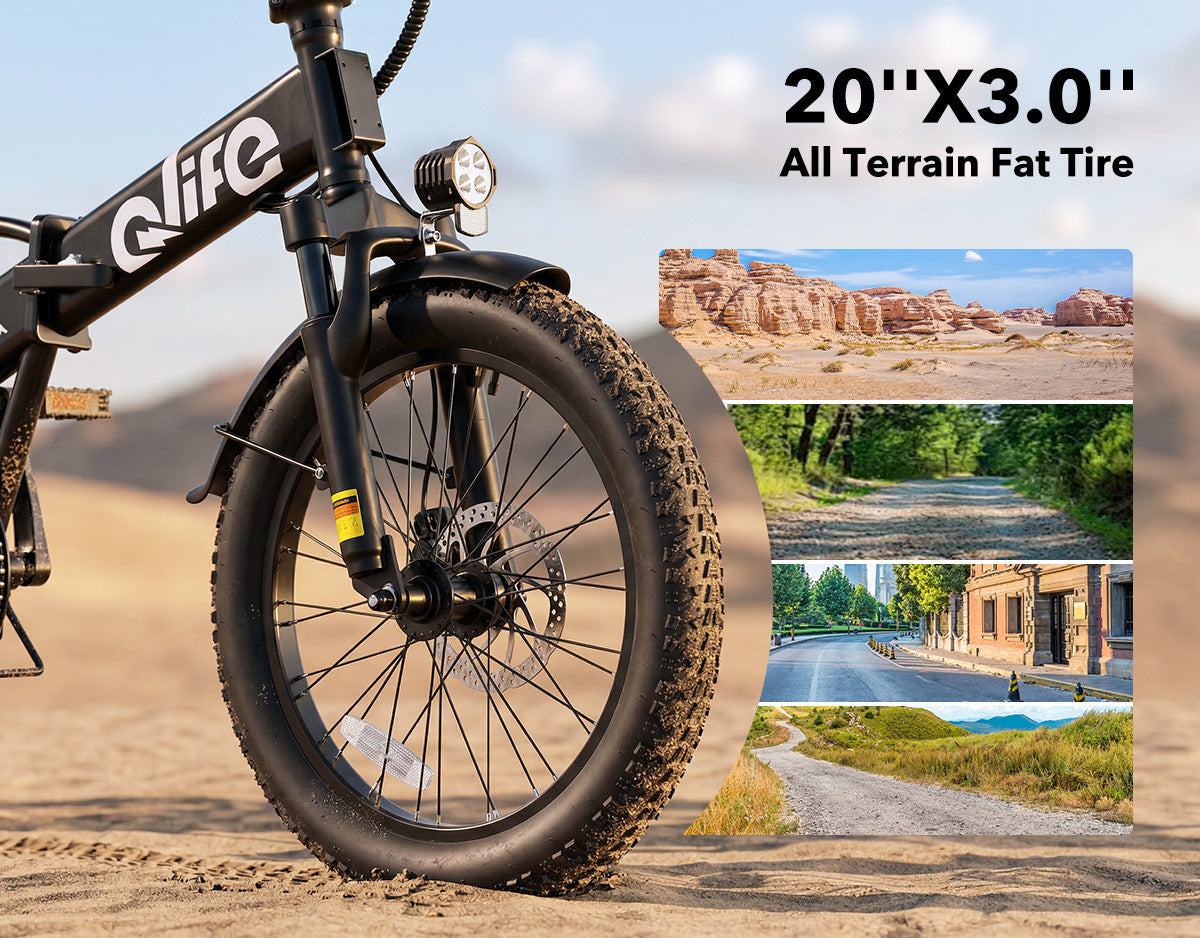
Mountain tracks, gravel trails, city streets — the term “all-terrain” covers a lot. The promise of an all-terrain bike is that it can handle everything you throw at it. That it’s as comfortable on tough, hilly ground as it is on smooth, local roads. It does ‘everything.’
That’s not strictly true. Not all bikes marketed as all-terrain actually are. In practice, these e-bikes sit somewhere between a commuter bike and a full off-road bike. They offer greater versatility, but they’re not quite as capable in each specialist bike’s respective terrain.
So, what can you really expect from an all-terrain electric bike? What features should you look for? And is it worth the investment, or should you opt for something more specialist?

What Is an All-Terrain Electric Bike?
All-terrain electric bikes are better thought of as a hybrid design — a “jack-of-all-trades.” They borrow features from more specialist models, combining them into a model that can handle mixed surfaces (road and off-road).
But by combining elements comes a compromise. They don’t have the suspension or motor to handle the toughest terrain, nor are they lightweight and speedy compared to the best commuter/road bikes.
If you’re looking for a bike that sits between the two, however, they’re ideal. Most people don’t want to own multiple bikes for different purposes. They want an e-bike they can commute on, take on weekend rides, and use for the occasional tricky trail. That’s the sweet spot all-terrain e-bikes occupy.
What Counts as “All-terrain” in Practice?
“All-terrain” sounds like it can handle anything. And to a point, that’s true. A good all-terrain bike can manage most surfaces without falling apart. But it isn’t perfection, and it won’t outperform specialist models.
- Roads and bike lanes. This is your baseline. Any all-terrain e-bike should feel comfortable on smooth roads without feeling slow or awkward.
- Gravel paths. Where things start to change. Loose surfaces need more grip and stability, and this is where better tires and suspension actually matter.
- Trails and dirt. Uneven ground, small obstacles, and rougher terrain. You don’t need full mountain bike specs, but the bike should feel controlled rather than sketchy.
- Sand or snow (within reason). This is where the “limits” come in. Some all-terrain bikes can handle it, but not all. You’ll need the right tires and setup — otherwise, it’s a struggle.
At the end of the day, all-terrain doesn’t mean perfect for everything. It means good enough across most conditions without needing a different bike for each one.
Key Features That Make an E-Bike Truly All-Terrain
Motor Power (and Why It Matters)
Motor power matters here. The e-bike needs enough power to tackle the average hill or uneven ground, assisting the rider. However, high motor power isn’t a defining feature of all-terrain e-bikes.
Take the Qlife collection, for example. Across the range, all-terrain bikes have a motor power between 1,200 and 1,500W. That’s pretty good compared to average models. But it’s a far cry from the 2,000-3,000W peaks you see from higher-end models.
Battery Capacity (Range vs Power Trade-Off)
If all-terrain e-bikes sit in the Goldilocks zone of bikes, you can expect the range to sit somewhere in the middle as well. And it does.
Generally, they average between 55 and 75 miles of range under ideal conditions. That's enough battery capacity for most commutes or hilly bike rides. The ideal balance for longer, mixed rides. But not enough for epic road trips.
There is an upgrade you can consider. Dual battery options are available for some models. While it slightly increases the e-bike’s weight, it almost doubles the range.
Tires (Fat vs Hybrid vs MTB)
Tires are where most of the trade-off shows up: it’s always grip vs efficiency. Fat tires give you maximum traction and comfort, especially on loose or rough terrain, but they’re slower and less efficient on roads. Hybrid or MTB-style tires sit in the middle, offering enough grip for trails without sacrificing too much speed.
In most cases, fat tires only make sense if you’re regularly riding on sand, snow, or very rough ground — otherwise, they’re overkill.
Suspension Setup
The big differentiator between all-terrain e-bikes and MTBs is suspension. MTBs have full suspension as standard, whereas all-terrain bikes offer a choice between front and full suspension.
If you’re not dealing with hills or tricky terrain on a regular basis, front suspension is probably enough. You can expect travel between 80 mm and 120 mm, suitable for absorbing shocks from potholes, tree roots, or rocky trails.
Rear suspension is much rarer. The obvious benefit is a smoother, more comfortable ride. However, the added weight and complexity make it unsuitable for most use-cases.
Frame Strength and Geometry
The last thing you want is an e-bike that falls apart at the first sign of rocky ground. Ideally, you want a bike with an aluminum frame — strong enough for the standard commute and a bit of off-road riding, but still light enough to pick up easily.
Geometry also matters. Most all-terrain e-bikes opt for a more upright riding position, reducing strain on your back and neck, at least compared to mountain or road bikes.
Braking System
Last is the brakes. The two options are:
- Hydraulic brakes: Use fluid to transfer force, so you get stronger, smoother stopping power with less effort. They’re more consistent and better for heavier, faster e-bikes, but cost more and are harder to maintain.
- Mechanical brakes: Use a cable system, making them simpler, cheaper, and easier to fix. They do the job but require more hand force and don’t offer the same level of control or stopping power as hydraulic setups.
Again, it really depends on the kind of riding you’re doing. Hydraulic brakes are better for sudden stopping when going downhill. The Racer Plus is fitted with front and rear mechanical disc brakes, but with a specific design that offers hydraulic-like responsiveness.
All-terrain vs Other Types of E-Bikes
All-terrain vs Commuter E-Bikes
Commuter e-bikes are designed for speed and efficiency. They’re the workhorse of the e-bike world. Designed to get you from A to B as quickly as possible, they have a lightweight frame, thin wheels, and more range than your average all-terrain bike.
The downside? They’ll struggle the moment you take them off-road. You’ll notice a firmer suspension, less grip, and less power to tackle tough hills and uneven ground.
All-terrain vs Fat Tire E-bikes
Here, the line is blurred. You could theoretically fit fat tires onto an all-terrain e-bike. However, generally, fat tire e-bikes are intended for off-road riding, with a frame and motor that’s adjusted accordingly.
In the Qlife range, the Racer, Racer Plus, and Racer Max can all be fitted with fat tires — either for aesthetic reasons (they look cool) or because you want something with more stability.
The main difference is the extra weight of the tires and higher rolling resistance. It means the bike won’t go as far on a single charge.
All-terrain vs Electric Mountain Bikes (MTBs)
MTBs and all-terrain electric bikes have a lot of differences. MTBs have more powerful motors, full suspension, and a frame that’s designed for tackling difficult terrain. All-terrain bikes mimic some of these features, but they’re not as specialized.
The problem with an MTB is that you wouldn’t want to ride it to work every day. It’s a master in its element. However, the all-terrain offers genuine practicality and versatility.
Pros of All-Terrain Electric Bikes
1. Versatility Across Different Surfaces
One bike for multiple use cases. That’s the idea behind an all-terrain e-bike. And for the most part, it delivers. You can balance weekday commutes with weekend trail riding. Don’t expect it to excel at either one. But if you don’t want to buy two specialist bikes, this is the best of both worlds.
2. Strong Performance on Hills and Rough Ground
If you’re used to taking your standard road e-bike off-road, you’ll notice a big upgrade. Whether it’s the suspension, the motor, or thicker tires, these bikes scamper up hills and over rough ground like a mountain goat.
That said, if you’re downgrading from an MTB, expect a slightly firmer ride and less traction.
3. Suitable for Both Commuting and Weekend Riding
Investing in two specialist e-bikes can set you back the better part of $4,000+ — sometimes a lot more. Unless you’re truly dedicated to cycling, it’s a lot of money.
Most people decide to compromise. They pick an e-bike that can handle both environments comfortably, albeit without excelling in either one. If you’re a regular commuter who enjoys a bit of trail riding (nothing too crazy), this works well.
4. More Comfortable Than Standard Road E-Bikes
Even if you’re just commuting, many people choose an all-terrain e-bike. It might be a little slower and less efficient; however, the improved suspension and motor power simply offer a more comfortable ride.
When you’re cycling day in day out, that quiet upgrade makes a big difference — especially if the only sacrifice is charging the bike more often.
Cons of All-Terrain Electric Bikes
1. Not Specialized for Any One Thing
The main downside is also its main benefit. The all-terrain e-bikes don’t excel on either the road or off-road. It’s a balance between the two.
If you’re primarily commuting every day or you’re an experienced mountain bike rider, it’ll feel like a step down in either direction. That’s the point.
2. Heavier Than Standard Commuter Bikes
The thicker frame, tires, and motor make these bikes a bit heavier than a standard commuter bike. For example, the Cityone Step Over 2.0 weighs just 57.3 lbs, whereas the Racer Plus comes in at 67.5 lbs.

That 10 lb difference is a lot if you’re carrying upstairs or onto public transport.
3. Can Be More Expensive
All-terrain e-bikes tend to sit firmly in the mid-to-high price range.
Entry-level models usually start around $1,200–$1,800, but these are often more basic in terms of power and components. Once you move into more capable setups with better motors, suspension, and battery capacity, you’re typically looking at $1,800–$3,000.
Higher-end models can easily push beyond $3,000–$5,000+, especially if they’re built for serious off-road use.
4. Lower Efficiency Than Road-Focused Bikes
Unless you opt for a dual battery upgrade, all-terrain e-bikes aren’t going to be as efficient as their road-focused counterparts.
That said, in the actual specs, you might not notice a difference. The reason is that manufacturers compensate for the decreased efficiency by increasing the battery capacity of all-terrain models. The logic is that commuters aren’t traveling as far each day.
What to Look for Based on How You Ride
Mostly Road with Occasional Trails
An all-terrain e-bike is a good option for this kind of rider. You’ll want to avoid fat tires. Opt for a lighter tire and stick with the single battery setup.
The Qlife Hunter is actually a really good option if you fall into this category. As a foldable e-bike, it’s a lot easier to use day-to-day compared to bigger e-bikes.
 Mixed Terrain (Road + Gravel + Light Trails)
This is the true sweet spot where all-terrain bikes shine. You want something with thicker tires and good suspension. A more powerful motor isn’t necessarily a must.
 The Racer Fat Tire 2.0 and Racer Plus Fat Tire are both excellent options.
Off-Road Focus with Some Road Use
Here, you’re looking for an MTB-light. Full suspension is extremely useful, as are fat tires and a more powerful motor. The ideal model is the Racer Plus Fat Tire 2.0. With a 1,500W motor, fat tires, and a range of up to 75 miles, it offers the best of all worlds. It will be a bit heavier for the average commuter.
How Fast Can an All-Terrain E-Bike Go?
In the US, e-bikes are grouped into the following classes:
- Class 1 (pedal assist) — 20 mph
- Class 2 (pedal assist + throttle) — 20 mph
- Class 3 (speed pedal assist) — 28 mph
Almost all-terrain e-bikes fall in Class 3, due to the more powerful motor. They’re typically capped at 28 mph, although some models can go faster. You may also notice a blend of Class 2 and 3, with models that have a throttle but can reach 28 mph.
How Far Can an All-Terrain E-Bike Go?
Depending on the battery capacity, all-terrain e-bikes have a range between 30 and 80 miles. You should treat the listed range with a bit of skepticism. It’s based on cycling under ideal conditions. However, most all-terrain bikes will tackle more difficult terrain, which can affect the battery more.
So, if the range is listed as 75 miles, expect something more like 55 miles in real-world conditions.
How Much Do All-Terrain E-Bikes Cost?
All-terrain e-bikes are a bit more expensive than your average commuter bike ($750-$1,500). You can expect to pay:
- Entry-level: ~$1,200–$1,800
- Mid-range: ~$1,800–$3,000
- High-end: $3,000+
They are worth the money, however. You’re paying for the motor, battery, and build quality. For a bike with such versatility, it’s like getting two bikes for the price of one.
FAQs
Are all-terrain e-bikes good for commuting?
Yes — most models are intended (in part) for commuting. They’re a comfortable, reliable e-bike for a daily commute. Some people may find them preferable if their commute involves harsh conditions (e.g., snow or heavy rain) or difficult terrain (e.g., bike trails or hills).
Can you ride an all-terrain e-bike off-road?
Yes — within limits. All-terrain e-bikes have the suspension, tires, and motor to handle tougher terrain. They’re a great option for gravel, light hills, sand, or other loose ground. However, don’t expect them to deal with extreme trails and rough paths like an electric mountain bike.
How fast do all-terrain e-bikes go?
Under US law, most all-terrain e-bikes are restricted to 20-28 mph. Some models can go faster. However, higher speeds are restricted to private land.
Do all-terrain e-bikes have a good range?
Yes. All-terrain e-bikes are less efficient than other bikes due to the extra weight. Manufacturers often give them a bigger battery capacity to compensate. That means they can reach 50-80 miles on a single charge. Just remember that the battery will drain faster, the harder the terrain.
Are all-terrain e-bikes heavy?
Yes, they’re generally heavier than standard commuter e-bikes. That’s due to stronger frames, larger tires, suspension, and bigger batteries. Most weigh between 25 and 35 kg, sometimes more.
Are all-terrain e-bikes worth it?
It depends on how you ride. If you regularly switch between roads, gravel, and trails, they’re a solid investment. But if most of your riding is on smooth roads or commuting, you’re likely better off with a lighter, more efficient bike designed specifically for that purpose.
Share:
Best Moped Style E-Bike 2026
Are Folding Electric Bikes Any Good?